Failed Experiments · Engineering
The Nuclear Landmine Britain Planned to Keep Warm With Live Chickens
On 1 April 2004, Britain's National Archives put a seven-ton nuclear landmine on public display and released the file explaining how the army had planned to stop its electronics from freezing in a German winter: seal live chickens inside the bomb, with food and water, and let their body heat do the job. Reporters phoned to ask whether the archivists were having a laugh. The answer, memorably, was that "the Civil Service does not do jokes."
By the Curiosities Desk · · 5 min read · Filed under Engineering · Today’s round
Part of The Animals Hired for a Job
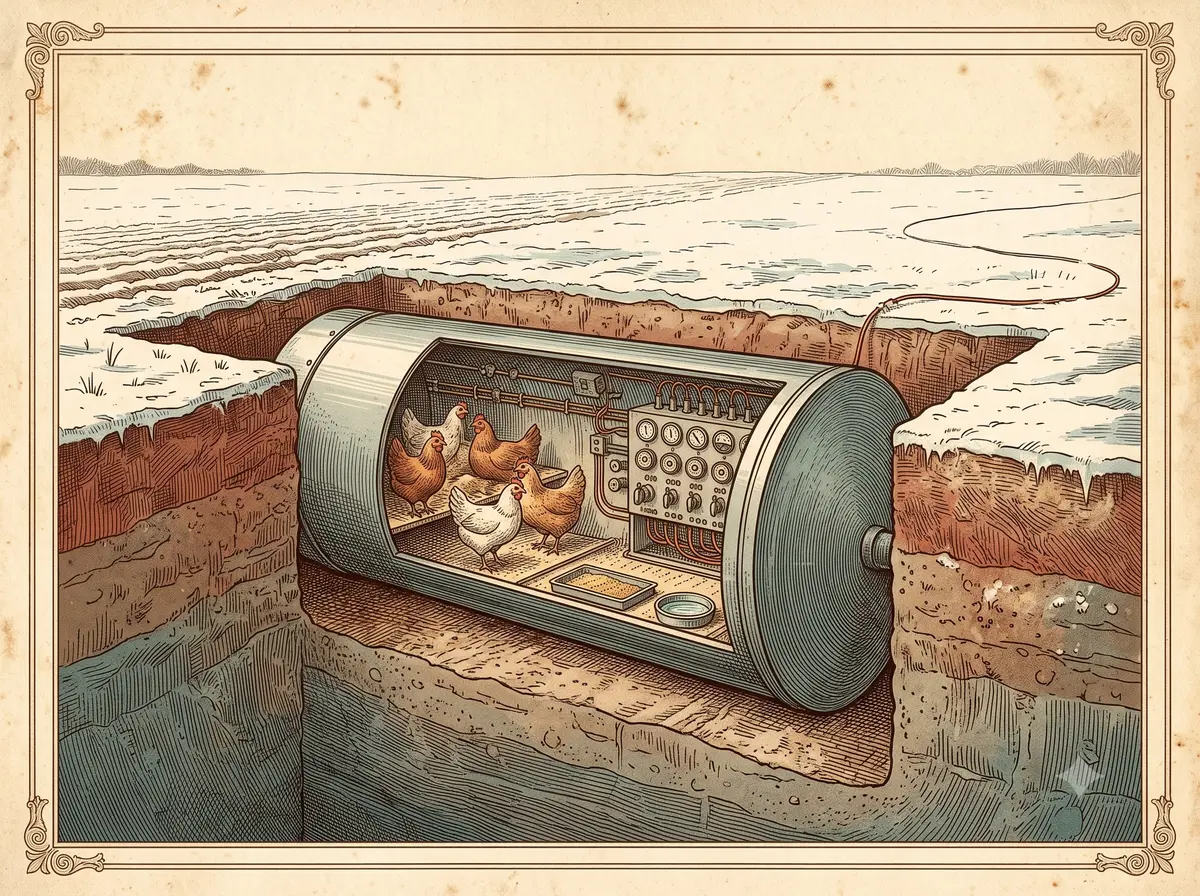
What happened: Project Blue Peacock
In the early 1950s, British defence planners were staring at a map of the North German Plain and not enjoying the view. It is flat, open country — ideal terrain for Soviet armour to roll west across. The British Army of the Rhine could not realistically hold it with conventional forces. So the Royal Armament Research and Development Establishment at Fort Halstead in Kent began work, around 1954, on a weapon that would deny the ground rather than defend it.
The device went through a run of splendidly un-menacing codenames — Brown Bunny, then Blue Bunny, finally Blue Peacock. (The British had a system of deliberately meaningless “rainbow codes” for secret projects, which is why so many Cold War weapons sound like paint samples.) It was, in essence, the plutonium core of the Blue Danube free-fall bomb repackaged into a squat steel casing you could bury. It weighed 7.2 long tons — about 7,300 kilograms — and had a yield of roughly ten kilotons, comparable to the weapon dropped on Hiroshima.
The concept was a demolition charge on an apocalyptic scale. Buried in advance at chokepoints and river crossings, Blue Peacock could be fired by a wire from three miles away, or left on an eight-day timer, and the resulting crater and contamination would make the ground unusable to an advancing army. Because the mines would sit unattended, the designers packed in anti-tamper measures: the casing was pressurised, and once armed, the weapon would detonate ten seconds after being moved, losing pressure, or being flooded with water. Testing the enormous steel shell for watertightness had to be done outdoors, in a flooded gravel pit near Sevenoaks in Kent.
Then came the mundane problem that made the whole project famous. Buried metal gets cold. Northern European winters could drop the temperature inside the casing below the point where the mine’s electronics could be relied on to work. Engineers tried the obvious fixes — insulating blankets, thick fibreglass pillows packed around the components — but insulation only slows heat loss; it does not make heat.
Someone, in one of the design documents, proposed a source that did. Seal live chickens inside the casing with enough feed and water to last roughly a week. Birds run hot — a chicken’s body temperature sits around 41°C — and a few of them in a sealed steel box would keep the electronics comfortably above freezing for about eight days, conveniently matching the timer.
Two firing units were built, one casing and one warhead, and in July 1957 the British Army ordered ten Blue Peacocks for deployment in Germany, under the cover story that they were “atomic power units” for field troops. In February 1958 the Ministry of Defence cancelled the project. The stated reasoning was not technical: burying nuclear weapons on allied soil, with the fallout and political fallout that implied, was judged indefensible.
The project itself surfaced publicly in July 2003, reported by New Scientist and The Guardian from newly released files. The chickens arrived the following spring, when the fuller file went on show at Kew — on April Fools’ Day, which is why Tom O’Leary of the National Archives spent part of that week telling journalists, “It does seem like an April Fool but it most certainly is not.”
Why it was strange: Project Blue Peacock
The strangeness isn’t the chickens on their own. It’s the collision of scales. Here is a weapon designed to erase a section of the German countryside, and its Achilles’ heel is a thermostat problem you’d recognise from a garden shed. The most advanced destructive technology of the century, undone by cold weather, and the proposed fix is livestock.
It’s also a genuinely rational idea wearing an absurd costume. Nobody was being silly. Faced with “we need a low-power, self-contained heat source that runs unattended for eight days in a sealed box,” a 1950s engineer had a short list: chemical heaters (consume oxygen, produce fumes), electric heaters (need a power source that also needs to survive), or an animal that converts feed into heat with no wiring at all. The chicken is the answer to a well-posed question. It only sounds like a punchline from outside.
Worth flagging honestly: the chicken proposal appears in the project paperwork as a suggestion, and there is no evidence it was ever adopted, tested with actual birds, or built into the prototypes. The story is often retold as “Britain built chicken-powered nukes.” Britain did not. Britain wrote it down, which is a different and in some ways funnier thing.
It shares a shelf with The Mongooses Hired to Hunt Rats — Who Worked the Day Shift, in The Animals Hired for a Job.
What scientists learned: Project Blue Peacock
The technical lesson is one every thermal engineer eventually meets: insulation and heat generation are not the same thing. A fibreglass pillow has an R-value — it resists the flow of heat — but it has no output. Wrap a cold object in the world’s best insulation and you get a cold object, more slowly. Any sealed system that must hold a temperature above ambient for days needs a source inside the boundary.
A chicken is a small metabolic furnace, turning roughly 100 grams of feed a day into somewhere in the region of 10 to 15 watts of waste heat. That is not much — a couple of birds put out about as much as a dim incandescent bulb — but in a thick steel box, sustained for a week and with nowhere to go, it’s enough to hold the interior above freezing. The arithmetic works. The ethics and the logistics are where it falls apart.
The broader lesson landed at policy level. Blue Peacock is one of the clearest cases of a Cold War weapon killed not by physics but by asking who, exactly, the blast was for. Atomic demolition munitions would have gone off on the territory of a NATO ally, in the middle of towns Britain was ostensibly defending. Both the US and USSR built similar devices; all of them were eventually retired, with the American arsenal finally withdrawn in the late 1980s.
Also in The Animals Hired for a Job: The Bomb Three Pigeons Were Trained to Steer.
How it reaches us today: Project Blue Peacock
Every declassification batch from the 1950s reshapes what historians think Cold War planning actually looked like — less a chess game between grandmasters, more a scramble of improvised answers to impossible questions. Blue Peacock’s file is a small monument to that. It also nudged a real policy conversation: nuclear demolition mines are now widely treated as a category of weapon nobody wants back, precisely because their logic requires detonating them on the ground you are defending.
The thermal principle, meanwhile, is still everywhere. Spacecraft face exactly Blue Peacock’s problem — instruments that stop working when they get too cold, in an environment with no ambient warmth to trap. The solution is the same in structure and better in execution: radioisotope heater units, small plutonium pellets whose decay produces about a watt of heat each, keep the Mars rovers’ electronics alive through freezing nights. Insulation plus a source inside the box. The engineers who suggested chickens had the right diagram and the wrong animal.
Another from The Animals Hired for a Job: The Toad Australia Released to Fight a Pest — and Turned Into a Bigger One.
Fun fact: Project Blue Peacock
The National Archives dated the release to 1 April 2004 entirely by accident, and had to spend the day insisting the chickens were real. When the BBC pressed, the archives’ reply became one of the great deadpan statements in the history of British bureaucracy: “The Civil Service does not do jokes.”
Sources: Project Blue Peacock
- BBC News, “Cold war bomb warmed by chickens”, 1 April 2004 — contemporaneous reporting on the file’s release and the National Archives’ response.
- Jamie Wilson, “Nuclear mines ‘to stop Soviets’”, The Guardian, 17 July 2003 — the initial 2003 reporting on the declassified Blue Peacock files, including the Sevenoaks gravel-pit testing.
- Rob Edwards, “British army planned nuclear landmines”, New Scientist, 16 July 2003 — technical detail on yield, triggering, and the eight-day timer.
- Tamir Sinai, “Eyes on target: ‘Stay-behind’ forces during the Cold War”, War in History 28(3), 2020 — peer-reviewed context on NATO stay-behind and demolition planning in West Germany.
- Blue Peacock, Wikipedia — used as an index to the above primary reporting.
Related stories: Project Blue Peacock
- Part of The Animals Hired for a Job
- The Bomb Full of Sleeping Bats That Burned Down Its Own Air Base — Bats carrying tiny incendiaries burned down the base that built them
- The Airplane That Carried a Nuclear Reactor — A bomber that flew with a live nuclear reactor aboard
- The Plan to Set Off a Nuclear Bomb on the Moon So Everyone Could Watch — A serious plan to detonate a nuclear bomb on the Moon