The Mongooses Hired to Hunt Rats — Who Worked the Day Shift
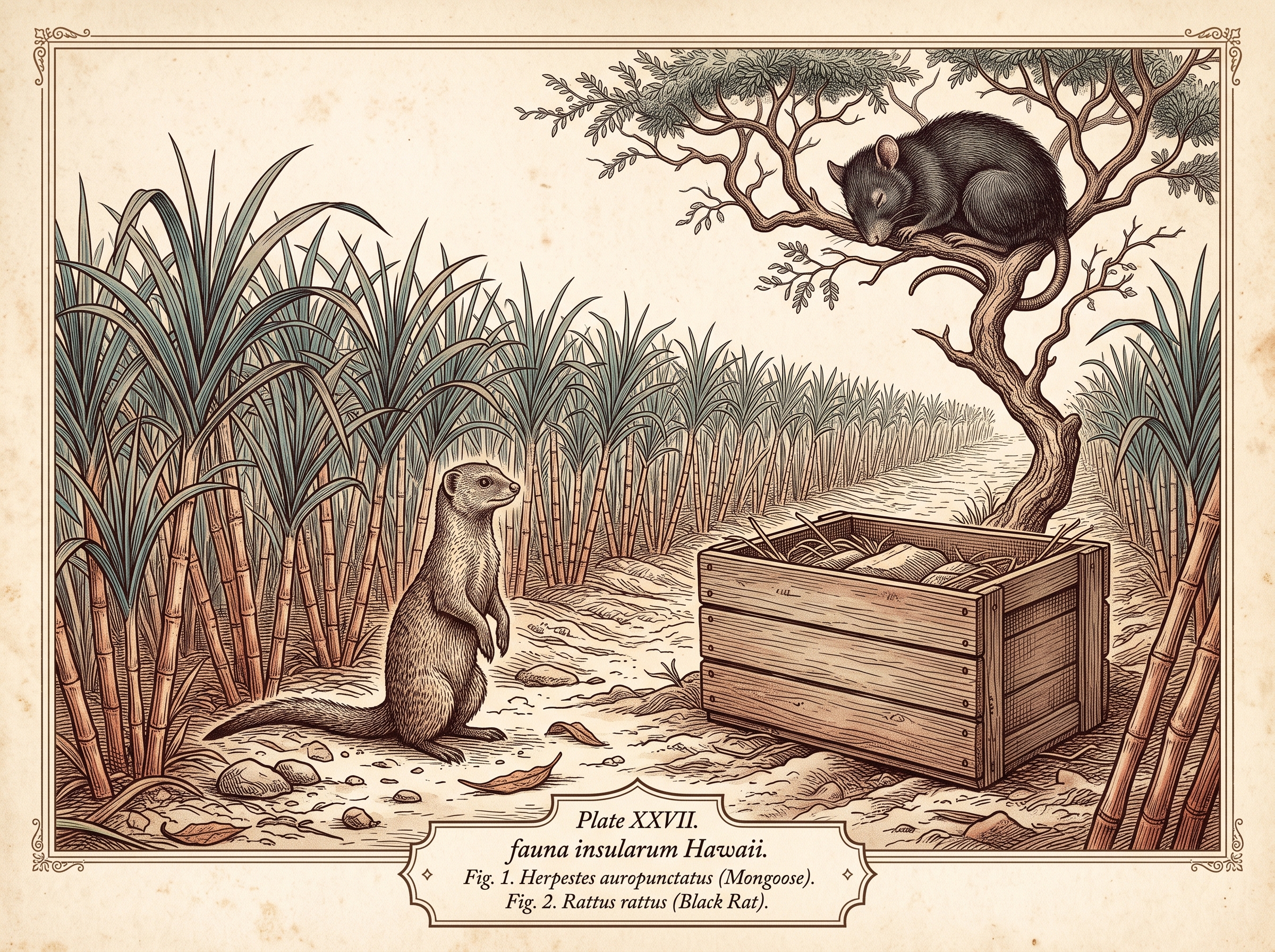
In 1883, 72 mongooses arrived on the Hāmākua coast of Hawaiʻi Island, shipped from Jamaica with one job: kill the rats eating the sugarcane. The mongooses got to work bright and early every morning. The rats, meanwhile, got to work after dark. The two crews passed each other like coworkers on opposite shifts — and the new hires, finding the night shift's main target asleep somewhere out of reach, started eating almost everything else.
By the Curiosities Desk · · 5 min read · Filed under Biology · Today’s round
Part of The Animals Hired for a Job
What happened?
The story starts not in Hawaiʻi but in Jamaica, eleven years earlier. In the 1870s, rats were chewing through Jamaica’s sugar plantations — by one estimate of the time, a large estate could lose about a fifth of its produce to them. Planters had already tried importing ferrets, toads from Barbados, and even an aggressive ant. None of it worked.
William Bancroft Espeut, a planter and fellow of the Linnean Society, had a rat problem on his Spring Garden Estate. His wife, Bessie Espeut, had a suggestion. Years earlier in Ceylon (now Sri Lanka), she had kept a pet Indian mongoose and had watched it kill rats. Why not try it here?
In February 1872, nine mongooses — four males and five females — arrived from India. Espeut released them straight into his cane fields. Within six months, he reported “evidence, clear and certain” that the rats were doing less damage. He was thrilled, and so were his neighbors. Local trappers caught mongooses on his estate and sold them to other planters, and the animals were shipped onward to Grenada, Barbados, St. Lucia, Cuba, Puerto Rico and beyond.
Word reached Hawaiʻi, where sugar was booming and rats were feasting. In 1883 a planter named William Herbert Purvis, an investor in the Pacific Sugar Mill near Waipiʻo Valley, brought in 72 mongooses descended from the Jamaican stock. Sugar growers soon spread them to Maui, Molokaʻi and Oʻahu.
Then things went sideways. The small Indian mongoose is diurnal, meaning it hunts by day and sleeps in a den at night. Hawaiʻi’s rats are mostly nocturnal, and one of the main species, the black rat, is a nimble climber that spends much of its time in trees. The animals simply weren’t meeting very often. Mongooses did eat some rats, but they also ate the eggs and chicks of ground-nesting birds, sea turtle eggs, insects, lizards, fruit and plants.
Back in Jamaica, the cracks showed early. Even Espeut admitted that quail and other ground-nesting birds had “diminished.” By 1888 a coffee planter complained that the mongoose was “getting dainty” and no longer eating as many rats. In 1890 a government committee concluded the mongoose had driven several Jamaican birds to extinction. With insect-eating birds and lizards disappearing, ticks boomed — badly enough that livestock owners reportedly faced ruin.
One island in Hawaiʻi dodged the whole thing. Kauaʻi never received an established mongoose population. According to the zoologist P. Quentin Tomich’s 1986 account, dockworkers who recognized a mongoose shipment bound for the island threw it into the harbor. A more colorful popular version says they did it because a mongoose bit one of them — a detail no one has confirmed. Either way, Kauaʻi stayed mongoose-free, and still is.
Why was it strange?
On paper, the plan looked airtight. Mongooses kill rats. There were too many rats. Add mongooses.
But a predator isn’t a pest-control machine; it’s an animal with its own schedule, appetite and preferences. The Espeuts’ evidence came from watching one pet mongoose in Ceylon, not from studying how wild mongooses behave in a new ecosystem. Nobody asked the questions that now seem obvious: When does this animal hunt? What else will it eat? What lives here that has never faced a predator like it?
Islands made the gamble worse. Hawaiʻi had no native land mammals except a bat, so its ground-nesting birds, like the nēnē (the Hawaiian goose), had evolved without anything like a mongoose stalking their nests. To them, the new arrival was an entirely unfamiliar threat.
It shares a shelf with The Toad Australia Released to Fight a Pest — and Turned Into a Bigger One, in The Animals Hired for a Job.
What did scientists learn?
The mongoose became a textbook case of how not to move animals around. A 2007 worldwide review in Pacific Science found that the small Indian mongoose had been deliberately released on at least 45 islands, plus one mainland, between 1872 and 1979, and documented its toll on native birds, mammals, reptiles and amphibians.
Interestingly, Hawaiʻi’s Invasive Species Council argues the mongoose shouldn’t even be called “biological control gone wrong.” Real biological control — biocontrol, the use of a pest’s natural enemy to keep it in check — is a scientific process. Researchers first find a predator or parasite that targets the pest in its home range, then run extensive tests to make sure it will attack only that pest before it is ever released. The mongooses skipped every one of those steps. They were a private planters’ experiment, not a scientific one.
That distinction is the real lesson. The problem wasn’t the idea of using nature against a pest. It was skipping the homework.
The same thread — Rats — continues in The Rat-Tail Bounty That Turned Hanoi Into a Rat Farm.
How does it affect us today?
The mongoose is still here. It is listed as injurious wildlife in Hawaiʻi, and it is illegal to bring one into the state, keep one or breed one without a permit. Mongooses still threaten endangered birds, including the nēnē, the Hawaiian crow (ʻalalā) and Hawaiian petrels, along with hawksbill sea turtle nests. A 1999 estimate put mongoose damage in Hawaiʻi and Puerto Rico at about $50 million a year.
Kauaʻi keeps its streak alive with vigilance. Stowaway mongooses occasionally ride in on cargo, and five have been captured alive on the island, most recently in April 2023 at Nāwiliwili Harbor. Airport and harbor workers are the first line of defense.
And modern biocontrol programs now require the careful host-specificity testing that nobody did in 1872 or 1883. In a sense, every insect or fungus carefully screened before release today carries a little of the mongoose’s lesson with it.
Also in The Animals Hired for a Job: The Bomb Full of Sleeping Bats That Burned Down Its Own Air Base.
Fun fact
When a British colonial official named Henry Hesketh Bell arrived in Jamaica in 1896, he found a small bowl of oil with a feather in it in his guest room. His host explained it was for removing ticks — a household accessory that, by Bell’s account, traced back to the rat-hunting mongooses.
Sources
- Holmes, M. (2023). “A plague of weasels and ticks: animal introduction, ecological disaster, and the balance of nature in Jamaica, 1870–1900.” The British Journal for the History of Science, 56(3), 391–407. https://doi.org/10.1017/S0007087423000286
- Hays, W. S. T., & Conant, S. (2007). “Biology and Impacts of Pacific Island Invasive Species. 1. A Worldwide Review of Effects of the Small Indian Mongoose, Herpestes javanicus.” Pacific Science, 61(1), 3–16. https://scholarspace.manoa.hawaii.edu/items/70d33000-6d4f-471d-a3d4-95088cf72bed
- Hawaiʻi Invasive Species Council (DLNR). “Mongoose (Urva auropunctata).” https://dlnr.hawaii.gov/hisc/mongoose-urva-auropunctata/
- Kauaʻi Invasive Species Committee. “Mongoose.” https://www.kauaiisc.org/pests/mongoose/
- Nēnē.org. “Mongoose — Threats to Nēnē.” https://www.nene.org/threats/mongoose
Related stories
- Part of The Animals Hired for a Job