The Plan to Set Off a Nuclear Bomb on the Moon So Everyone Could Watch
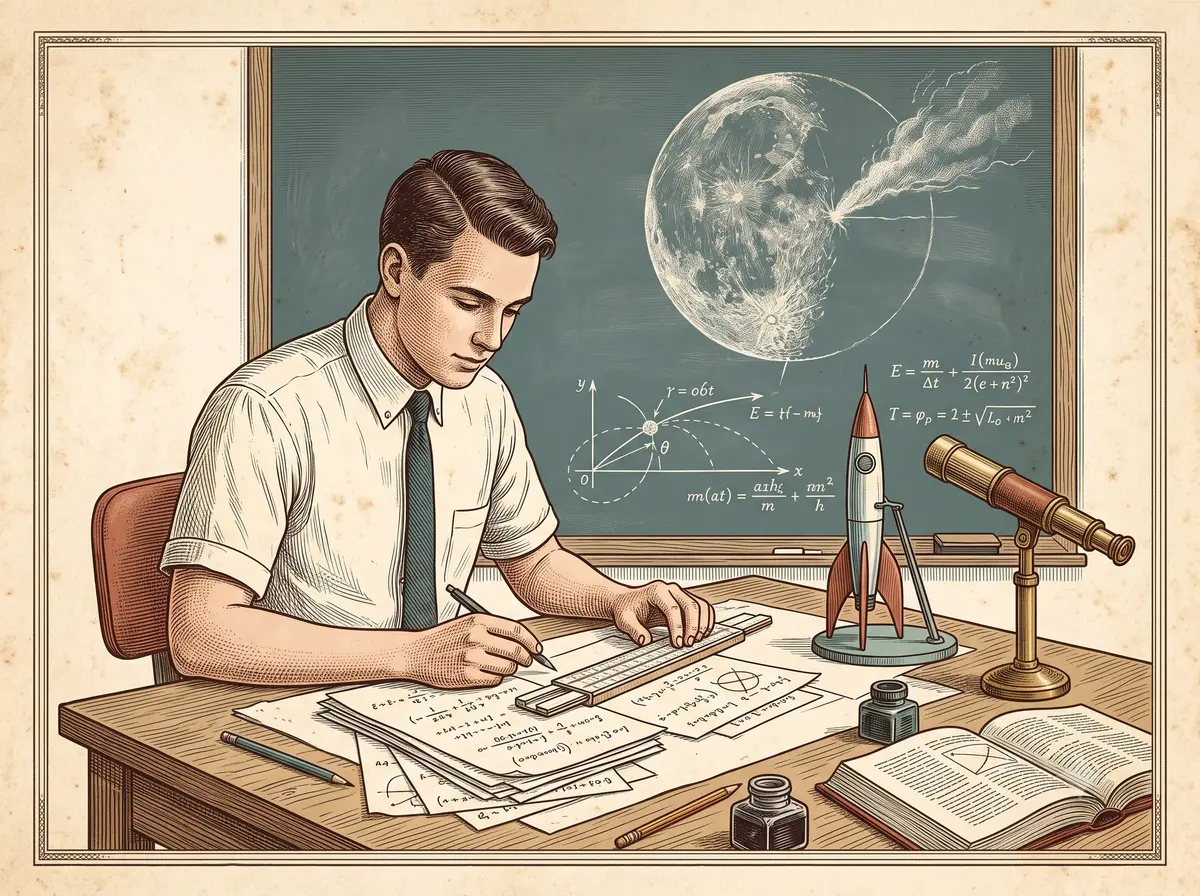
In a physics lab in Chicago in 1958, a graduate student named Carl Sagan sat down with a slide rule to answer a question the U.S. Air Force had asked in all seriousness: if we set off an atomic bomb on the Moon, how big would the dust cloud be — and would people on Earth be able to see it?
By the Curiosities Desk · · 5 min read · Filed under Space · Today’s round
Part of When Atoms Got Away From Us
What happened: The Plan to Set Off a Nuclear Bomb on the Moon So Everyone Could Watch
The Soviet Union launched Sputnik 1 on 4 October 1957. It was a polished metal sphere about the size of a beach ball, and it beeped as it went overhead, and it terrified official Washington. Two American attempts to answer with a satellite of their own failed publicly and expensively. The press called it the Sputnik crisis. Almost immediately, newspapers began printing a rumor — sourced to an anonymous tip — that the Soviets meant to celebrate the anniversary of the October Revolution by detonating a hydrogen bomb on the Moon during the lunar eclipse of 7 November.
The rumor appears to have been just that. But it landed in a Washington already primed to answer spectacle with spectacle. In May 1958, the Air Force quietly commissioned the Armour Research Foundation at the Illinois Institute of Technology to study what would happen if the United States detonated a nuclear weapon on or near the Moon. The classified study was designated A119. Its title was blandly bureaucratic: A Study of Lunar Research Flights.
The physicist Leonard Reiffel, then manager of physics research at Armour, led a team of about ten. It included the astronomer Gerard Kuiper — the Kuiper Belt is named for him — and Kuiper’s doctoral student, a 24-year-old Carl Sagan. Sagan’s assignment was to model how a cloud of dust and vapor would expand in a vacuum under the Moon’s weak gravity, since that expanding cloud, lit by sunlight, was the thing anyone on Earth would actually see. He also contributed a chapter on organic matter and the Moon, asking whether an explosion might reveal signs of biology there.
The engineering was constrained in a very mundane way. A hydrogen bomb was the obvious choice for visibility, but it was too heavy for the rockets available, so the Air Force vetoed it. The team worked instead with a W25 warhead — a small, light device with a yield of about 1.7 kilotons, roughly a tenth of the bomb dropped on Hiroshima. The plan was to send it toward the terminator, the line dividing the Moon’s lit and dark halves, where a flash and a rising plume would stand out against the shadow.
The Air Force cancelled the project in January 1959. Reiffel later said the concerns were the risk to people on Earth if a launch went wrong, and the possibility that radioactive contamination would spoil the Moon for the science that would follow. The declassified report itself is more careful than you might expect. Its introduction notes that the motivation for such a detonation is “clearly threefold: scientific, military and political,” and warns that “unless the climate of world opinion were well-prepared in advance, a considerable negative reaction could be stimulated.”
Then the whole thing vanished for four decades. Eight reports were produced; most were destroyed by the institute in the 1980s. The story surfaced only because the writer Keay Davidson, researching a biography of Sagan, noticed that Sagan had listed two classified A119 paper titles in a 1959 fellowship application — apparently a security breach. When the biography appeared in 1999, Reiffel broke his silence in a letter to Nature in May 2000, and a Freedom of Information request pried Volume I of the report into daylight. The U.S. government has never formally acknowledged the study.
Why it was strange: The Plan to Set Off a Nuclear Bomb on the Moon So Everyone Could Watch
The strangest part isn’t the bomb. It’s the audience.
This was not primarily a weapons test or an experiment. It was staging. Reiffel told reporters in 2000 that the main aim was “a PR exercise and a show of one-upmanship,” and said the Air Force wanted a cloud large enough to be seen from Earth. He also said, plainly, that he was “horrified that such a gesture to sway public opinion was ever considered.”
There’s a second oddity buried in the physics. The popular retelling has the Air Force asking for a mushroom cloud over the Moon — but a mushroom cloud is an atmospheric phenomenon. It forms when a fireball heats air, which rises and drags a stem of debris behind it. The Moon has essentially no atmosphere, so there is no rising air, no stem, no mushroom. What you would get instead is a brief brilliant flash and a fast, thin, ballistic spray of pulverized rock arcing outward and falling back. Working out how visible that would be, from a quarter of a million miles away, against a bright and blotchy lunar background, was exactly the problem handed to a graduate student with a slide rule.
It shares a shelf with The Airplane That Carried a Nuclear Reactor, in When Atoms Got Away From Us.
What scientists learned: The Plan to Set Off a Nuclear Bomb on the Moon So Everyone Could Watch
Quite a lot, oddly, and none of it required the bomb.
To evaluate the idea at all, the team had to first assemble what was actually known about the Moon — and in 1958, that was thin. The declassified volume works through lunar optical observation, seismology, the high-energy radiation environment, magnetic fields, plasma effects, and the question of organic material on the surface. Much of it reads like a planetary-science research agenda, because it is one. The seismic chapter, for instance, reasons about how much energy a surface explosion would couple into the Moon’s interior, and how you would read the returning waves to map what’s inside — the same logic Apollo astronauts later used when they deliberately crashed spent rocket stages into the Moon and listened with seismometers they had left behind.
The team also took the contamination problem seriously. Volume I contains an appendix on prevailing attitudes toward biological contamination of other worlds — an early, awkward, genuine version of the planetary-protection question that space agencies now formalize: don’t wreck a place before you’ve read it.
The same thread — Declassified — continues in The Flying Saucer the Air Force Built That Maxed Out at 35 MPH.
How it reaches us today: The Plan to Set Off a Nuclear Bomb on the Moon So Everyone Could Watch
The impulse behind A119 lost, and that loss shaped the decade that followed. The United States answered Sputnik with footprints instead of a fireball. The British nuclear historian David Lowry has pointed out what the alternative would have cost us: had the plan gone ahead, “we would never have had the romantic image of Neil Armstrong taking ‘one giant leap for mankind.’”
The idea also became formally impossible. The Partial Test Ban Treaty of 1963 outlawed nuclear explosions in space, and the Outer Space Treaty of 1967 barred placing nuclear weapons in orbit or on celestial bodies. A119 belongs to a narrow window — after rockets could plausibly reach the Moon, before anyone had agreed on rules for what you could do when you got there.
And the underlying scientific instinct survived, minus the warhead. In 2009 NASA’s LCROSS mission steered a spent rocket stage into a permanently shadowed crater near the lunar south pole and watched the plume with a trailing spacecraft. Same basic experiment — hit the Moon, study what flies up — with kinetic energy instead of fission. It found water ice.
Also in When Atoms Got Away From Us: The Rocket That Exploded on Live TV and Got Called ‘Kaputnik’.
FAQ
What was Project A119?
A classified Air Force study, begun in May 1958, of detonating a nuclear weapon on or near the Moon. Its cover title was A Study of Lunar Research Flights. Leonard Reiffel led it at the Armour Research Foundation, and Carl Sagan modeled the dust cloud people on Earth might see. The Air Force cancelled it in January 1959. No bomb was sent.
Did the US plan to nuke the Moon?
The Air Force commissioned a study of a blast visible from Earth. A hydrogen bomb was judged too heavy for the rockets of 1958, so the team worked with a W25 warhead of about 1.7 kilotons. The project ended before any flight, over launch risk and the chance of spoiling the Moon for later science.
Fun fact: The Plan to Set Off a Nuclear Bomb on the Moon So Everyone Could Watch
The report that finally exposed the plan is dated 19 June 1959 — five months after the Air Force had already cancelled it. The team finished the paperwork anyway.
Sources: The Plan to Set Off a Nuclear Bomb on the Moon So Everyone Could Watch
- Reiffel, L., et al. A Study of Lunar Research Flights, Volume I, Air Force Special Weapons Center, Kirtland AFB, 19 June 1959 (declassified; AD0425380) — the primary document.
- Reiffel, Leonard. “Sagan breached security by revealing US work on a lunar bomb project”, Nature 405, 13 (4 May 2000).
- Broad, William J. “U.S. Planned Nuclear Blast on the Moon, Physicist Says”, The New York Times, 16 May 2000.
- Ulivi, Paolo, and David M. Harland. Lunar Exploration: Human Pioneers and Robotic Surveyors, Springer, 2004, pp. 19–21.
- NASA. LCROSS Lunar Impactor Mission — the modern, non-nuclear version of the experiment.
Related stories: The Plan to Set Off a Nuclear Bomb on the Moon So Everyone Could Watch
- Part of When Atoms Got Away From Us
- The Spaceship That Was Supposed to Ride Atomic Bombs to Saturn — A spaceship designed to ride nuclear explosions to Saturn
- The Nuclear Landmine Britain Planned to Keep Warm With Live Chickens — Britain proposed keeping a buried nuclear mine warm with live chickens
- The Airplane That Carried a Nuclear Reactor — A bomber that flew with a live nuclear reactor aboard