The Spaceship That Was Supposed to Ride Atomic Bombs to Saturn
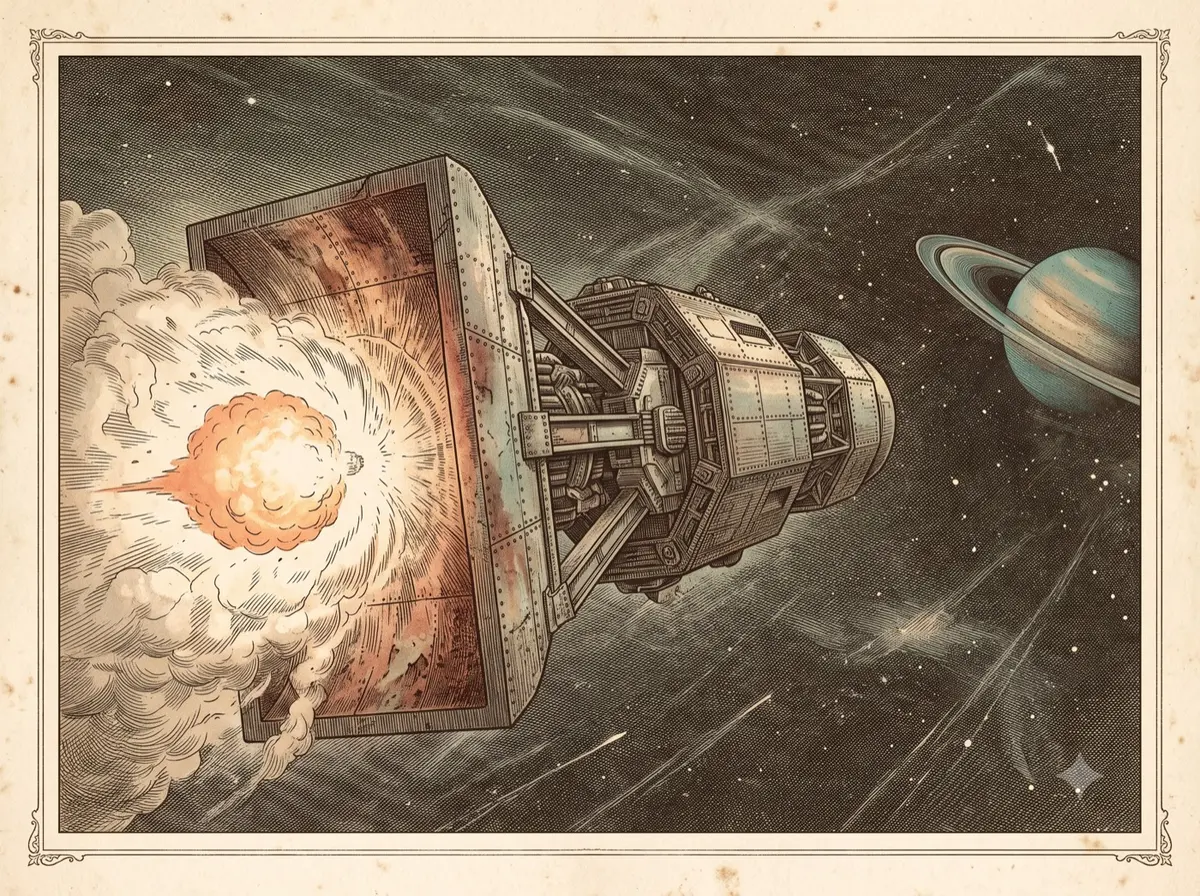
The plan was not a metaphor. To fly the ship, you would drop an atomic bomb out the back, let it explode a short distance behind you, and ride the shockwave. Then you would drop another. And another — hundreds of them, one every second or so — kicking a giant steel plate again and again until the whole vessel, crew and all, was hurled toward the outer planets. Serious physicists spent years on this, and for a while the U.S. government paid them to do it.
By the Curiosities Desk · · 5 min read · Filed under Space · Today’s round
Part of Built to Do the Impossible
What happened: Project Orion
In the late 1950s, at General Atomics in San Diego, a team of scientists began designing a spacecraft powered by nuclear explosions. They called it Project Orion. The idea had deep roots — the mathematician Stanislaw Ulam had sketched the concept of propelling a vehicle with a rapid series of atomic detonations years earlier, and by 1958 the physicist Ted Taylor, a gifted bomb designer, was determined to turn it into a real vehicle. He was soon joined by Freeman Dyson, one of the most brilliant theoretical physicists of the era, who took leave from Princeton to work on it.
The engineering was audacious but coherent. At the rear of the ship sat a massive “pusher plate,” a thick slab of steel connected to the crew compartment by enormous shock absorbers. Small nuclear devices — pulse units — would be ejected behind the ship and detonated. Each blast would slam a burst of superheated plasma against the plate, shoving the whole craft forward. The shock absorbers would smooth the violent kicks into something a human crew could survive. A protective coating sprayed on the plate would ablate — burn away in thin layers — rather than melt, protecting the metal from each fireball.
The project ran, under government funding from the new Advanced Research Projects Agency and later the Air Force, into the mid-1960s. The team studied ships of staggering scale — reference designs weighing thousands of tons, far heavier than anything a chemical rocket could ever lift. Dyson’s rough calculations suggested such a ship could carry a large crew and cargo to Mars and back, or out to the moons of Saturn, on timescales that made chemical rockets look hopeless. The unofficial rallying cry was “Saturn by 1970.”
Why it was strange: Project Orion
Every instinct says you cannot build a spaceship out of the same weapons designed to level cities. A hydrogen bomb is the least gentle thing humanity has ever made. Turning that into a smooth, survivable ride seems like a contradiction.
But the strangest part is that, on paper, it worked — and in some respects worked better than everything else. Ordinary rockets are limited by how fast their exhaust leaves the nozzle, which caps how much speed you can wring out of a given load of fuel. Nuclear explosions release energy on a completely different scale. Orion promised both enormous thrust and extraordinary efficiency at the same time, a combination chemical rockets simply cannot achieve. The team wasn’t chasing a slightly better rocket. They were sketching a ship that could move meaningful tonnage across the solar system, the way an ocean liner moves people across the sea.
The same thread — Spaceflight — continues in The Moon Rocket Struck by Lightning Twice — and the Switch Nobody in Mission Control Had Heard Of.
What scientists learned: Project Orion
The core physics held up under scrutiny. To prove the pusher-plate principle without nuclear material, the team built small flying models driven by conventional chemical explosives — a device nicknamed “Hot Rod” or “Put-Put.” In a 1959 test, one of these models flew under a rapid series of chemical charges and stayed stable in the air, showing that a vehicle really could be pushed by repeated blasts without tumbling out of control. That was the crucial insight: pulsed external explosions could produce controllable, sustained flight.
The team also learned the limits. The ablative coating survived simulated blast conditions better than skeptics expected. But the truly hard problems were never the physics — they were the consequences. Launching an Orion from the ground would mean detonating a long string of nuclear devices low in the atmosphere, scattering radioactive fallout with every liftoff. Dyson himself later estimated that each launch could, statistically, contribute to a number of cancer deaths downwind. That was a price he and others came to see as unacceptable.
The end came from politics as much as from engineering. The 1963 Partial Test Ban Treaty prohibited nuclear detonations in the atmosphere, in space, and underwater — which made an atmospheric Orion launch flatly illegal. Without a mission NASA wanted and with the treaty closing the door, funding dried up, and the project was shut down around 1965. Dyson wrote a candid post-mortem for the journal Science, mourning what he called the death of a project that had briefly made the outer planets feel reachable.
Another machine that should not have worked: The Giant Space Mirror Russia Built to Turn Night Into Day — and the Antenna That Snagged the Sequel.
How it reaches us today: Project Orion
Orion never flew, but it never entirely died either. The concept of nuclear pulse propulsion echoed forward into later, more contained ideas — most famously Project Daedalus, a British study for an interstellar probe driven by tiny fusion explosions inside a chamber rather than open-air bombs. The dream of high-thrust, high-efficiency propulsion still drives serious research into nuclear-thermal and nuclear-electric rockets, technologies space agencies are revisiting today as they think about faster crewed trips to Mars.
Orion also endures as a cautionary tale about the gap between “can we?” and “should we?” It is one of the clearest cases in which a workable technology was set aside not because it failed, but because its side effects — radioactive fallout over a shared planet — were judged too high a price. That’s a question we keep facing, in new forms, every time a powerful new technology arrives.
Another invention that refused to stay on paper: The Airplane That Carried a Nuclear Reactor.
Fun fact: Project Orion
The most ambitious version dreamed up on paper was a “super Orion” so large — envisioned by Dyson at a scale of millions of tons — that it could function as a self-contained ark, carrying a whole community on a voyage lasting generations toward another star. Decades later, Freeman’s son, the historian George Dyson, wrote the definitive account of the project, titling it Project Orion: The True Story of the Atomic Spaceship. One of the small chemical-powered test models survives in the collection of the Smithsonian.
Sources: Project Orion
- George Dyson, Project Orion: The True Story of the Atomic Spaceship (Henry Holt, 2002). https://us.macmillan.com/books/9780805072846/projectorion
- Freeman J. Dyson, “Death of a Project,” Science, vol. 149 (1965). https://www.science.org/doi/10.1126/science.149.3680.141
- Smithsonian National Air and Space Museum — Project Orion overview. https://airandspace.si.edu/
- NASA / Glenn Research Center — history of nuclear propulsion concepts. https://www.nasa.gov/
- Encyclopedia entry: “Project Orion (nuclear propulsion),” Wikipedia (with underlying citations). https://en.wikipedia.org/wiki/Project_Orion_(nuclear_propulsion)
Related stories: Project Orion
- The Airplane That Carried a Nuclear Reactor — A bomber that flew with a live nuclear reactor aboard
- The Plan to Set Off a Nuclear Bomb on the Moon So Everyone Could Watch — A serious plan to detonate a nuclear bomb on the Moon
- The Aircraft Carrier Britain Tried to Build Out of Ice — Britain’s plan for a warship made of ice and sawdust