The Giant Space Mirror Russia Built to Turn Night Into Day — and the Antenna That Snagged the Sequel
Before dawn on February 4, 1993, a patch of light about the width of a small town slid across a sleeping Europe at roughly 8 kilometers per second. It started over southern France, crossed Switzerland, Germany, the Czech Republic and Poland, and faded out over Belarus as the real sunrise caught up with it. Almost nobody saw it, because most of the continent was under clouds. Its source was a sheet of foil 20 meters across, spinning 400 kilometers overhead, and it had been put there on purpose to see whether humans could aim the Sun at the night.
By the Curiosities Desk · · 5 read · Filed under Space · Today’s round
What happened?
The experiment was called Znamya, Russian for “Banner,” and it belonged to Vladimir Syromyatnikov, one of the most respected engineers in the Soviet space program. He had worked on the Vostok spacecraft that carried Yuri Gagarin, and he designed the docking mechanism that let an American Apollo capsule and a Soviet Soyuz link up in orbit in 1975.
In the late 1980s, his passion project was the solar sail: a huge, ultra-thin reflective sheet that pushes a spacecraft using only the faint pressure of sunlight. When interest in sails flagged, he reframed the hardware. A sail is, after all, a mirror. Pointed the right way, it could bounce sunlight onto northern cities through their long winter nights. Lengthening the working day appealed to planners, and the project survived the collapse of the Soviet Union with funding from Russian state-owned companies.
The first full-scale test, Znamya 2, launched from Baikonur on October 27, 1992, aboard the uncrewed cargo ship Progress M-15, which spent about three months docked to the Mir space station. On February 4, 1993, the Progress undocked and backed away.
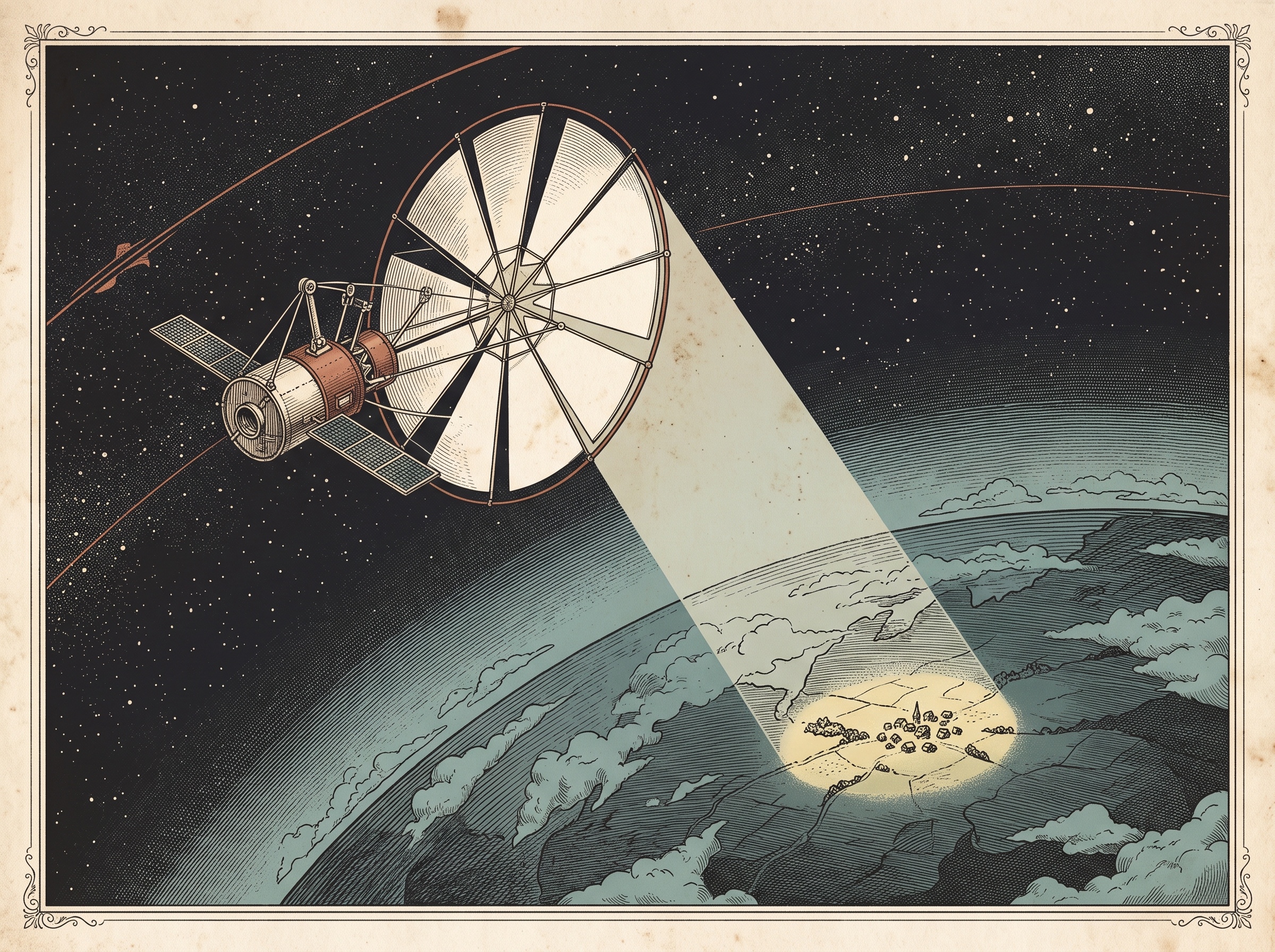
The mirror had no rigid frame: just eight wedge-shaped panels of thin reflective film folded around a drum on the cargo ship. The drum spun up, and the film flung outward like a pizza chef’s tossed dough, held flat by centrifugal force, the outward pull felt by anything on a spinning object. Soon a disc 20 meters (about 65 feet) across was turning in the sunlight.
Then the Progress tilted the whole assembly to catch the Sun and throw its reflection down onto the dark side of the planet. According to contemporary reports, the bright spot was roughly 4 to 5 kilometers wide. Before the test, Russian engineers predicted it would shine like three to five full moons; estimates of what it actually delivered range from about one full moon to two or three. The cosmonauts aboard Mir could follow the faint spot moving across the ground below. On the cloudy surface, only a handful of observers reported a brief flash, like a star suddenly brightening and fading.
After a few hours the mirror was cut loose. A sheet that large and that light catches the thin upper atmosphere like a kite, so its orbit sank fast; within about a day it was down to around 200 kilometers, and it soon burned up.
Six years later, Syromyatnikov tried again with a bigger mirror. Znamya 2.5 was 25 meters across and was meant to throw a spot about 7 kilometers wide, with a brightness estimated at five to ten full moons. On February 4, 1999, exactly six years to the day after the first test, the cargo ship Progress M-40 undocked from Mir and began to spin out the film. This time the membrane caught on an antenna on the cargo ship that hadn’t fully retracted. The thin sheet tangled and tore. Controllers tried repeatedly to free it, then gave up. On February 5, the Progress fired its engines and burned up over the Pacific, taking the mirror with it.
A planned 60-to-70-meter Znamya 3 was never built. Syromyatnikov returned to docking systems until his death in 2006.
Why was it strange?
Humans have always fought the night with light made on the ground. Znamya proposed borrowing light that would otherwise sail past Earth into empty space. It sounds like a comic-book villain’s scheme, yet it came from a sober engineer whose hardware had already been trusted to join crewed spacecraft together.
Stranger still, it worked. Not well enough to light a city, but well enough to prove that a giant film mirror could be unfolded in orbit, steered, and used to put a moving moonbeam on the ground. Then the sequel was undone by one small, ordinary part sticking out where it shouldn’t.
Another machine that should not have worked: The Spaceship That Was Supposed to Ride Atomic Bombs to Saturn.
What did scientists learn?
The first lesson was that rotation, rather than heavy struts, can hold a huge membrane flat, a technique still studied for solar sails and large antennas.
The second was an optical limit. The Sun isn’t a point; from Earth it spans about half a degree of sky. A flat mirror therefore can’t squeeze its reflection into a tiny dot. The spot spreads out by roughly 1 kilometer for every 107 kilometers of distance. From 400 kilometers up, that works out to a spot about 4 kilometers wide, almost exactly what Znamya produced.
That spreading is why the light was so dim: a 20-meter mirror’s worth of sunlight was smeared across an area tens of thousands of times larger than the mirror. A brighter spot needs a much larger mirror, or many mirrors aimed at one place. And because an orbiting mirror races along at nearly 8 kilometers per second, it can light any one spot for only minutes at a time.
The same thread — Light Pollution — continues in The Dung Beetles Scientists Fitted With Tiny Hats to Prove They Steer by the Milky Way.
How does it affect us today?
The idea has returned, with modern money behind it. On July 9, 2026, the U.S. Federal Communications Commission approved a California startup, Reflect Orbital, to launch a test satellite called Earendil-1. It carries a steerable reflector about 59 feet on a side, designed to cast a patch of light roughly three miles wide. The company says it eventually hopes to fly up to 50,000 such satellites by 2035 to supply light and power to solar farms after dark.
This time the pushback is loud. The American Astronomical Society objected before the approval, and on August 6, 2026, a coalition including Earthjustice, DarkSky International and the American Bird Conservancy asked the FCC to reverse course, citing risks to wildlife, astronomy and people’s eyes. Znamya was one brief flash over a cloudy continent; the new debate is whether artificial sunlight should become a routine part of the night.
Another invention that refused to stay on paper: Greek Fire: The Byzantine Weapon That Burned on Water — and Whose Recipe Died With the Empire.
Fun fact
Reflect Orbital’s first test mirror, about 59 feet across, is slightly smaller than the 65-foot Mylar disc Russia unfurled in 1993, and much smaller than the 82-foot Znamya 2.5 that tore on its antenna in 1999.
Sources
- McDowell, Jonathan. “Jonathan’s Space Report No. 143” (February 10, 1993), Harvard-Smithsonian Center for Astrophysics — contemporary record of the Znamya 2 deployment and reentry.
- McDowell, Jonathan. “Jonathan’s Space Report No. 388” (February 10, 1999) — contemporary record of the Znamya 2.5 snag and the deorbit of Progress M-40.
- Lewis, Danny. “How a Russian Space Mirror Briefly Lit Up the Night”, Smithsonian Magazine (2016), citing New York Times reporting from 1993.
- Bassi, Margherita. “An Aerospace Startup Just Got Approval to Test Beaming Sunlight to Earth”, Smithsonian Magazine (August 13, 2026).
- “Projects to harness solar power from space date back to 1990s”, Physics Today (2016), DOI: 10.1063/PT.5.029523.