The 480 Million Copper Needles America Scattered Around Earth to Build a Radio Ring
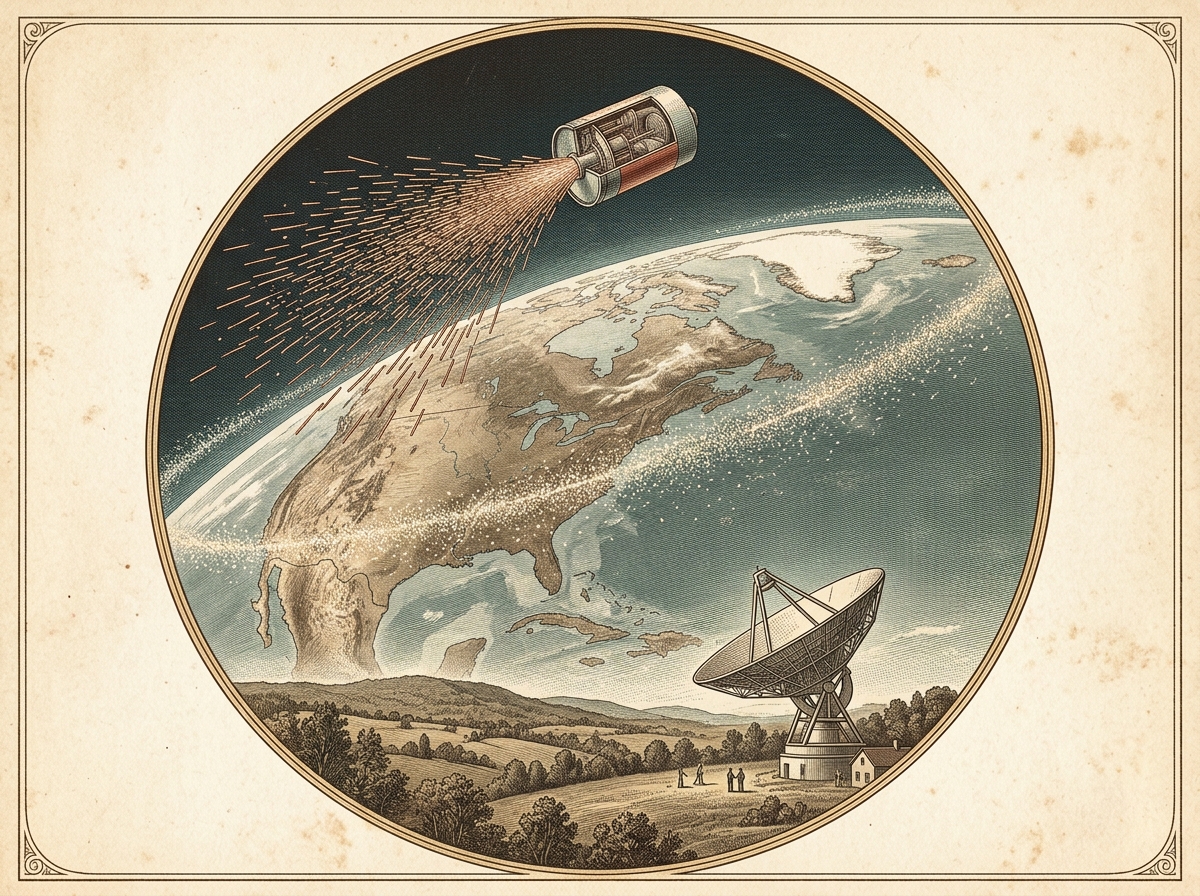
In May 1963, engineers in California spoke into a microphone, and their voices crossed the continent to Massachusetts by bouncing off a cloud of copper needles. Each needle was shorter than a staple and thinner than a human hair, and there were hundreds of millions of them, drifting in a loose ring about 3,600 kilometers above the planet. The United States had built a radio antenna out of glitter, and it worked.
By the Curiosities Desk · · 5 read · Filed under Space · Today’s round
What happened?
The idea, first called Project Needles, came out of MIT’s Lincoln Laboratory in 1958, proposed by engineer Walter Morrow and Harold Meyer of the defense firm Ramo-Wooldridge. It was a Cold War worry wearing a lab coat. Long-distance military radio depended on two things: undersea cables, which an enemy could cut, and the ionosphere, the electrically charged upper layer of the atmosphere that bounces shortwave radio signals over the horizon. That same year, American high-altitude nuclear tests showed how easily the ionosphere could be disrupted.
So why not build a spare one? The plan was to put about 480 million tiny copper wires into orbit. Each was cut to 1.78 centimeters (0.7 inch), about half the wavelength of the 8-gigahertz microwave signals the system would use. That length turns a scrap of wire into a dipole, the simplest kind of antenna, which catches a radio wave and re-radiates it in all directions. One needle reflects almost nothing. Hundreds of millions spread around the planet, the reasoning went, would act like a giant, unjammable mirror. All together the copper weighed only about 19 kilograms.
The project was renamed West Ford, after Westford, Massachusetts, home of Lincoln Lab’s Millstone Hill radar site, which would talk to a partner station at Camp Parks in northern California. To keep the needles from tangling during launch, they were packed into blocks of naphthalene gel, a cousin of mothball chemistry, meant to evaporate in the vacuum of space and set the wires free.
The first attempt rode an Air Force rocket on October 21, 1961, sharing the launch with a missile-warning satellite. It failed. According to Lincoln Lab’s own history, the dispenser never spun up properly, and the needles stayed bundled together.
The second try launched on May 9, 1963, with a redesigned dispenser, and this time the needles spread out. Within days the stations were sending voice calls, data, and teletype across the country by aiming 60-foot dishes at an empty-looking patch of sky. Early on, the link carried about 20,000 bits per second. As the needles drifted farther apart, the signal faded; by mid-June it had dropped to a few hundred bits per second.
Not everything dispersed. A NASA review later concluded that only 25 to 45 percent of the planned needles separated properly. The rest stayed stuck together in clumps.
Why was it strange?
Most of us picture satellites as single machines. West Ford was the opposite: a “satellite” with no electronics at all, just a fog of identical wires doing collectively what none could do alone.
It also struck the world’s astronomers as alarming. Optical astronomers feared the needles would scatter sunlight across the night sky. Radio astronomers feared stray reflections in their receivers. Britain’s Royal Astronomical Society protested, as did prominent scientists including Jodrell Bank’s Bernard Lovell. The Soviet newspaper Pravda ran the headline “U.S.A. Dirties Space.” At the United Nations, U.S. Ambassador Adlai Stevenson argued that sunlight would push the needles out of orbit within a few years.
The bigger fear wasn’t one experiment. It was the precedent: one country deciding, alone, to change the sky everyone shares.
Another orbital mess that drew a bill: The Time a Falling Space Station Got a $400 Littering Ticket.
What did scientists learn?
Technically, West Ford proved its point. A passive belt of scatterers could carry reliable transcontinental communications, and it would have been hard for an enemy to knock out.
The needles also became a lesson in orbital physics. Lincoln Lab designed them with a huge surface area for their tiny mass, so the gentle push of sunlight, called solar radiation pressure, would stretch their orbits into long ovals. Each pass dipped the low point of the orbit deeper into the thin upper atmosphere until drag pulled the needle down. By Lincoln Lab’s account, the belt was essentially gone by early 1966, roughly on schedule.
The clumps were another story. Heavier for their size, they shrugged off sunlight more easily and stayed up. In 2013, NASA’s Orbital Debris Program Office counted 46 clumps of West Ford needles still circling Earth.
The biggest technical lesson, though, was that the approach was already being overtaken. Telstar, an active satellite with its own receiver and transmitter, had relayed television across the Atlantic in 1962. Electronics in orbit beat a cloud of wire, and West Ford was shelved.
Another mirror in the sky that worked on its own terms: The Giant Space Mirror Russia Built to Turn Night Into Day.
How does it affect us today?
West Ford’s lasting legacy is legal. The outcry helped shape the 1967 Outer Space Treaty, which asks nations to hold international consultations before experiments that could cause “potentially harmful interference” with other countries’ activities in space. The international scientific committee COSPAR also set up a group to review risky space experiments, which evolved into the panel that handles its orbital debris discussions today.
The argument also never really ended. As companies launch thousands of internet satellites, astronomers raise many of the same worries about streaks in telescope images and radio interference that their predecessors raised in 1961. The International Academy of Astronautics has described West Ford as the worst deliberate release of debris into space.
Fun fact
The giant radio dish built just up the hill from Millstone in Westford is called Haystack. According to one of its longtime scientists, the name came from newspapers joking that the lab was looking for needles in space, and it stuck even though the staff never liked it.
Sources
- Ward, W. W. & Floyd, F. W., “Thirty Years of Space Communications Research and Development at Lincoln Laboratory,” Lincoln Laboratory Journal, Vol. 2, No. 1 (also NASA SP-4217, Ch. 8)
- NASA Orbital Debris Quarterly News, Vol. 17, Issue 4 (October 2013), on the fate of the West Ford needles
- MacLellan, D., “Looking Back: Project West Ford,” MIT Lincoln Laboratory
- “Project West Ford and the plan to pollute space,” The Boston Globe (2017)
- MIT Technology Review, “Haystack’s first heyday” (2025)