The Time a Falling Space Station Got a $400 Littering Ticket
On July 11, 1979, a 76-ton American space station broke apart over the Indian Ocean, scattered chunks of scorched metal across the Australian Outback, and rattled a few sleeping farm towns with sonic booms. A teenager grabbed a piece of it off his lawn and got on a plane before breakfast to go claim $10,000. And a rural Australian shire, surveying the wreckage, did the only sensible thing a local government can do when a superpower dumps debris on its land: it wrote NASA a ticket for littering.
By the Curiosities Desk · · 6 min read · Filed under Space · Today’s round
Part of When the Experiment Left the Lab
What happened: The Time a Falling Space Station Got a $400 Littering Ticket
Skylab was America’s first space station, launched in May 1973 and nearly lost before it ever got started — the workshop’s meteoroid shield and one solar panel tore away during launch, forcing the first crew to spend part of their 28-day mission on emergency repairs. Two more crews visited after that, and by the time the last astronauts left in February 1974, NASA hoped Skylab could stay in orbit until a future space shuttle arrived to boost it higher, or bring it down in a controlled way.
That plan depended on the Sun cooperating. It didn’t. The solar cycle that followed turned out to be the second-most active in a century, according to NASA’s own history office, and the extra radiation puffed up Earth’s upper atmosphere, thickening the drag on Skylab and dragging its orbit down years ahead of schedule. Engineers scrambled: in 1978 they reactivated the dormant station’s systems — remarkably, its batteries had survived four years of neglect — and used its remaining maneuvering thrusters to tilt it into orientations that minimized drag, buying a few extra months. But delays in the space shuttle program meant no rescue mission would ever fly. On December 19, 1978, NASA formally gave up on saving Skylab and turned its attention to managing where the wreckage would land instead.
There was no way to steer a 169,000-pound station to a precise spot, but controllers could nudge the odds. On its final orbit, they tumbled Skylab to try to time the breakup so debris would fall over the Indian Ocean rather than a populated coastline. It almost worked. The station held together a little longer than predicted, broke apart at around 10 miles altitude — lower than expected — and the shifted timing carried the debris footprint further east than planned, raining fragments across a stretch of the sparsely populated Western Australian Outback, centered near the town of Esperance.
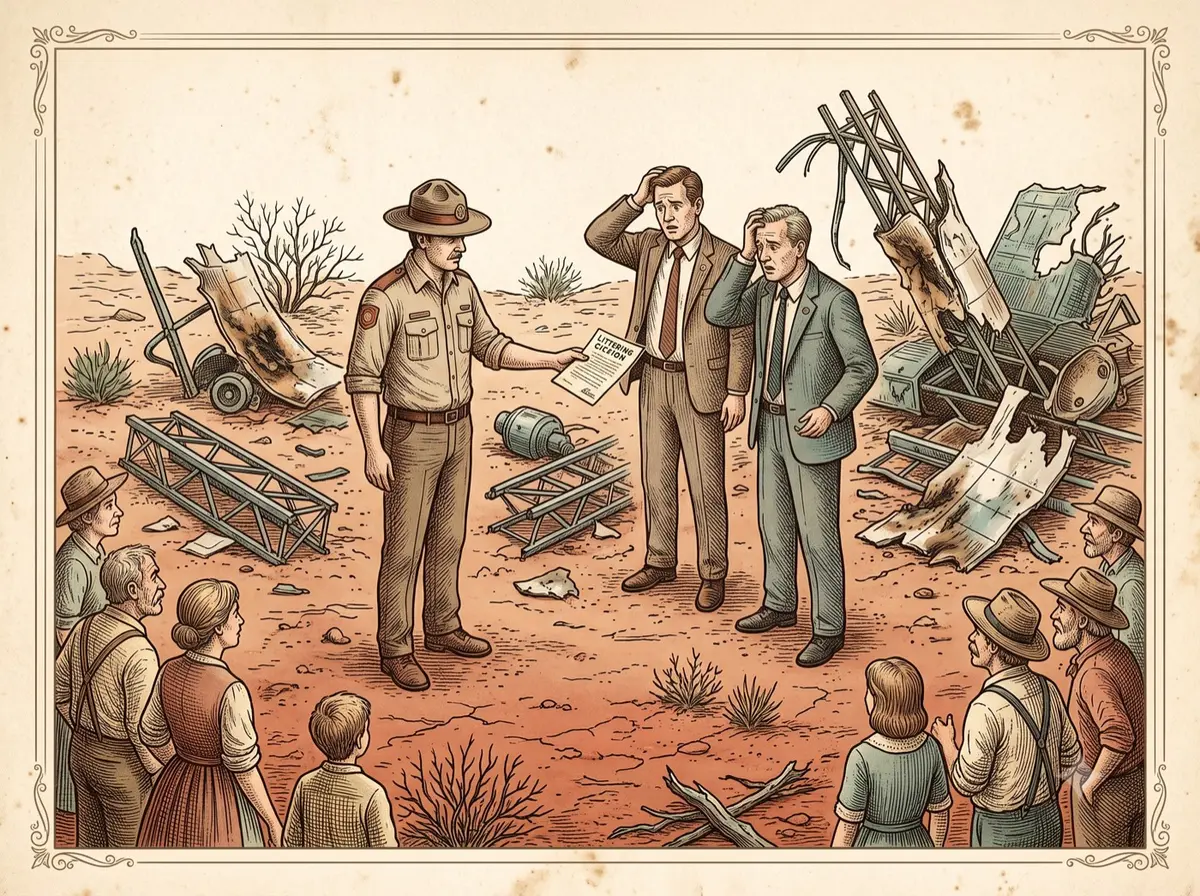
No one was hurt. NASA’s Skylab flight director, Charles S. Harlan, told reporters afterward: “The surprise is over. No more suspense. Skylab is on the planet Earth.” But the ground reception got a comic postscript. When a NASA team traveled to Esperance to inspect the wreckage, local officials staged a mock ceremony and had a parks officer formally cite the agency for littering — a $400 fine, tongue firmly in cheek. A 1979 NASA newsletter quoted Marshall Space Flight Center public affairs officer J.M. Jones describing the scene: “Upon our arrival, the president of the shire had arranged a mock ceremony in which an officer of the parks service ticketed NASA for littering, the evidence having been found all about the country-side.” NASA never paid it.
Meanwhile, the San Francisco Examiner had offered $10,000 to the first person who could bring an authentic piece of Skylab to its office. Seventeen-year-old Stan Thornton, who lived in Esperance and had debris land on his own house that night, grabbed some charred fragments, got himself on a flight to California, and collected the prize.
Why it was strange: The Time a Falling Space Station Got a $400 Littering Ticket
Nations don’t usually get billed by rural town councils. The whole event turned an anxious, months-long global spectacle — newspapers had been tracking “Skylab Is Falling” for weeks, and NASA fielded genuine public worry about where a flaming 76-ton object might come down — into a joke that Esperance’s residents were happy to let run for three decades. The fine was never meant to be collected; it was small-town theater aimed at a federal space agency that, for once, had no say in where its hardware would land.
Another good intention with a bad landing: The Space Tomato That Vanished for Nearly a Year — and the Astronaut Accused of Eating It.
What scientists learned: The Time a Falling Space Station Got a $400 Littering Ticket
Skylab’s reentry was a hard lesson in how unpredictable atmospheric drag can be. Solar activity — not something engineers could dial in — turned out to be the dominant variable in when and how a spacecraft that size would come down, and it derailed a carefully laid plan to save the station by roughly four years. The event also demonstrated the limits of “steering” an object that can’t fire main engines: controllers could only tilt Skylab’s orientation and pick a favorable orbital pass, not choose a landing site. Those lessons directly shaped how later, much larger stations were deorbited. The Soviet Salyut 7 complex, lost to ground control years before its 1991 reentry, came down uncontrolled over Argentina. Learning from both, engineers designed the 1986-launched Mir station’s 2001 retirement as a deliberate, engine-assisted descent into an empty stretch of the South Pacific — and NASA has applied the same thinking in planning the eventual controlled deorbit of the International Space Station, a spacecraft roughly five times heavier than Skylab.
Another time it went sideways: The Woodpeckers That Grounded a Space Shuttle — and the Plastic Owls NASA Sent to Guard It.
How it reaches us today: The Time a Falling Space Station Got a $400 Littering Ticket
Every time a large satellite, rocket stage, or space station nears the end of its life, agencies now model reentry footprints and, wherever engines and fuel allow, execute a controlled deorbit burn aimed at empty ocean — directly because of what Skylab’s uncontrolled tumble revealed about the risks of leaving it to chance. Skylab’s debris also became an unlikely piece of civic memorabilia: the Esperance Municipal Museum still displays a recovered oxygen tank, a food freezer, thruster-system nitrogen spheres, and a section of the hatch the astronauts once climbed through.
As for the ticket: it stayed unpaid until 2009, when California radio host Scott Barley asked his listeners to chip in and finally settle NASA’s debt for the 30th anniversary of the reentry. Esperance’s mayor said the fine had “been written off years ago,” but accepted the money anyway, and Barley flew out to receive a key to the city. The comically oversized novelty check now hangs in the museum above the recovered space station parts.
A close cousin: The Unit Mix-Up That Doomed a Mars Probe.
Fun fact: The Time a Falling Space Station Got a $400 Littering Ticket
Nobody at NASA or in Esperance ever expected the $400 to be paid — it was a piece of local political comedy, not a real legal claim. Which makes it all the funnier that, three decades later, it actually got paid, in full, by a California radio audience that had never seen a scrap of the debris.
Sources: The Time a Falling Space Station Got a $400 Littering Ticket
- John Uri, “45 Years Ago: Skylab Reenters Earth’s Atmosphere,” NASA History Office, July 11, 2024 — https://www.nasa.gov/history/45-years-ago-skylab-reenters-earths-atmosphere/
- Nick Greene, “NASA’s Unpaid $400 Littering Ticket For Skylab Debris in Australia,” Mental Floss, Nov. 3, 2015 — https://www.mentalfloss.com/science/space/nasas-unpaid-400-littering-ticket-skylab-debris-australia
- “First fine for littering from space,” Guinness World Records — https://www.guinnessworldrecords.com/world-records/114725-first-fine-for-littering-from-space
- “Skylab’s Remains in Esperance,” Atlas Obscura — https://www.atlasobscura.com/places/skylabs-remains
- “Skylab,” Wikipedia — https://en.wikipedia.org/wiki/Skylab
Related stories: The Time a Falling Space Station Got a $400 Littering Ticket
- The Corned Beef Sandwich That Got NASA Hauled Before Congress — A smuggled sandwich in orbit triggered a congressional hearing
- The Rocket That Exploded on Live TV and Got Called ‘Kaputnik’ — A rocket that exploded on live television and earned a nickname
- The Venus Lander That Tested the Hardness of Its Own Lens Cap — A Venus lander dropped its lens cap exactly where its instrument landed