The Space Tomato That Vanished for Nearly a Year — and the Astronaut Accused of Eating It
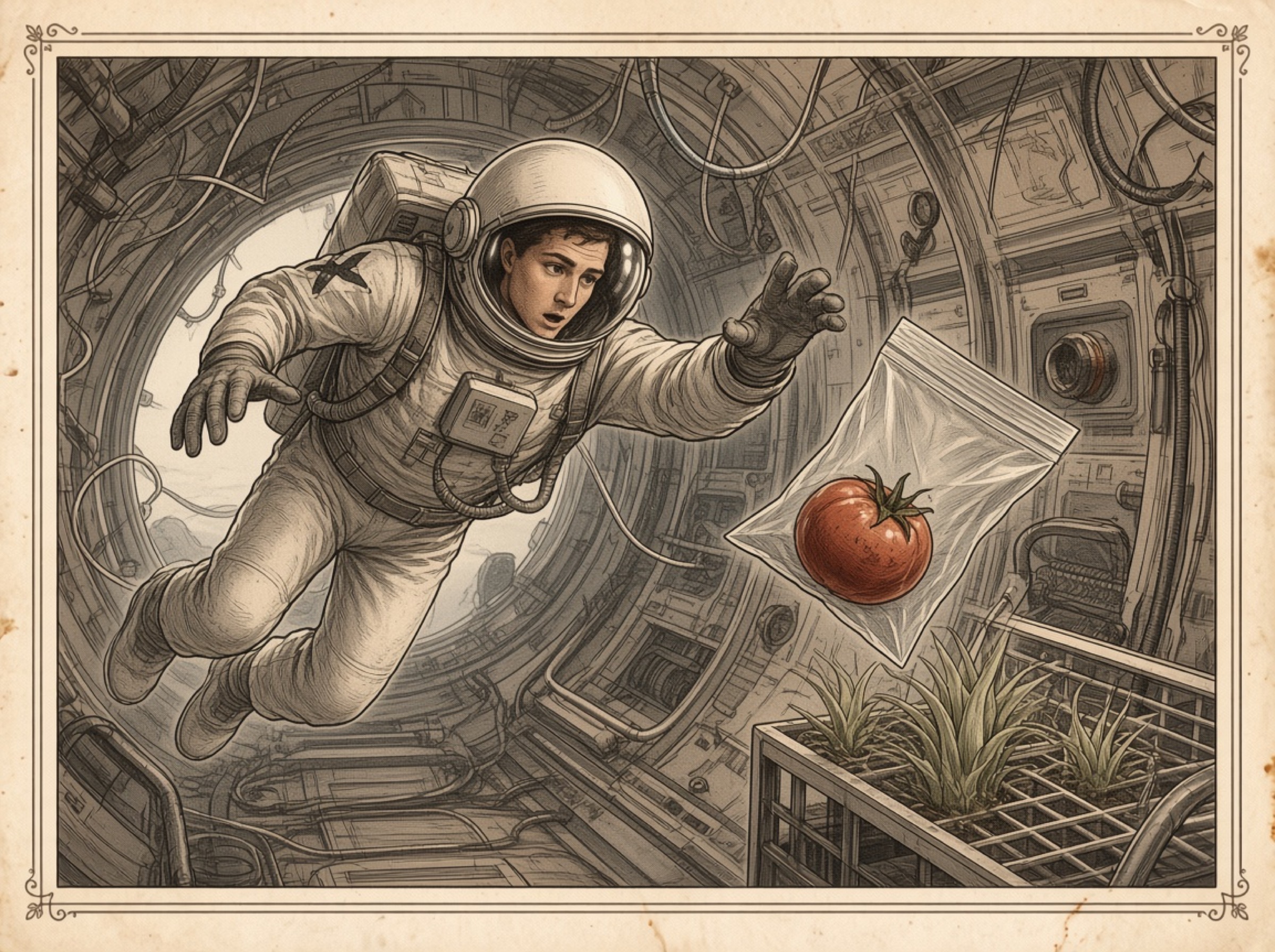
Somewhere aboard the International Space Station in 2022, astronaut Frank Rubio tucked a freshly picked tomato into a plastic bag, turned his attention to something else for a moment — and never saw it again. For more than a year, his crewmates had a theory about where it went, and it involved Rubio's stomach. He kept insisting he was innocent. In December 2023, the evidence finally floated into view: a shriveled, squished little tomato, still sealed in its bag, and no bite marks in sight.
By the Curiosities Desk · · 5 min read · Filed under Space · Today’s round
What happened?
Frank Rubio, a U.S. Army flight surgeon and helicopter pilot turned NASA astronaut, launched to the space station on September 21, 2022, aboard a Russian Soyuz capsule. He was supposed to stay about six months. Then, on December 14, 2022, his ride home sprang a coolant leak — most likely punctured by a tiny micrometeoroid, a speck of space debris or rock. The Soyuz was deemed unsafe to carry a crew back through the atmosphere, a replacement had to be sent, and Rubio’s mission stretched to 371 days. When he landed in Kazakhstan on September 27, 2023, he held the record for the longest single spaceflight by an American, beating Mark Vande Hei’s 355 days.
A year is a long time to spend in a tin can 250 miles up, and Rubio filled part of it with gardening. In 2022 he worked on an experiment called XROOTS, short for eXposed Root On-Orbit Test System. Instead of soil, XROOTS grows plants using hydroponics (roots bathed in a nutrient-rich water solution) and aeroponics (roots hanging in air and misted with that solution). The point is to learn how to farm without hauling heavy bags of dirt into orbit.
During a plant check, two small tomatoes broke off a plant. Rubio bagged them. Then, in the way of all objects that aren’t strapped down in microgravity, the bag drifted off. Rubio searched. And searched. “I spent so many hours looking for that thing,” he said during a 2023 event, and after returning to Earth he put his search time at “18 to 20 hours” of his own off-duty time — a figure that may have been a little exaggerated for comic effect. He suggested the station’s dry air, which he described as being around 17% humidity, had probably shriveled the fruit to nothing, and predicted that the “desiccated tomato” would show up someday “and vindicate me.”
His crewmates, meanwhile, had a simpler explanation: he ate it.
The vindication came on December 6, 2023, during a livestreamed celebration of the space station’s 25th anniversary. NASA astronaut Jasmin Moghbeli announced that the crew of Expedition 70 had found the missing produce. “We can exonerate him,” she said. A week later, NASA published a photo and an update with the details: the fruit had turned up in a plastic bag, “dehydrated and slightly squished,” and — other than some discoloration — showed no visible mold or microbial growth.
One honest footnote: the story shifted a bit in the telling. Early news coverage described a single tomato from a different experiment, Veg-05, harvested on March 29, 2023, which would have meant it was lost for about eight months. NASA’s own update in December 2023 corrected this: there were two tomatoes, they came from XROOTS in 2022, and they were found “nearly a year” later. That’s why you’ll still see headlines saying “8 months.” NASA’s version is the one to trust.
Why was it strange?
The space station is not huge. Its pressurized interior is roughly the volume of a large house, and it is one of the most carefully inventoried places humans have ever built — every item is logged, labeled, and tracked. You might expect it to be the last place anything could go missing.
But microgravity rewrites the rules of losing things. On Earth, a dropped object goes to the floor, so you know where to look. In orbit there is no floor. Anything let go of simply drifts, often riding the air currents produced by fans and ventilation systems, and can end up wedged behind a panel, tangled in a cable bundle, or tucked inside a stowage bag that nobody opens for months. A small tomato inside a plastic bag makes a very effective stowaway.
Another good intention with a bad landing: The Time a Falling Space Station Got a $400 Littering Ticket.
What did scientists learn?
The lost tomato wasn’t a real experiment, but it was an accidental one. It showed, in a small and memorable way, what the station’s environment does to food left unattended. With very low humidity, the fruit dried out rather than rotting into a fuzzy mess. NASA noted no visible fungal or microbial growth, though the tomatoes were discarded, so they never came back to Earth for a lab to confirm that.
The real science lives in the experiments the tomatoes came from. XROOTS tested how to grow crops without any soil or growth medium, a key question for long missions where every pound counts. Veg-05, which Rubio also worked on, grew dwarf tomatoes in the station’s Veggie plant chamber and studied how light quality and fertilizer affect fruit production, plus food safety, nutrition, and how much the crew actually liked eating the results. NASA also reports that astronauts get psychological benefits from tending plants — a little green in a world of white walls and metal.
Another time it went sideways: The Woodpeckers That Grounded a Space Shuttle — and the Plastic Owls NASA Sent to Guard It.
How does it affect us today?
Fresh food is one of the hardest problems standing between humans and long trips to the Moon and Mars. Packaged food slowly loses vitamins over time, and a crew on a multi-year Mars mission can’t wait for a grocery delivery. Experiments like XROOTS and Veg-05 are early steps toward a working space garden. NASA’s Plant Habitat-03 study, which followed, looks at whether adaptations a plant develops in space can be passed to the next generation of seeds.
And the lost tomato became a kind of mascot for that research. It turned a technical program about root zones and fertilizer into a story millions of people followed — a reminder that space science is done by real people who misplace things, get teased by their coworkers, and spend their free time hunting behind panels for a missing piece of fruit.
A close cousin: The Unit Mix-Up That Doomed a Mars Probe.
Fun fact
The first space-grown food NASA astronauts were cleared to eat was a red romaine lettuce called “Outredgeous.” On August 10, 2015, Scott Kelly, Kjell Lindgren, and Japan’s Kimiya Yui wiped the leaves with citric-acid sanitizing wipes, tasted them plain, then added olive oil and balsamic vinegar. Kelly’s verdict: “Tastes good.” Half the crop was frozen and sent back to Earth for testing.
Sources
- NASA. “Let’s Ketchup on International Space Station Tomato Research.” December 14, 2023 (updated December 15, 2023). (Primary source: NASA’s official account of the XROOTS tomatoes and their condition.)
- Space.com. “ISS astronauts find tomato that was lost in space for 8 months.” December 2023. (Moghbeli’s announcement and Rubio’s quotes; see NASA’s later correction above.)
- Astronomy. “Astronaut Frank Rubio returns to Earth after breaking U.S. spaceflight record.” September 2023.
- Live Science. “NASA astronauts finally find 1-inch tomato that was ‘lost in space’ for 8 months.” December 2023.
- collectSPACE. “Astronauts eat first space-grown lettuce.” August 10, 2015.