The Flake of Chipped Paint That Made a $1.5 Billion Telescope Nearsighted
In the summer of 1990, investigators walked into a test chamber at an optics plant in Danbury, Connecticut, and found the machine they were looking for exactly where it had been left nine years earlier — untouched, still holding the settings used to shape the most famous mirror ever made. When they took it apart, they found a small metal cap with a patch of black anti-reflective coating flaked off it, about the size of a comma. That missing speck of paint had just cost NASA a $1.5 billion telescope's eyesight.
By the Curiosities Desk · · 6 min read · Filed under Space · Today’s round
What happened?
The Hubble Space Telescope launched aboard the shuttle Discovery on April 24, 1990, carrying a 2.4-meter primary mirror that had taken years to grind and polish. Two months later, on June 27, NASA held a press conference to announce that the pictures were wrong. Both of Hubble’s cameras — the Wide Field and Planetary Camera and the Faint Object Camera — showed the same soft halo around every point of light. The mirror had spherical aberration: instead of bringing all incoming light to one sharp focal point, different parts of the mirror focused light at slightly different distances, so nothing ever came fully into focus.
NASA formed an investigation board on July 2, chaired by Lew Allen, then director of the Jet Propulsion Laboratory. The board’s report, published that November, traced the fault back to the ground.
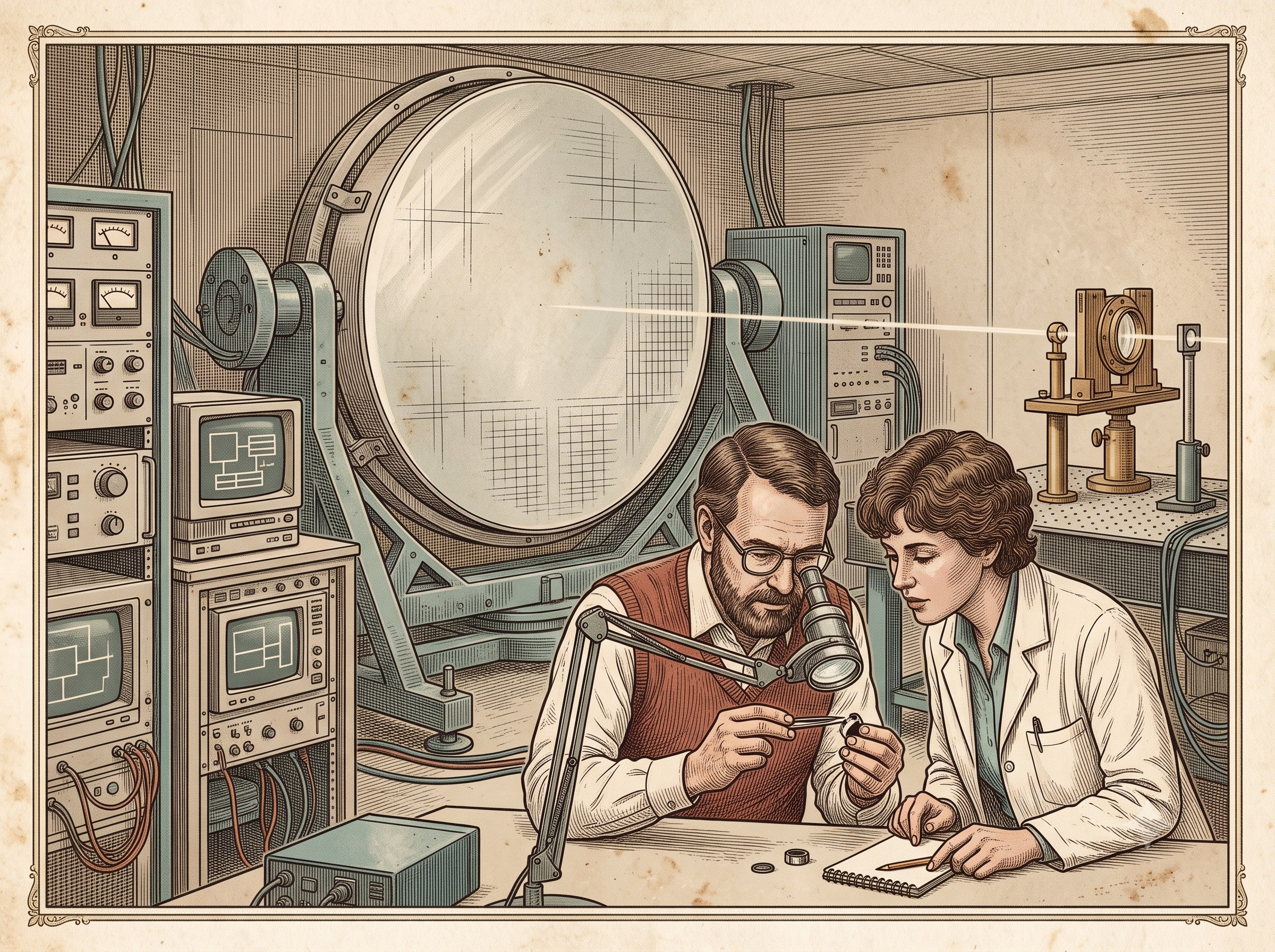
Polishing a mirror this precise means you cannot simply measure it with a ruler. Opticians use a null corrector — an optical jig that reshapes a test beam so that a perfectly finished mirror reflects it back as a flat, featureless pattern. If the null corrector is right, the mirror will be right. Perkin-Elmer, the contractor, built a reflective null corrector for Hubble and set its internal optics using polished Invar rods of exact length, sighting on the rod ends with an interferometer.
To keep the rods centered on the beam, the company fitted small “field caps” over one end, each with a tiny aperture in the middle and a black anti-reflective coating so the cap itself would not throw back a reflection. On one cap, some of that coating had broken away. The interferometer locked onto the bright bare metal of the cap instead of the rod end just beneath it. The cap was 1.3 millimeters thick.
That 1.3 millimeters propagated straight through everything that followed. A lens inside the null corrector ended up 1.3 mm farther from its neighbor than the design called for. When technicians tried to seat it, the adjustment screws ran out of travel — so they inserted spacers to make room, and set it there. The Allen board later noted that the bolts securing the lens assembly were never staked, a routine step that would have invited a second look, and that the paperwork describing the spacers “was never filed or has been lost.”
The mirror was then polished to match the wrong template — beautifully, to within a whisper of the wrong shape. Its outer edge finished about 2.2 micrometers too flat, roughly one-fiftieth the width of a human hair. In the language of the report: a 0.4-wave RMS wavefront error at 632.8 nanometers, ten times larger than the specification allowed.
Why was it strange?
The strangest part is that the evidence was already sitting in the filing cabinet. Perkin-Elmer had two other, simpler devices — a refractive null corrector and an inverse null corrector — and both, when used on the mirror, showed spherical aberration. Both results were set aside on the reasoning that these instruments were less precise than the reflective null corrector, and therefore less trustworthy. The Allen board’s verdict was blunt: the refractive corrector “was quite accurate enough to detect the gross error, and indeed did so.”
So the telescope was not blind because nobody looked. It was blind because the one instrument everyone trusted most had a chip in its paint, and the two instruments that disagreed with it were assumed to be wrong.
The public reaction was merciless. Barbara Mikulski, the Maryland senator who would later become one of Hubble’s fiercest defenders, called it a “techno-turkey.” David Letterman ran a Top Ten list of NASA excuses. In The Naked Gun 2½, released the following year, a photo of Hubble hangs on a wall of famous disasters beside the Titanic.
It shares a shelf with The Unit Mix-Up That Doomed a Mars Probe, in The Missions Undone by One Small Thing.
What did scientists learn?
Here is the redeeming twist: because the error was so precisely characterized, it was correctable. Once the board established exactly how the mirror was wrong — down to the 1.3 mm — opticians could grind a small set of mirrors with the opposite error and put them in the light path. The telescope did not need a new mirror. It needed glasses.
The Wide Field and Planetary Camera 2 team built the correction directly into their replacement camera. For the other instruments, engineers built COSTAR — the Corrective Optics Space Telescope Axial Replacement — a refrigerator-sized box that unfolded ten small mirrors on arms into the beam.
On December 2, 1993, the shuttle Endeavour launched on STS-61. Over five spacewalks totaling 35 hours and 28 minutes, the crew — Story Musgrave, Jeffrey Hoffman, Kathryn Thornton, and Thomas Akers — swapped in WFPC2 and installed COSTAR. The before-and-after images of the galaxy M100 became one of the most convincing “it worked” pictures in the history of engineering.
Also in The Missions Undone by One Small Thing: The Most Expensive Hyphen in History Was Not a Hyphen.
How does it affect us today?
Hubble went on to help measure the accelerating expansion of the universe, work that contributed to a Nobel Prize, and has logged well over a million observations. The wider legacy is procedural: the failure is now a standard case study in why a single trusted measurement, unverified by an independent method, is a fragile thing to build a program on. Redundant verification of critical optics — the exact step skipped here — is now expected practice.
COSTAR itself became obsolete. Every instrument installed after 1990 had the correction built in, so in May 2009, astronauts removed COSTAR to make room for the Cosmic Origins Spectrograph and brought it home. It is on display at the Smithsonian National Air and Space Museum in Washington, D.C. — a refrigerator-sized pair of eyeglasses, retired.
Another from The Missions Undone by One Small Thing: The Venus Lander That Tested the Hardness of Its Own Lens Cap.
Fun fact
The reflective null corrector that caused the whole thing had been sitting in its test chamber, unused and unchanged, since the day Hubble’s mirror was finished. Investigators did not have to reconstruct the mistake from documents — they simply walked in nine years later and measured the error still frozen in place.
Sources
- Lew Allen et al., The Hubble Space Telescope Optical Systems Failure Report, NASA TM-103443, November 1990 (primary source) — https://ntrs.nasa.gov/api/citations/19910003124/downloads/19910003124.pdf
- NASA Science, “Hubble’s Mirror Flaw” — https://science.nasa.gov/mission/hubble/observatory/design/optics/hubbles-mirror-flaw/
- NASA, “Servicing Mission 1” — https://science.nasa.gov/mission/hubble/observatory/missions-to-hubble/servicing-mission-1/
- Smithsonian National Air and Space Museum, “COSTAR (Corrective Optics Space Telescope Axial Replacement), Hubble, Flown” — https://airandspace.si.edu/collection-objects/costar-corrective-optics-space-telescope-axial-replacement-hubble-flown/nasm_A20120157000
- Ben Evans, “Techno-turkey: Remembering Hubble’s vision troubles, 30 years on,” Astronomy — https://www.astronomy.com/space-exploration/techno-turkey-remembering-hubbles-vision-troubles-30-years-on/
Related stories
- Part of The Missions Undone by One Small Thing
- The Genesis Capsule That Crashed Because a Switch Was Installed Backward — A parachute that never fired, because of a part drawn the wrong way round
- The Unit Mix-Up That Doomed a Mars Probe — Pounds and newtons, and a $150 million probe lost at Mars
- The Loose Cable That Made Neutrinos Outrun Light for Five Months — When the instrument, not the universe, turns out to be the problem