The Venus Lander That Tested the Hardness of Its Own Lens Cap
On 5 March 1982, a Soviet lander named Venera 14 dropped through sixty kilometres of sulfuric acid cloud, touched down on a basalt plain hot enough to melt lead, popped the protective covers off its cameras, and swung out a mechanical arm to punch the ground and find out how hard Venus is. The arm came down on the lens cap.
By the Curiosities Desk · · 5 read · Filed under Space · Today’s round
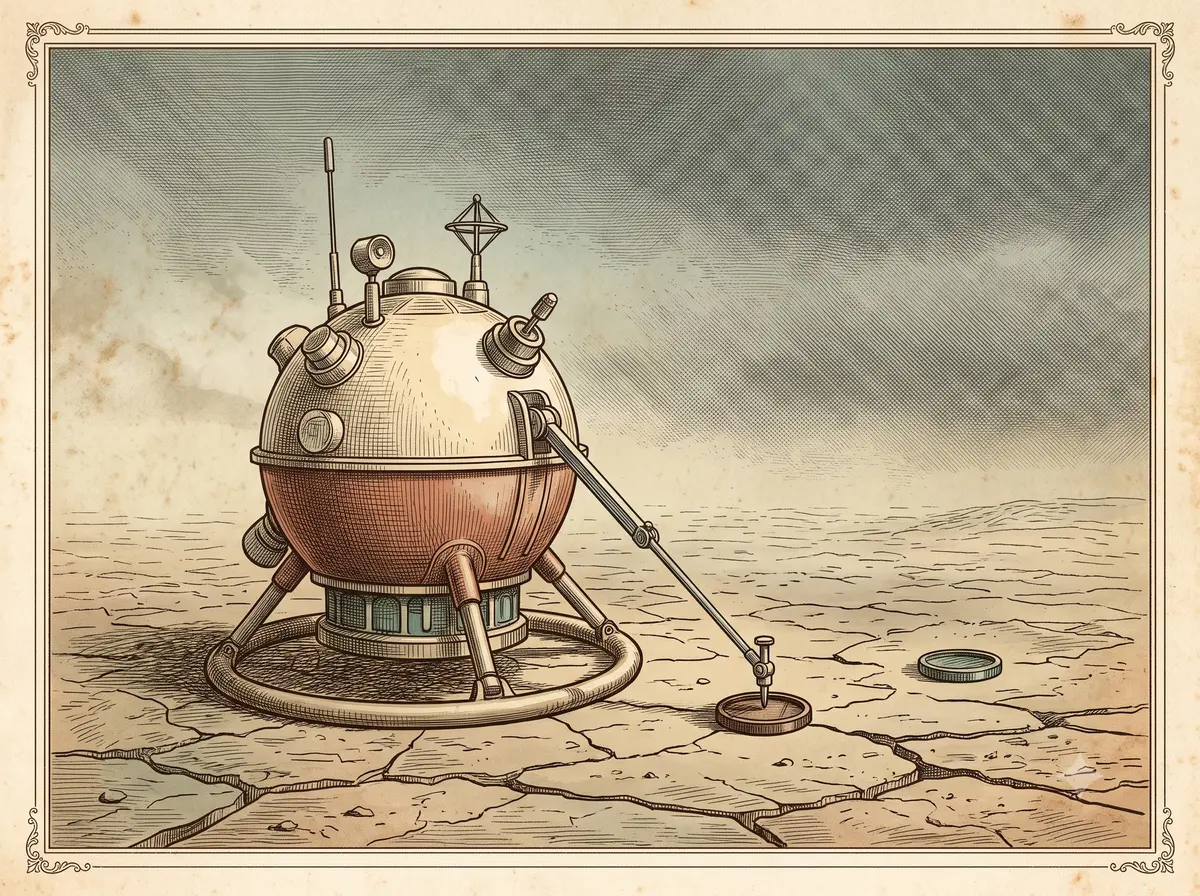
What happened: Venera 14 on Venus
Venera 14 and its twin, Venera 13, were the high-water mark of Soviet planetary engineering. Each was a squat pressure vessel — a titanium sphere on a ring-shaped landing platform, wrapped in insulation and pre-chilled before entry — built to keep working in an environment that destroys spacecraft as a matter of routine. At the Venera 14 landing site, on the eastern flank of a highland region called Phoebe Regio, the temperature was 465 °C and the pressure 94 Earth atmospheres, roughly what you would feel a kilometre beneath the ocean.
Venera 13 landed first, on 1 March 1982. Venera 14 followed four days later, about 950 kilometres away. Both were designed to survive 32 minutes on the surface. Venera 13 lasted 127. Venera 14 lasted 57, transmitting the whole time to its flyby bus overhead, which relayed the signal to Earth.
Among the instruments was PrOP-V, a dynamic penetrometer: an arm carrying a spring-driven punch that would strike the ground and measure how much the surface resisted. It is a simple, blunt, extremely useful experiment. Nobody had ever measured the mechanical strength of Venusian rock, and you cannot design a future lander, a drill, or a rover without knowing whether the ground under it is solid basalt or something closer to packed ash.
The camera windows were sealed by quartz-protecting lens caps, blown clear by pyrotechnic charges once the lander was down. On Venera 13, the cap flew off and settled harmlessly in the frame — you can see it in the panorama, a pale disc near the foot of the lander. On Venera 14, the cap came to rest on the exact patch of ground where the penetrometer arm was about to swing. The arm punched down onto its own discarded hardware.
The published Venera 14 panorama shows both objects: the penetrometer at lower left, and the pale, curved lens cap beside it. Peer-reviewed analysis of the Venera panoramas by Alexander Basilevsky and colleagues describes the outcome plainly — the Venera 14 punch impacted the view-port cover, returning what they call a “poorly understandable combined response” of cover and rock. It is worth being precise here: no Soviet mission report ever announced “we measured our lens cap.” The conclusion comes from the photographs and from the strangeness of the number the instrument returned, and NASA’s own archive caption for the image hedges with it is possible that. But it is the reading the scientific literature has settled on.
Venera 13’s penetrometer, which hit actual ground, gave a bearing strength of roughly 2.6 to 10 kilograms per square centimetre — soft-ish, in the range of compacted soil or weathered rock rather than solid lava. That single measurement, from the twin that got lucky, is still the only direct mechanical test of the surface of Venus that anyone has.
Why it was strange: Venera 14 on Venus
Space missions fail in familiar ways. A rocket explodes. A parachute doesn’t open. Software converts pounds to newtons and drives a probe into a planet. Venera 14 failed in none of those ways. Every stage worked. The heat shield held, the parachute deployed and released on schedule, the lander survived nearly twice its rated lifetime in conditions that would flatten a submarine, the cameras returned some of the only photographs ever taken from the surface of another world.
And then the mission’s one instrument for touching Venus was defeated by a piece of the mission itself, landing in a spot roughly the size of a saucer.
There is also a quiet pattern behind it. Lens caps were the recurring nemesis of the Venera program. On Venera 9, in 1975, a second camera’s cap failed to eject at all under the atmospheric pressure, so half the intended panorama never existed. On Venera 11 and 12, in 1978, every colour camera cap stuck, and two landers sat on Venus for over an hour photographing the inside of their own covers. Venera 14’s cap did exactly what it was supposed to do. It just did it in the wrong place.
It shares a shelf with The Genesis Capsule That Crashed Because a Switch Was Installed Backward, in The Missions Undone by One Small Thing.
What scientists learned: Venera 14 on Venus
The lens cap incident is a textbook case of what engineers now call jettison-debris interference — the problem that anything a spacecraft throws away stays nearby, and on an airless or slow-wind world it stays exactly where it lands. Nothing sweeps it off. Nothing buries it. Discarded hardware becomes part of your landing site.
More broadly, Venera 13 and 14 did deliver the science that mattered most. Their X-ray fluorescence spectrometers analysed drilled soil samples and found that Venera 14 had set down on rock chemically close to Earth’s oceanic tholeiitic basalt — the ordinary stuff of mid-ocean ridges — while Venera 13’s site was an unusual potassium-rich alkaline basalt. Two landers, 950 kilometres apart, two different volcanic rock types. That told geologists Venus is not a uniform lava ball but a world with varied volcanic history. Those remain the only direct chemical measurements of Venusian surface material ever made.
The same thread — Venus — continues in The Most Expensive Hyphen in History Was Not a Hyphen.
How it reaches us today: Venera 14 on Venus
Every modern lander design carries the lesson. When Mars rovers and landers eject heat shields, backshells, lens covers, and descent-stage hardware, the discarded pieces are deliberately thrown clear on trajectories that carry them well away from the working area, and mission teams photograph the debris field to confirm nothing landed where an instrument needs to work. Sample-handling arms get keep-out zones; cameras check the ground before an arm commits.
It matters again right now, because Venus is back on the schedule. NASA’s DAVINCI probe and the Russian-planned Venera-D lander are both being designed to work on or near a surface we have measured mechanically exactly once — with Venera 13’s single punch. Everything we think we know about standing on Venus rests on a data point its twin was supposed to confirm.
Also in The Missions Undone by One Small Thing: The Flake of Chipped Paint That Made a $1.5 Billion Telescope Nearsighted.
FAQ
What happened to Venera 14’s lens cap?
On 5 March 1982, the Soviet lander Venera 14 reached the surface of Venus, blew its camera lens caps clear, and swung a penetrometer arm down to test how hard the ground was. The cap had landed on the spot the arm was aimed at. The punch hit the cover. Photographs and later analysis are the evidence; no Soviet mission report announced the mistake in those words.
When did Venera 14 land?
Venera 14 landed on 5 March 1982, four days after its twin, Venera 13. It kept transmitting for 57 minutes at about 465 °C and 94 Earth atmospheres.
Fun fact: Venera 14 on Venus
Venera 13 and 14 carried microphones, making them the first spacecraft to record sound on another planet. Analysis of the recordings gave surface wind speeds of just 0.3 to 0.5 metres per second — slower than a stroll. But the air down there is roughly fifty times denser than Earth’s at sea level, so that gentle breeze would shove against you less like wind and more like a slow current in a swimming pool.
Sources: Venera 14 on Venus
- Basilevsky, A. T., Head, J. W., & Abdrakhimov, A. M. (2004). “Impact crater air fall deposits on the surface of Venus,” Journal of Geophysical Research: Planets — peer-reviewed analysis of the Venera panoramas, including the penetrometer/view-port cover result.
- Surkov, Yu. A., et al. (1984). “New data on the composition, structure, and properties of Venus rock obtained by Venera 13 and Venera 14,” Journal of Geophysical Research — the primary report of the landers’ soil chemistry.
- NASA Astronomy Picture of the Day, 11 May 2025: “The Surface of Venus from Venera 14” — the panorama itself, with the penetrometer and ejected lens cap identified in frame.
- Mitchell, D. P., “Soviet Venus Images,” Mental Landscape — reconstructions from the original Venera digital data, and the record of the earlier lens-cap failures on Venera 9, 11, and 12.
- Ksanfomaliti, L. V., et al. (1982). “Acoustic Measurements of the Wind Velocity at the Venera-13 and Venera-14 Landing Sites,” Soviet Astronomy Letters 8, 227 — the surface wind measurements.
Related stories: Venera 14 on Venus
- Part of The Missions Undone by One Small Thing
- The Unit Mix-Up That Doomed a Mars Probe — Pounds and newtons, and a $150 million probe lost at Mars
- The Genesis Capsule That Crashed Because a Switch Was Installed Backward — A switch installed backward drove a capsule into the Utah desert
- The Time a Falling Space Station Got a $400 Littering Ticket — Skylab fell on Australia and got a $400 littering ticket