The Genesis Capsule That Crashed Because a Switch Was Installed Backward
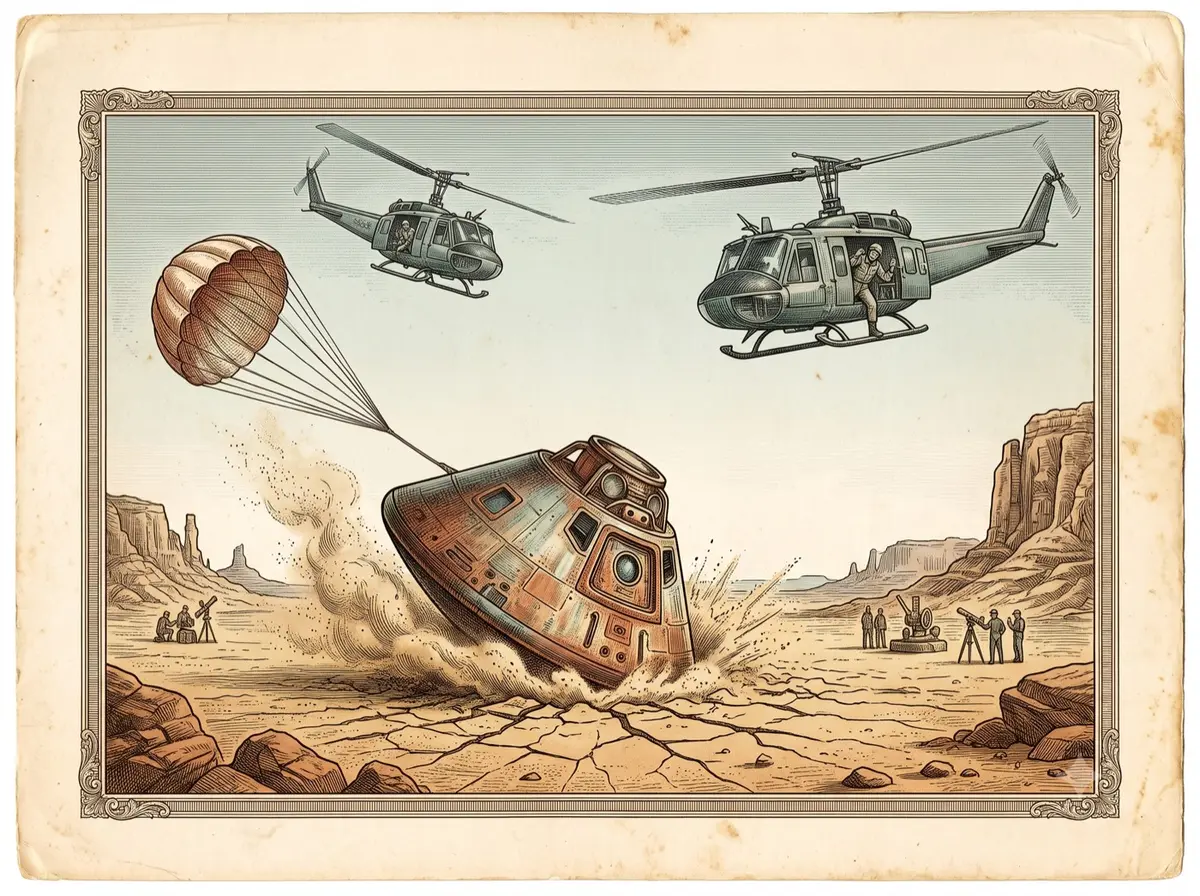
Two helicopters hovered over the Utah desert on the morning of September 8, 2004, their pilots trained for months to snag a falling spacecraft out of the air with a hook on a pole. At 2,700 feet, someone in mission control called out the number everyone was waiting to hear next: parachute. It never came. The capsule tumbled straight down and hit the desert floor at nearly 200 miles an hour, burying itself in the sand in full view of the cameras that were supposed to record its rescue.
By the Curiosities Desk · · 6 min read · Filed under Space · Today’s round
What happened: The Genesis Capsule That Crashed Because a Switch Was Installed Backward
The capsule belonged to Genesis, a NASA mission built by Lockheed Martin to do something no spacecraft had done before: catch pieces of the sun and bring them home. Launched on August 8, 2001, Genesis traveled to a gravitationally stable point in space called L1, about a million miles from Earth toward the sun, where it spent more than two years with its collector arrays open, letting solar wind — the constant stream of charged particles the sun throws off — embed itself in ultra-pure wafers of silicon, gold, sapphire, and diamond-like materials. The goal was to measure the sun’s chemical makeup with a precision no telescope could match, since the sun’s atoms are also, in large part, the raw material the whole solar system formed from.
Genesis closed its collectors in April 2004 and headed home. Because a hard landing risked shattering the delicate wafers, mission planners designed an elaborate recovery: the capsule would reenter the atmosphere, deploy a drogue parachute to slow its fall, then a larger parafoil to glide it gently earthward, where a helicopter crew — rehearsed extensively beforehand — would catch it in midair before it ever touched ground.
None of that happened. As the capsule entered the atmosphere over Oregon and descended toward Dugway Proving Ground in Utah, the parachute deployment sequence simply never triggered. With nothing to slow it but the drag of its own shape, the capsule slammed into the desert at an estimated 193 miles per hour (about 311 km/h). It broke open on impact; the inner sample capsule was breached too. A NASA Mishap Investigation Board later traced the failure to a set of small devices called gravity switches, or accelerometers, that were supposed to sense the deceleration of reentry and fire the parachutes. According to the board’s findings, the internal mechanism of the switch design had been installed backward — not by a technician on the assembly line, but in the original engineering design itself, a mistake that survived every design review before flight.
Why it was strange: The Genesis Capsule That Crashed Because a Switch Was Installed Backward
This was one of the most carefully rehearsed recoveries in NASA’s history — a mid-air helicopter catch practiced again and again specifically because the science depended on a soft landing — undone by a component so small it fits in the palm of a hand, oriented the wrong way on a drawing years earlier. Investigators found that a pre-launch test that likely would have caught the flaw had been skipped. The mission’s own board chair, Michael Ryschkewitsch, admitted plainly that none of NASA’s review procedures had caught it: “It would be very easy to mix this up,” he said. Genesis has since become a textbook case cited alongside the origin story often told about “Murphy’s Law” itself — a mid-20th-century mishap involving an accelerometer wired backward — though in that earlier case, as with much of Murphy’s Law folklore, the precise details are disputed rather than settled fact.
It shares a shelf with The Flake of Chipped Paint That Made a $1.5 Billion Telescope Nearsighted, in The Missions Undone by One Small Thing.
What scientists learned: The Genesis Capsule That Crashed Because a Switch Was Installed Backward
The immediate engineering lesson was sobering: even a mission that succeeds at every other stage can be undone by an assumption nobody double-checked, and formal design reviews are not automatically enough to catch a switch installed the wrong way round. NASA tightened its scrutiny of components that can physically be assembled in more than one orientation, and pushed harder on testing hardware in the exact configuration it will fly in, not a stand-in.
But the more remarkable lesson came from the wreckage itself. Despite the crash, scientists recovered thousands of fragments of the collector wafers, painstakingly sorted by hand with tweezers over years. Genesis samples went on to show that the sun — and by extension the early material of the solar system — has a notably different ratio of oxygen isotopes than the Earth, Moon, and meteorites, evidence that something depleted a particular form of oxygen from the material that built the rocky planets before they ever formed. Genesis data also revealed the sun’s nitrogen isotope ratio to be unlike anything else yet measured in the solar system, information that reshapes models of how our solar system’s raw ingredients were mixed and sorted 4.6 billion years ago.
Also in The Missions Undone by One Small Thing: The Venus Lander That Tested the Hardness of Its Own Lens Cap.
How it reaches us today: The Genesis Capsule That Crashed Because a Switch Was Installed Backward
Genesis’ solar wind samples are still being analyzed today, more than two decades after the crash — cosmochemists continue publishing new findings on solar composition, coronal mass ejections, and space weathering using material recovered from that Utah crash site. The mission’s principal investigator, Caltech’s Don Burnett, has described it as proof that “sample returns are forever”: unlike a single instrument reading beamed back once, a physical sample can be revisited with better tools decades later. The mission ultimately achieved its major science goals by around 2010, years after the crash, and its findings still inform how planetary scientists model the birth of the solar system. On the engineering side, the failure remains a standard case study in aerospace reliability courses on why symmetric parts that can be installed backward eventually will be.
Another from The Missions Undone by One Small Thing: The Most Expensive Hyphen in History Was Not a Hyphen.
Fun fact: The Genesis Capsule That Crashed Because a Switch Was Installed Backward
Genesis’ sibling mission, Stardust, used a similar general parachute-deployment concept and landed successfully in Utah in January 2006 — a reminder that the same basic design, built and checked by a different team at a different time, worked exactly as intended just over a year later.
Sources: The Genesis Capsule That Crashed Because a Switch Was Installed Backward
- NASA Genesis Mishap Investigation Board, Genesis Mishap Investigation Board Report, Volume 1 (PDF), June 13, 2006 — https://www.nasa.gov/pdf/149414main_Genesis_MIB.pdf
- “Genesis (spacecraft),” Wikipedia — https://en.wikipedia.org/wiki/Genesis_(spacecraft)
- Leonard David, “Investigators Find Preliminary Cause of Genesis Crash,” Space.com, October 2004 — https://www.space.com/442-investigators-find-preliminary-genesis-crash.html
- Leonard David, “20 years after crashing in the Utah desert, NASA’s Genesis mission is still teaching us about solar wind,” Space.com, January 19, 2025 — https://www.space.com/the-universe/20-years-after-crashing-in-the-utah-desert-nasas-genesis-mission-is-still-teaching-us-about-solar-wind
- NASA Science, “Genesis” mission overview — https://science.nasa.gov/mission/genesis/
Related stories: The Genesis Capsule That Crashed Because a Switch Was Installed Backward
- Part of The Missions Undone by One Small Thing
- The Unit Mix-Up That Doomed a Mars Probe — Pounds and newtons, and a $150 million probe lost at Mars
- The Venus Lander That Tested the Hardness of Its Own Lens Cap — A Venus lander dropped its lens cap exactly where its instrument landed
- The Rocket That Exploded on Live TV and Got Called ‘Kaputnik’ — A rocket that exploded on live television and earned a nickname