The Docking Target That Showed Up in Orbit Looking Like an Angry Alligator
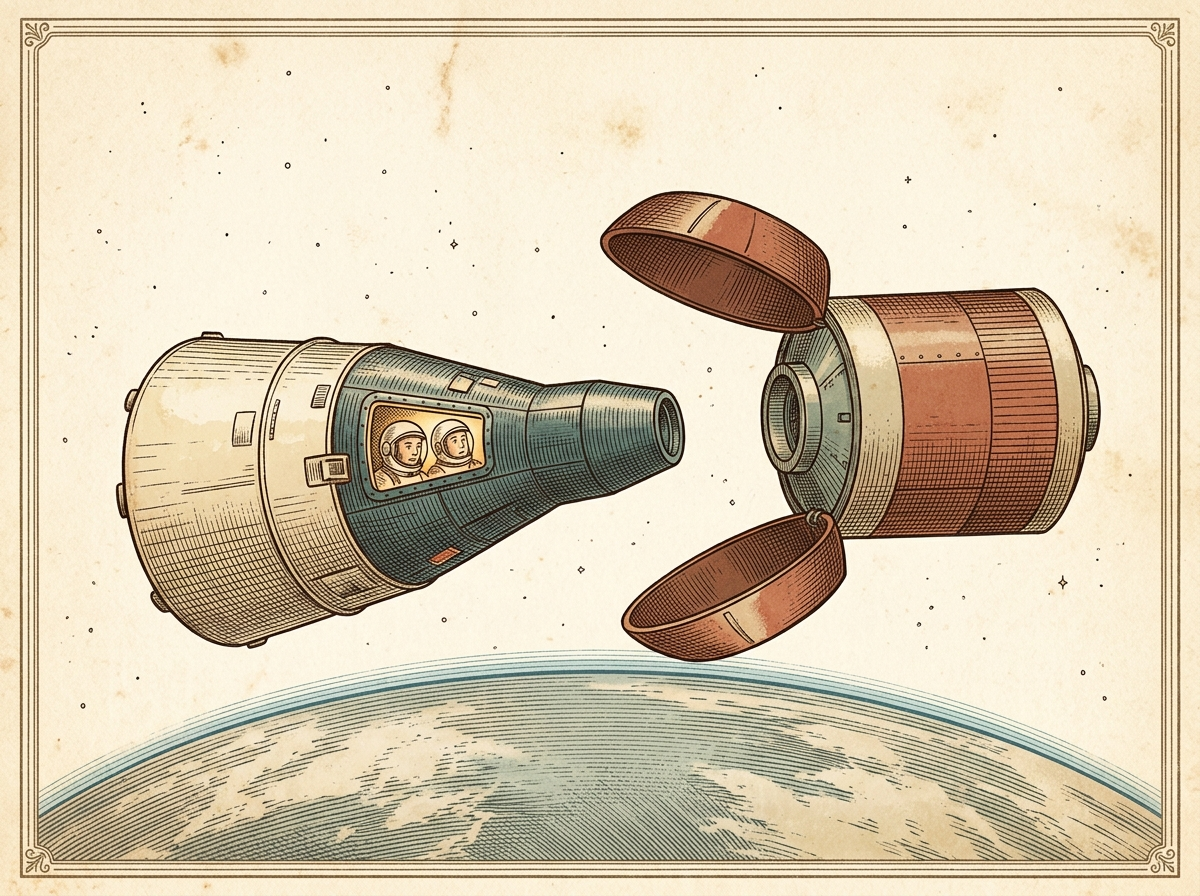
On June 3, 1966, Gemini IX-A astronaut Tom Stafford flew his spacecraft to within a few feet of the target he had come to dock with — and found it gaping at him. Its nose cover had split open but never let go, leaving two halves hanging off the front like jaws. "It looks like an angry alligator out here rotating around," he radioed. The alligator, it turned out, had been tied shut by a little tape.
By the Curiosities Desk · · 5 min read · Filed under Space · Today’s round
What happened?
Project Gemini was NASA’s bridge between Mercury and Apollo. Before anyone could go to the Moon, astronauts had to prove they could find another spacecraft in orbit, pull up alongside it, and latch on — the same moves a lunar module would someday need to make on its way home. Gemini IX was supposed to practice exactly that, by docking with an uncrewed target rocket called an Agena.
The mission had already had a hard spring. Its original crew, Elliot See and Charles Bassett, were killed when their T-38 jet crashed in St. Louis on February 28, 1966. Their backups, Stafford and Gene Cernan, moved up to the prime crew less than three months before launch. Then, on May 17, the Atlas rocket carrying their Agena malfunctioned, and the target ended up in the Atlantic Ocean instead of orbit.
NASA had a plan B. McDonnell, the company that built Gemini, had prepared a simpler backup target: the Augmented Target Docking Adapter, or ATDA. It had a docking collar like the Agena’s but no engine of its own, so it could be flown to and docked with but couldn’t take the astronauts anywhere. The crew reportedly nicknamed the plain-looking stand-in “the Blob.” The ATDA launched on June 1 and reached an orbit about 161 miles up. Almost immediately, telemetry — data radioed down from the spacecraft — hinted that its protective nose shroud had not come off. Gemini’s own launch that day was scrubbed with three minutes to go when ground computers lost contact with the spacecraft, and the crew finally lifted off on June 3.
Stafford and Cernan spotted the ATDA about three hours and 20 minutes into the flight. As they closed in, the trouble came into focus. The shroud, a two-piece cover meant to protect the docking collar during launch, had split down the middle but stayed attached at its base. The halves hung open in front of the docking collar, exactly where the Gemini’s nose needed to go.
Stafford suggested easing forward and nudging the jaws apart with the spacecraft. Flight director Gene Kranz said no: too much risk of damaging Gemini. Buzz Aldrin, on the backup crew, proposed that Cernan spacewalk over and snip the stubborn straps with surgical scissors. Ground tests showed the cut was possible, but also that the target had sharp edges and that the metal bands under tension could snap back and tear a spacesuit. That idea was shelved too.
The cause emerged later, and it was very ordinary. The shroud’s explosive bolts had actually fired. But a pair of lanyards, cords meant to pull loose the electrical connectors when the shroud separated, had never been hooked up. According to accounts of the investigation, the Douglas engineer who normally handled that step had to leave to be with his pregnant wife. The technicians who installed the shroud were working from instructions that pointed to a blueprint they didn’t have. Unsure what to do with the dangling cords, they neatly taped them down. That tidy bit of housekeeping held the alligator’s mouth half-shut for the rest of its life.
Why was it strange?
Space missions are supposed to fail in dramatic ways: a rocket tumbles, a thruster jams, a computer crashes. Here, everything worked. The ATDA reached orbit. The radar found it. Stafford flew a near-perfect rendezvous. The bolts even blew on cue. The whole docking experiment was undone by a few strips of tape applied on the ground with good intentions.
It also showed how a spacecraft is really a handoff between many organizations. The shroud came from Douglas, the target from McDonnell, and the procedures had been passed along from Lockheed’s Agena paperwork. Each step made sense to the people doing it. The gap was in between. It belongs alongside The Weather Satellite That Fell on Its Face Because 24 Bolts Were Missing in The Missions Undone by One Small Thing.
What did scientists learn?
Since docking was off the table, the crew turned the alligator into a training partner. They backed away and flew a second rendezvous approaching from below, steering by eye rather than radar. Then they tried a third approach from above, simulating a lunar module climbing back to its mother ship. That one taught NASA something useful: flying by eye alone wasn’t enough, and the rendezvous radar would be essential for Apollo.
The mission’s other experiment was even more sobering. On June 5, Cernan stepped outside for what was meant to be a long spacewalk, including a test of the Astronaut Maneuvering Unit, a backpack with its own thrusters. Instead, his pressurized suit was so stiff he could barely bend, there were too few places to hold on, and he tumbled at the end of his tether. His heart rate topped 180 beats per minute and his visor fogged until he was nearly blind. After a little over two hours, he called it off and worked his way back to the hatch largely by feel. Spacewalking, NASA learned, was far harder than it looked on paper. For another lesson learned the hard way above Earth, see The Genesis Capsule That Crashed Because a Switch Was Installed Backward.
How does it affect us today?
Both lessons fed straight into Apollo and beyond. The optical-rendezvous trials helped settle how crews would find each other near the Moon. Cernan’s ordeal pushed NASA to add handholds and foot restraints and to rehearse spacewalks underwater, where neutral buoyancy, in which a body neither sinks nor floats, mimics weightlessness. By Gemini XII that November, Buzz Aldrin completed his spacewalks using those aids, and underwater training remains standard for astronauts today. The taped lanyards, meanwhile, became a classic example of why every handoff between teams needs a clear, checked procedure. It’s a cousin of The Unit Mix-Up That Doomed a Mars Probe.
Fun fact
Gemini IX-A’s splashdown on June 6, 1966, landed close to the recovery ship USS Wasp — and NASA says it was the first time a spacecraft’s parachute descent was shown on live television.
Sources
- John Uri, “Gemini IX and the Angry Alligator,” NASA History, 2021 — https://www.nasa.gov/history/gemini-ix-and-the-angry-alligator/
- Bob Granath, “Gemini IX Crew Found ‘Angry Alligator’ in Earth Orbit,” NASA, 2016 — https://www.nasa.gov/missions/gemini/gemini-ix/gemini-ix-crew-found-angry-alligator-in-earth-orbit
- NASA, Gemini IX mission page — https://www.nasa.gov/mission/gemini-ix
- “‘Like an Angry Alligator’: 50 Years Since the Challenging Mission of Gemini IX (Part 1),” AmericaSpace, 2016 — https://www.americaspace.com/2016/06/04/like-an-angry-alligator-50-years-since-the-challenging-mission-of-gemini-ix-part-1
- Barton C. Hacker and James M. Grimwood, On the Shoulders of Titans: A History of Project Gemini (NASA SP-4203), 1977 — https://american-spacecraft.org/documents/sp-4203/index.html
Related stories
- Part of The Missions Undone by One Small Thing
- The Weather Satellite That Fell on Its Face Because 24 Bolts Were Missing — Two dozen missing bolts toppled a satellite on the factory floor
- The Genesis Capsule That Crashed Because a Switch Was Installed Backward — A switch installed backward drove a capsule into the Utah desert
This story touches on the loss of astronauts Elliot See and Charles Bassett. If you’re grieving someone yourself, talking it through with people you trust — or a counselor — can help.