The Weather Satellite That Fell on Its Face Because 24 Bolts Were Missing
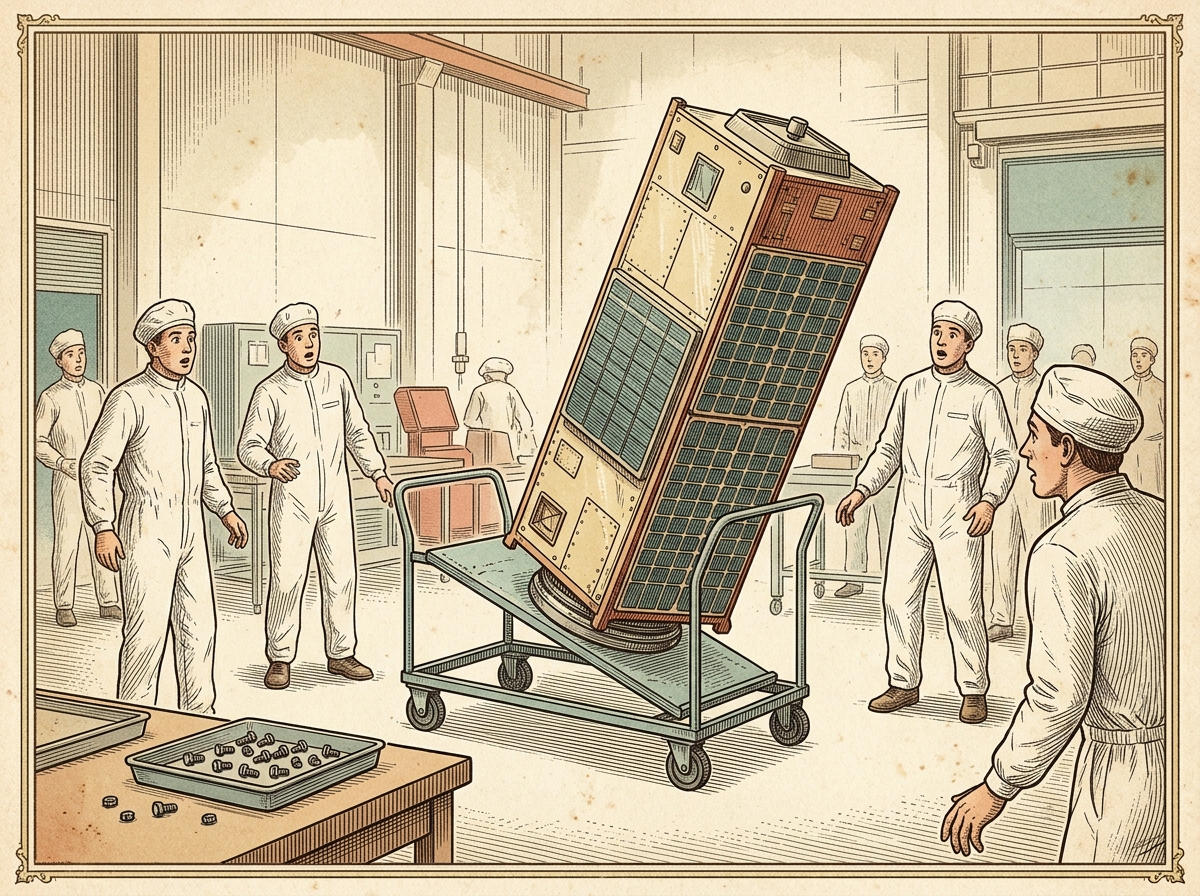
On the morning of Saturday, September 6, 2003, a team in a California clean room began gently tilting a 3,130-pound weather satellite onto its side. At 13 degrees, it kept going. NOAA-N Prime slid off its cart and crashed onto the factory floor — no rocket, no launch pad, no outer space required. It had been undone by two dozen bolts that were somewhere else entirely.
By the Curiosities Desk · · 5 min read · Filed under Space · Today’s round
What happened?
NOAA-N Prime was the last of a long family of polar-orbiting weather satellites known as TIROS, a lineage that had been watching Earth’s clouds since 1960. In 2003 it was nearly finished and sitting in a high bay — a tall, ultra-clean assembly hall — at Lockheed Martin Space Systems in Sunnyvale, California. That Saturday, a crew needed to rotate it from standing upright to lying horizontally, a routine move done with a piece of equipment called a turnover cart.
The crew arrived shortly after 6 a.m. Just before 7, they lifted the spacecraft onto the cart and bolted it to an adapter plate on top. They spun it 180 degrees around its vertical axis. Then, at about 7:16, they began tipping it toward horizontal. Twelve minutes later, at roughly 13 degrees of tilt, the satellite slipped off and fell about three feet to the floor, landing hard and tipping over. Nobody was hurt. The satellite was not so lucky.
NASA convened a Mishap Investigation Board three days later, and its final report reads like a slow-motion chain of small, ordinary decisions. The turnover cart was shared with another program in the same building, the Defense Meteorological Satellite Program, or DMSP, which builds military weather satellites. On August 27, the DMSP team had started converting the cart for its own spacecraft. They removed the 24 bolts that held NOAA-N Prime’s adapter plate to the cart, then stopped partway through the job. The plate stayed in place, looking perfectly normal, held down by nothing at all. No tag or note marked the change.
The NOAA team’s procedure required an engineer to physically inspect the cart before use. According to the board, he instead checked paperwork from an earlier operation. A lead technician and a quality inspector stamped the step as complete without seeing the cart either, which the board found had become routine. At one point, a technician supervisor mentioned that there were empty bolt holes; the report says the comment was dismissed and not followed up. Afterward, crew members recalled thinking it was “just another routine operation” — and one said it had been the smoothest the operation had ever gone, a remark the board later flagged as a missed warning sign. A loose plate, it turns out, makes a very smooth ride.
Why was it strange?
Spacecraft are built to survive extraordinary violence: the shaking of launch, the vacuum of space, wild swings between scorching sun and deep cold. The danger everyone plans for is up there. NOAA-N Prime was badly damaged by the most earthbound force there is — gravity, three feet of it — inside one of the most controlled rooms on the planet.
And no single person simply “forgot the bolts.” The bolts were removed by one team for a sensible reason, the check was skipped by another team for a familiar reason, and the warning was waved off because everything felt normal. Each step was small. Together they dropped a satellite. It’s the same family of failure as The Flake of Chipped Paint That Made a $1.5 Billion Telescope Nearsighted, in The Missions Undone by One Small Thing.
What did scientists learn?
The board identified a “proximate cause” — the direct, physical trigger — as the unbolted adapter plate. But most of its report was about the layers underneath. It found complacency, rushed planning, a crew smaller than the procedure required, vaguely worded instructions, and poor communication between two programs sharing one piece of equipment. Safety staff had not been notified at all. A NASA quality representative had approved the move by phone and arrived after the fall; he hadn’t known that a “Mandatory Inspection Point” required him to be present for any spacecraft movement. Government oversight, the board concluded, had also failed to catch problems it had already flagged.
The lesson engineers took away is that paperwork describes the world; it is not the world. A signature that says “verified” is only as good as the eyes that actually looked. Another case of hardware betrayed by a tiny detail: The Genesis Capsule That Crashed Because a Switch Was Installed Backward.
How does it affect us today?
The rebuild was enormous. Engineers replaced about 75 percent of the satellite’s components with new or spare hardware, recertifying the structure and other parts through vibration and thermal testing. By 2009, the repairs had cost NOAA more than $217 million, though much of that money had already been set aside to store the satellite until it was needed. Lockheed Martin gave up part of its profit on the program.
Then came the happy ending. Renamed NOAA-19 once in orbit, the satellite launched from Vandenberg Air Force Base on February 6, 2009. Satellites in its series were designed to last about five years. NOAA-19 kept feeding weather and climate data to forecasters until NOAA decommissioned it on August 13, 2025 — more than 16 years after launch. Today, the accident is a standard case study in aerospace safety training, a reminder that “routine” is often when the risk hides. For a mission that small details did not let off so lightly, see The Most Expensive Hyphen in History Was Not a Hyphen.
Fun fact
The satellite that once couldn’t stay upright on a cart for 13 degrees of tilt went on to circle Earth for more than 16 years — roughly three times as long as its series was designed to last.
Sources
- NASA, NOAA N-PRIME Mishap Investigation Final Report, 2004 — https://www.nasa.gov/wp-content/uploads/2015/01/65776main_noaa_np_mishap.pdf
- Spaceflight Now, summary of the NOAA N-Prime mishap investigation report, Oct. 4, 2004 — https://spaceflightnow.com/news/n0410/04noaanreport/
- Stephen Clark, “Back from the Brink: Broken Satellite Fixed and Ready to Fly,” Space.com, Feb. 2, 2009 — https://www.space.com/6081-brink-broken-satellite-fixed-ready-fly.html
- NOAA NESDIS, “Legacy Orbit: NOAA Decommissions the POES Satellite Constellation,” 2025 — https://www.nesdis.noaa.gov/news/legacy-orbit-noaa-decommissions-the-poes-satellite-constellation
Related stories
- Part of The Missions Undone by One Small Thing
- The Unit Mix-Up That Doomed a Mars Probe — Pounds versus newtons sent an orbiter too deep into Mars’s atmosphere
- The Genesis Capsule That Crashed Because a Switch Was Installed Backward — A switch installed backward drove a capsule into the Utah desert