The Most Expensive Hyphen in History Was Not a Hyphen
Four minutes and fifty-four seconds into America's first attempt to reach another planet, a range safety officer at Cape Canaveral pushed a button and blew up the rocket he had just watched leave the pad. Somewhere in the wreckage falling into the Atlantic was Mariner 1, a 447-pound probe built to fly past Venus. Newspapers would soon report that the whole thing had been lost over a missing hyphen. It wasn't a hyphen. It was a tiny horizontal line drawn *above* a letter — and it wasn't even the only thing that went wrong.
By the Curiosities Desk · · 5 min read · Filed under Space · Today’s round
What happened?
On the morning of July 22, 1962, an Atlas-Agena B rocket lifted off from Launch Complex 12 at Cape Canaveral at 09:21:23 UT. Bolted to the nose was Mariner 1, built by NASA’s Jet Propulsion Laboratory in an eleven-month crash program. The original plan had been a heavier probe riding the Centaur upper stage, but Centaur wasn’t going to be ready, so JPL hybridized its Venus spacecraft with its existing Ranger Moon probe and called the result “Mariner R.” Three were built: two to fly, one to test. Mariner 1 was the first up.
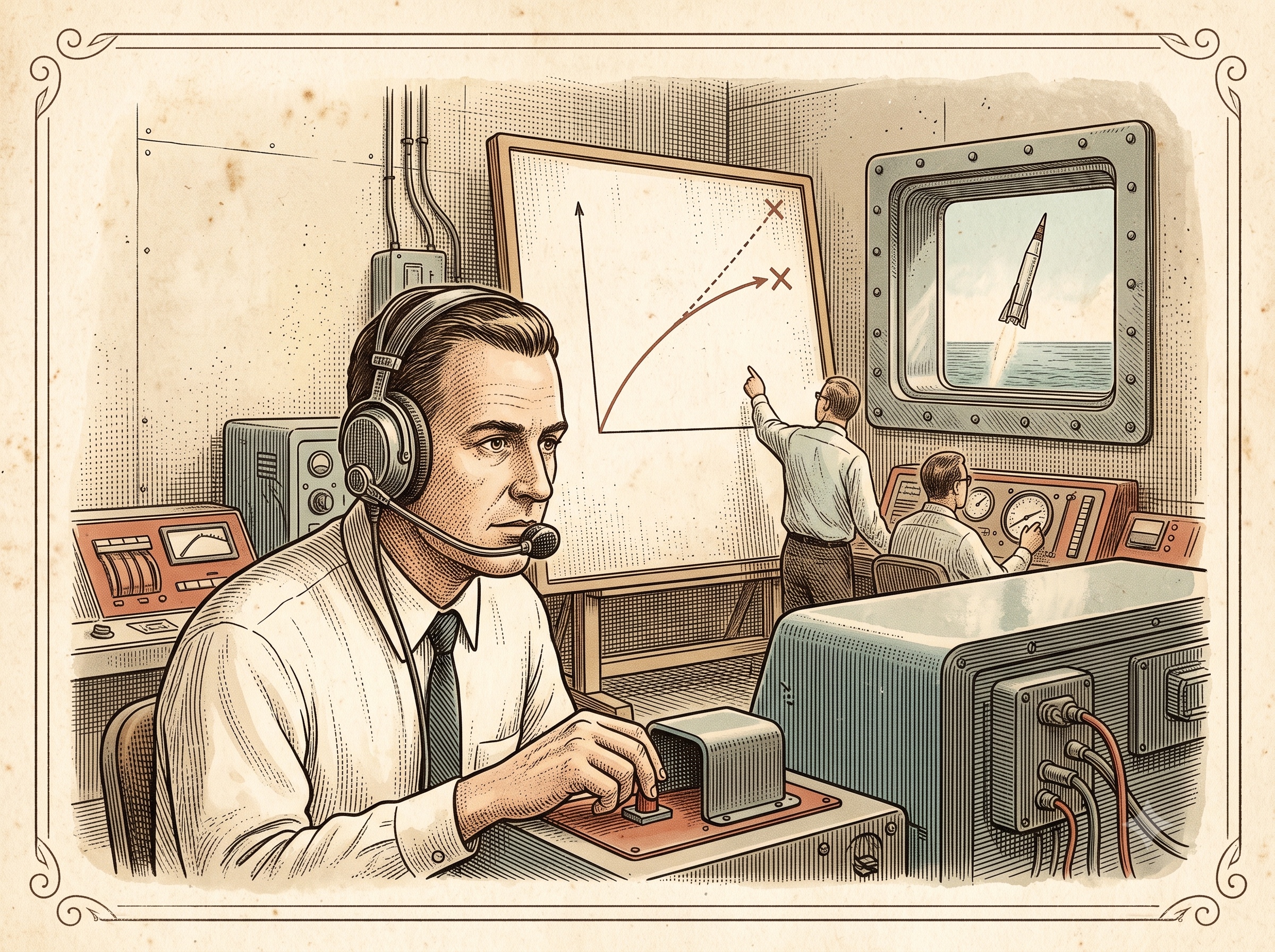
The launch went cleanly through booster separation. Then the rocket began to fishtail, swinging left and right, its trajectory drifting down and to the left toward busy Atlantic shipping lanes. At T+294.5 seconds — six seconds before the Agena second stage was due to separate, after which destruction would no longer be possible — the range safety officer sent the destruct command. Telemetry from the probe kept arriving for another minute and a half.
Atlas rockets in this era did not steer themselves. A ground-based Burroughs computer tracked the vehicle using a beacon aboard the Atlas and radioed steering corrections up to it. Losing that lock briefly was ordinary; the rocket was designed to coast on a preprogrammed course until the ground reacquired it.
Two things went wrong at once. First, hardware: NASA’s own mission summary traces the failure to a guidance antenna on the Atlas, which meant the ground computer kept losing clean velocity data. Second, software. The guidance equations had been written out by hand and then transcribed into the computer program, and in that transcription a single symbol was dropped — an overbar, the small line drawn above a letter to mean “the smoothed, averaged value of this quantity.” Without it, the program used the raw, jittery, moment-to-moment radius data instead of the averaged version. When lock was reestablished, the computer read normal noise as wild velocity swings and issued violent corrections. The rocket, being obedient, executed them.
The same flawed logic had already flown on Ranger launches without incident — because on those flights the beacon had behaved, and the bug never got the chance to matter.
Five days after the launch, JPL engineers had the answer. On July 27, the front page of The New York Times carried the headline “For Want of Hyphen, Venus Rocket Is Lost.” The phrase stuck. Arthur C. Clarke later called it “the most expensive hyphen in history,” and the story has been repeated that way ever since. NASA’s mission page now states the correction plainly: the omission was an overbar over the symbol R for radius — R instead of R̅ — and “was not a hyphen, as is sometimes erroneously reported.”
The loss is usually put at about $18.5 million in 1962 dollars, close to $200 million today. Thirty-six days later, on August 27, 1962, Mariner 1’s identical twin lifted off from the same pad. Mariner 2 reached Venus on December 14 and became the first spacecraft to return data from the vicinity of another planet.
Why was it strange?
We expect big failures to have big causes: a shattered engine, a structural collapse, a bad weld. Mariner 1’s rocket was working. Its engines burned correctly. Its probe was healthy enough to keep talking after the explosion. What killed it was a proofreading error in a stack of equations — the kind of slip that in almost any other line of work would be caught by whoever read the page next.
And the popular version of the story is stranger still, because the correction is smaller than the myth. The world settled on “hyphen” not because it was accurate but because it was easy to picture. An overbar is harder to explain in a headline than a dash. So a mark of statistical notation got demoted to punctuation, and stayed there for sixty years.
It shares a shelf with The Unit Mix-Up That Doomed a Mars Probe, in The Missions Undone by One Small Thing.
What did scientists learn?
The real lesson wasn’t “check your typing.” It was that a system can be built so that one small mistake cannot escalate into total loss.
Mariner 1 failed because of a coincidence: a marginal piece of hardware plus a latent software flaw that only revealed itself when that hardware misbehaved. Neither alone would have destroyed the mission. That pairing — a dormant bug waiting for the right failure to wake it — became a foundational case study in what would soon be called software engineering, a discipline that barely existed as a named field in 1962. The historian Paul Ceruzzi described the accident as summing up the whole problem of software reliability.
The response was procedural: rigorous pre-launch verification of guidance code, independent checking of hand-derived equations before they were entered, and designs in which a single faulty value could not command a violent response. The Smithsonian’s Time and Navigation exhibit draws the line forward — those corrective habits are part of why Apollo lunar modules kept landing safely despite software problems during descent. The Mod III-G guidance system that had given so much trouble was itself redesigned in 1963.
Also in The Missions Undone by One Small Thing: The Flake of Chipped Paint That Made a $1.5 Billion Telescope Nearsighted.
How does it affect us today?
Every time a spacecraft’s flight software is frozen months before launch, run through independent review, and tested against simulated hardware failures, Mariner 1 is somewhere in that procedure’s ancestry. So is the broader idea that safety-critical code needs bounds on how far it will let a single bad number push a machine — an idea now embedded in aviation, medical devices, and cars.
Mariner 1 also gave engineering culture a permanent cautionary tale, told slightly wrong. That’s worth noticing on its own: the version that spreads is the one that fits in a headline, not the one that fits the evidence.
The same thread — Venus — continues in The Venus Lander That Tested the Hardness of Its Own Lens Cap.
Fun fact
Mariner program director Jack James believed the destruct command hadn’t been necessary at all. In his judgment, the wandering rocket would not have come down anywhere but the middle of the ocean — meaning the most famous rocket destruction in NASA’s early history may have been a precaution taken against a danger that never existed.
Sources
- NASA Science, “Mariner 1” — official mission summary, including the T+294.5-second destruct time and the explicit correction that the missing character was an overbar, not a hyphen.
- NASA/JPL, Mariner-Venus 1962: Final Project Report (NASA SP-59, 1965) — the primary project report, covering the launch sequence, the range safety decision, and Jack James’s assessment of it (p. 87).
- Smithsonian, Time and Navigation, “Mariner 1 Destroyed” — museum account of the failure and its influence on software verification through Apollo.
- Paul E. Ceruzzi, Beyond the Limits: Flight Enters the Computer Age (MIT Press, 1989), p. 202 — the standard technical account of the combined hardware-and-logic failure.
- “Equation Error Cited in Mariner 1 Failure,” Aviation Week & Space Technology, August 6, 1962, p. 29 — contemporary trade-press reporting two weeks after the loss.