The Woodpeckers That Grounded a Space Shuttle — and the Plastic Owls NASA Sent to Guard It
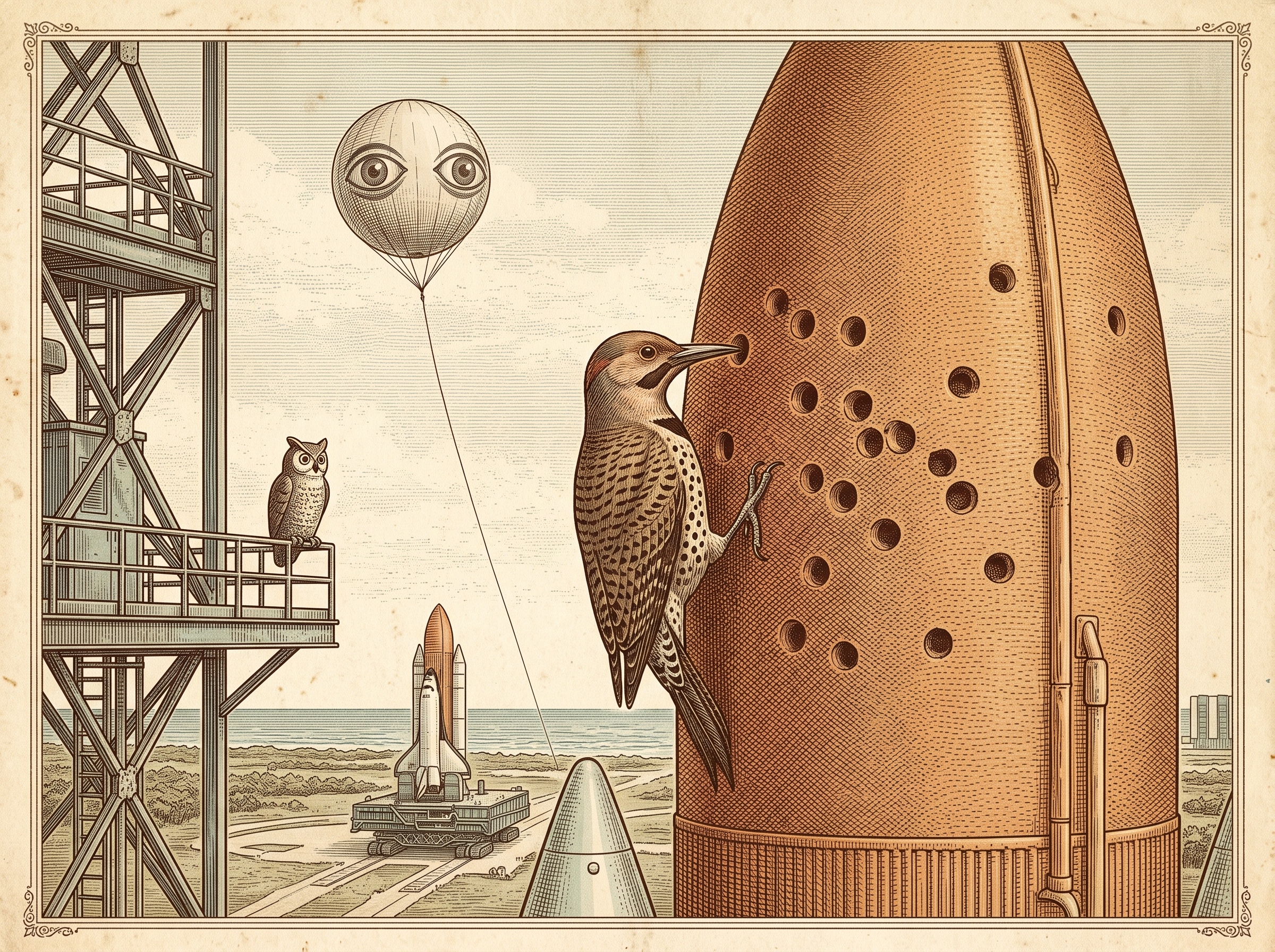
In late May 1995, the Space Shuttle Discovery stood on Launch Pad 39B at Kennedy Space Center, fueled with a decade of engineering and about two weeks from launch. Then technicians climbed the tower and found holes. Dozens of them, round and neat, some as wide as a coffee mug, drilled into the orange foam of the shuttle's giant fuel tank. The culprit was not a tool, a crack, or a saboteur. It was a woodpecker, and it had apparently decided that the most advanced flying machine on Earth was a very promising tree.
By the Curiosities Desk · · 5 min read · Filed under Space · Today’s round
What happened?
The mission was STS-70, and it had a tidy job: carry a Tracking and Data Relay Satellite (a communications relay that lets spacecraft talk to the ground) into orbit. Discovery rolled out to Pad 39B on May 11, 1995, with launch set for June 8. Its crew, Commander Tom Henricks, Pilot Kevin Kregel, and Mission Specialists Don Thomas, Nancy Currie, and Mary Ellen Weber, were finishing their last simulator sessions in Houston.
Kennedy Space Center sits inside the Merritt Island National Wildlife Refuge, one of the richest bird habitats in Florida. Among its residents is the Northern Flicker, a brown, spotted woodpecker about a foot long. Over the long Memorial Day weekend, with fewer people on the pad, at least one flicker (news reports at the time said a pair) went to work on the external tank, the tall orange cylinder that feeds fuel to the shuttle’s main engines.
When managers assessed the damage on May 31, they counted about 71 holes in the tank’s foam insulation, ranging from half an inch to four inches across. Some went all the way through to the tank’s metal skin. As inspectors looked more closely, the tally kept climbing: the Orlando Sentinel reported 135 holes a few days later, and NASA’s official mission summary now puts it at about 200, counting “single pecks and claw marks.” Don Thomas later recalled 205.
Technicians tried patching the tank on the pad. It didn’t work well enough. On June 2, NASA delayed the launch, and on June 8, the day Discovery was supposed to fly, the whole shuttle stack instead crawled back to the Vehicle Assembly Building for repairs. Thomas said that when an instructor told him a woodpecker had scrubbed his mission, he assumed it was a prank until his commander confirmed it.
NASA then faced an unusual engineering problem. The Northern Flicker is protected under federal migratory bird law, so harming the birds was off the table. Test director Steve Altemus, who told reporters he had never seen a flicker before, suddenly found himself fielding calls from the public offering advice: pepper spray, bitter apple spray, bright lights, ultrasonic blasters. One helpful suggestion was to paint the tank blue.
What NASA actually deployed sounds like a backyard garden defense scaled up to rocket size. According to Altemus, the pad got six plastic owls, rotated every 48 hours so the birds wouldn’t get used to them, plus recorded owl sounds, 10 security cameras, and human lookouts stationed 255 feet up the tower with air horns. Yellow “Predator Eye” balloons, printed with giant staring eyes, bobbed around the launch complex. In an interview for Kennedy’s Rocket Ranch podcast, employee Sandi Lee Morgan recalled being asked to stand on the pad over a weekend and blow an air horn at any woodpecker that approached. The volunteers later got pale blue T-shirts with a slightly cheeky name for their squad.
It worked. Discovery launched on July 13, 1995, and the mission went smoothly. The crew had hoped to be remembered as the first all-Ohio shuttle crew (Kregel, a New Yorker, received honorary Ohio citizenship to make it official). Instead, the space community mostly remembers them as the Woodpecker Crew.
Why was it strange?
We tend to imagine spaceflight risks as dramatic: engine failures, bad weather, cosmic radiation. Nobody’s risk model for a machine that could survive re-entry at thousands of miles an hour included “a bird mistakes it for a dead palm tree.”
But from the flicker’s point of view, the choice made sense. Flickers usually carve their nests in dead or rotting trees, where the wood is soft enough to dig. The tank’s spray-on foam was soft, tall, and standing in a wildlife refuge during nesting season. Every time the bird pecked through the foam, though, it hit hard aluminum where it expected rotten wood, so it moved over and tried again. The result was a spacecraft pocked like a golf ball, courtesy of a bird that eats mostly ants.
The same thread — Space Shuttle — continues in The Senator Who Went to Space and Came Back as a Unit of Nausea.
What did scientists learn?
The foam wasn’t decoration. The external tank held liquid hydrogen at about −423°F and liquid oxygen at about −297°F. The insulation kept those propellants cold and stopped ice from building up on the outside of the tank in Florida’s humid air. A hole in the foam is a spot where ice can form or where chunks of insulation can break loose during the violent ride to orbit, and debris hitting the shuttle at high speed is a serious hazard.
The episode also taught NASA that wildlife management was part of launch safety. The agency formed a group with a suitably on-the-nose acronym: the Bird Investigation Review and Deterrent team, or BIRD. Its plan had three parts: remove dead trees, old poles, and palms near the pads where flickers might want to nest; keep scaring birds off with owls, water sprays, and eye balloons; and keep people watching for birds around the clock. As far as the public record shows, woodpeckers never delayed another shuttle launch.
Another good intention with a bad landing: The Space Tomato That Vanished for Nearly a Year — and the Astronaut Accused of Eating It.
How does it affect us today?
Launch sites still share their land with wildlife, and managing that relationship is now routine work. Kennedy Space Center remains inside a wildlife refuge, and teams there watch for birds, alligators, and other neighbors that could interfere with launches or be harmed by them.
The woodpecker story also became an early, lighthearted chapter in a much more serious lesson about foam. In 2003, a piece of foam insulation broke off Columbia’s external tank during launch and struck the shuttle’s left wing, leading to the loss of the orbiter and its seven-person crew during re-entry. The two events had different causes, but both showed that the insulation on the outside of a rocket matters as much as the machinery inside it.
Another time it went sideways: The Time a Falling Space Station Got a $400 Littering Ticket.
Fun fact
When the extended delay reshuffled the schedule, Atlantis flew its mission to the Russian space station Mir first. STS-70 then launched just six days after Atlantis landed, which at the time was the quickest turnaround between shuttle missions in the program’s history.
Sources
- NASA — STS-70 mission page and launch highlights
- AmericaSpace — “Woodpecker Attack: Remembering STS-70, 25 Years On”
- The Spokesman-Review (via Orlando Sentinel), June 4, 1995 — “NASA Gets Lots of Advice on Shooing Woodpeckers”
- NPR, Robert Krulwich — “Eleven Inch Earthlings Attack Space Shuttle!”
- Cornell Lab of Ornithology — Northern Flicker Life History