The Senator Who Went to Space and Came Back as a Unit of Nausea
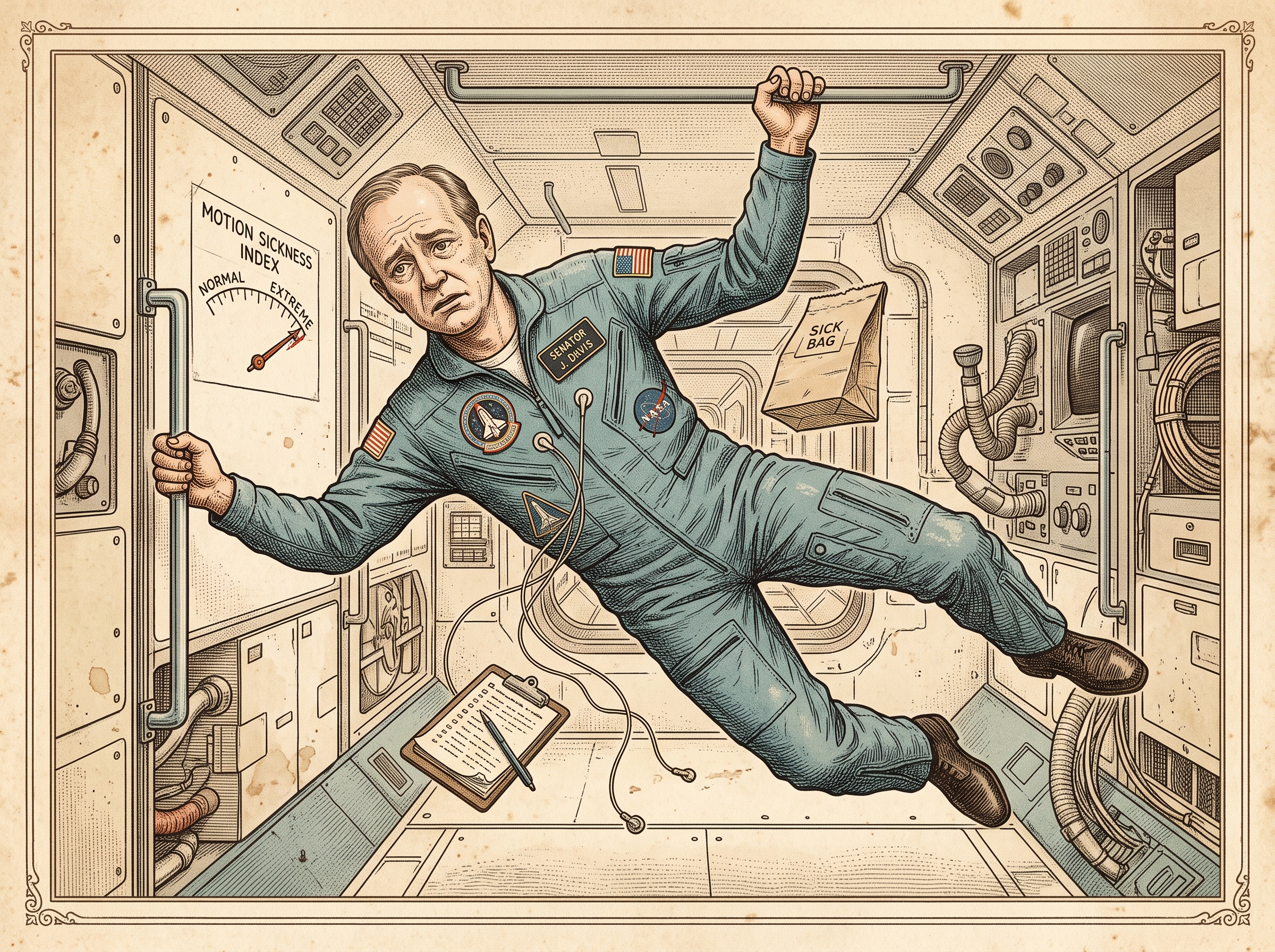
April 1985. A 52-year-old United States senator is floating on the middeck of the shuttle *Discovery*, feeling worse than he has ever felt in his life. He is no tourist — he is a retired Air National Guard colonel with more than 10,000 hours of flight time, a man who has spent decades not getting airsick. None of it is helping. And down in Houston, the astronaut corps is quietly inventing a new unit of measurement, named after him.
By the Curiosities Desk · · 5 min read · Filed under Space · Today’s round
What happened?
Jake Garn was the Republican senator from Utah, first elected in 1974, and — crucially — chairman of the Senate Appropriations subcommittee that handled NASA’s budget. He was also a pilot: U.S. Navy, then the Utah Air National Guard, from which he retired as a full colonel in 1979 with over 10,000 hours in the air.
By the account of his former chief of staff Jeff Bingham, Garn opened a meeting with NASA officials by asking, “When do I go?” It sounded like a joke. It didn’t stay one. NASA’s deputy administrator Hans Mark made the case for it plainly: “The whole purpose of the Space Shuttle is to have routine access to space. What better way to demonstrate that than to fly a member of Congress?”
So Garn flew. He launched as a payload specialist aboard Discovery on STS-51-D on April 12, 1985 — fifty-five minutes late, because a boat had strayed into the booster recovery zone. Over the next week the crew deployed two communications satellites and improvised a “flyswatter” out of spare parts for an unscheduled spacewalk. Garn came home on April 19 having logged 167 hours and 108 orbits as the first sitting member of Congress to fly in space.
His actual assignment was to be a test subject. NASA wanted data on space adaptation syndrome — the constellation of misery that hits most people in their first days off the planet — and Garn volunteered to be the instrumented body they measured it in.
He got extremely sick. Not queasy-for-an-afternoon sick; days of it. And back on the ground, the crew office turned his suffering into a joke, and then the joke hardened into a number.
Bob Stevenson, an oceanographer who taught astronauts at Johnson Space Center, explained the arithmetic in a 1999 NASA oral history interview. Garn, he said, “represents the maximum level of space sickness that anyone can ever attain, and so the mark of being totally sick and incompetent is one garn.” He added, cheerfully, “Most guys will get maybe to a tenth [of a] garn, if that high.”
The unit stuck. So did the ribbing — Doonesbury ran him as “Barfin’ Jake Garn.” Which brings up the part of the story that is legend rather than fact: you will often read that Garn scored a 13 on his own scale. He has spent forty years politely disputing it. “Well, I think that’s an exaggeration,” he laughed in a 2005 interview, “because, to be very candid about it, I did not throw up.” Even in training aboard the parabolic-flight aircraft nicknamed the Vomit Comet, he waved his unused sick bag at the cameras: “See, I never used it.”
He has been a remarkably good sport about all of it. “I’ve been very proud of the fact that they named something after me,” he said, “even if it was unofficial.” And: “Believe me, I’d throw up every day just to go into space again.”
Why was it strange?
The obvious expectation the story breaks is that a 10,000-hour pilot should be immune. He wasn’t — because space sickness isn’t airsickness with the volume turned up. It’s a different problem with a different cause, and being good at flying airplanes buys you almost nothing.
The stranger thing is the unit itself. NASA is an organization that will argue for months about a decimal place. And yet, for four decades, the shorthand its people reach for when describing how wretched someone feels in orbit has been a senator’s surname — never standardized, never written into a requirements document, never agreed on. Stevenson used it as a scale from 0 to 1. Others have used 1 to 10. Nobody ever fixed it, and it survived anyway.
The same thread — Space Shuttle — continues in The Woodpeckers That Grounded a Space Shuttle — and the Plastic Owls NASA Sent to Guard It.
What did scientists learn?
The leading explanation is sensory conflict. Inside your inner ear sit the semicircular canals, which sense rotation, and the otoliths — small crystal-loaded organs that sense linear acceleration. On Earth the otoliths always feel gravity pulling down, which gives your brain a permanent reference for “which way is down.” In free fall that steady signal vanishes. Your eyes, your inner ear, and the pressure sensors in your skin and joints start reporting different stories, and your brain has no stored pattern that matches. The result is nausea, headache, disorientation, and a strong desire not to move your head.
NASA’s current medical technical brief puts it at up to 73% of crew affected in the first two to three days of an initial flight, with the broader cluster of adaptation symptoms hitting 70–90%.
Garn’s most useful contribution is the thing the joke obscures: he showed up as a willing subject when the data set was thin. And what the data eventually showed is counterintuitive. You cannot predict who will get sick. Car sickness doesn’t predict it. Age and sex show no statistically significant difference. The main pattern is that it’s worse on a first flight. Dosing people before launch turns out not to help much. What does help is treating symptoms once they appear: promethazine, given by injection or suppository, has up to a 90% initial response rate and remains NASA’s treatment of choice.
Another treatment that history kept the receipt for: The Year in Space That Turned Twin Astronauts Into a Living Experiment.
How does it affect us today?
Spaceflight schedules are now built around the assumption that new arrivals will be impaired. Spacewalks aren’t scheduled within 72 hours of launch. Space station crews get protected “adaptation” time carved into flight days one through four, plus a daily private medical conference with a flight surgeon for the first five days. Promethazine flies in the onboard kit in oral, injectable, and suppository form, because vomiting makes swallowing a pill unreliable.
It matters more now than in 1985. Commercial vehicles carry passengers who have never flown anything, and Garn is the standing argument for briefing them honestly: the most experienced flyer aboard can still be the one having the worst week of his life.
The same sensory-conflict framework underlies seasickness, car sickness, and the queasiness some people get in virtual reality. If motion sickness is something you deal with, it’s worth a conversation with a clinician — the drugs that work best in orbit have real side effects at sea level.
Another odd chapter in medicine: The Airstream Trailer That Was Supposed to Save Earth From Moon Germs.
Fun fact
The unit escaped the astronaut corps almost immediately. Within about a month of Garn’s flight, a biochemist studying squirrel monkeys flown on a later shuttle mission told The New York Times the animals had come back “two garns” — pretty sick, but they could have been sicker.
Sources
- Jake Garn (Senator), Payload Specialist — Biographical Data, NASA Lyndon B. Johnson Space Center, May 1985.
- OCHMO-MTB-004: Space Adaptation Sickness (SAS) and Space Readaptation Syndrome, NASA Office of the Chief Health & Medical Officer, Rev A, September 2025.
- Robert E. Stevenson Oral History Transcript, NASA Johnson Space Center Oral History Project, May 13, 1999.
- Stephen Ornes, “It’s all smoots and garns”, Physics World, November 20, 2018.
- John Hollenhorst, “Former Senator Garn Memorialized with ‘Garn Scale’”, KSL-TV, December 19, 2005.