Weird Medical History · Engineering
The Box of Light Bulbs the Corn Flakes Doctor Said Cured a King
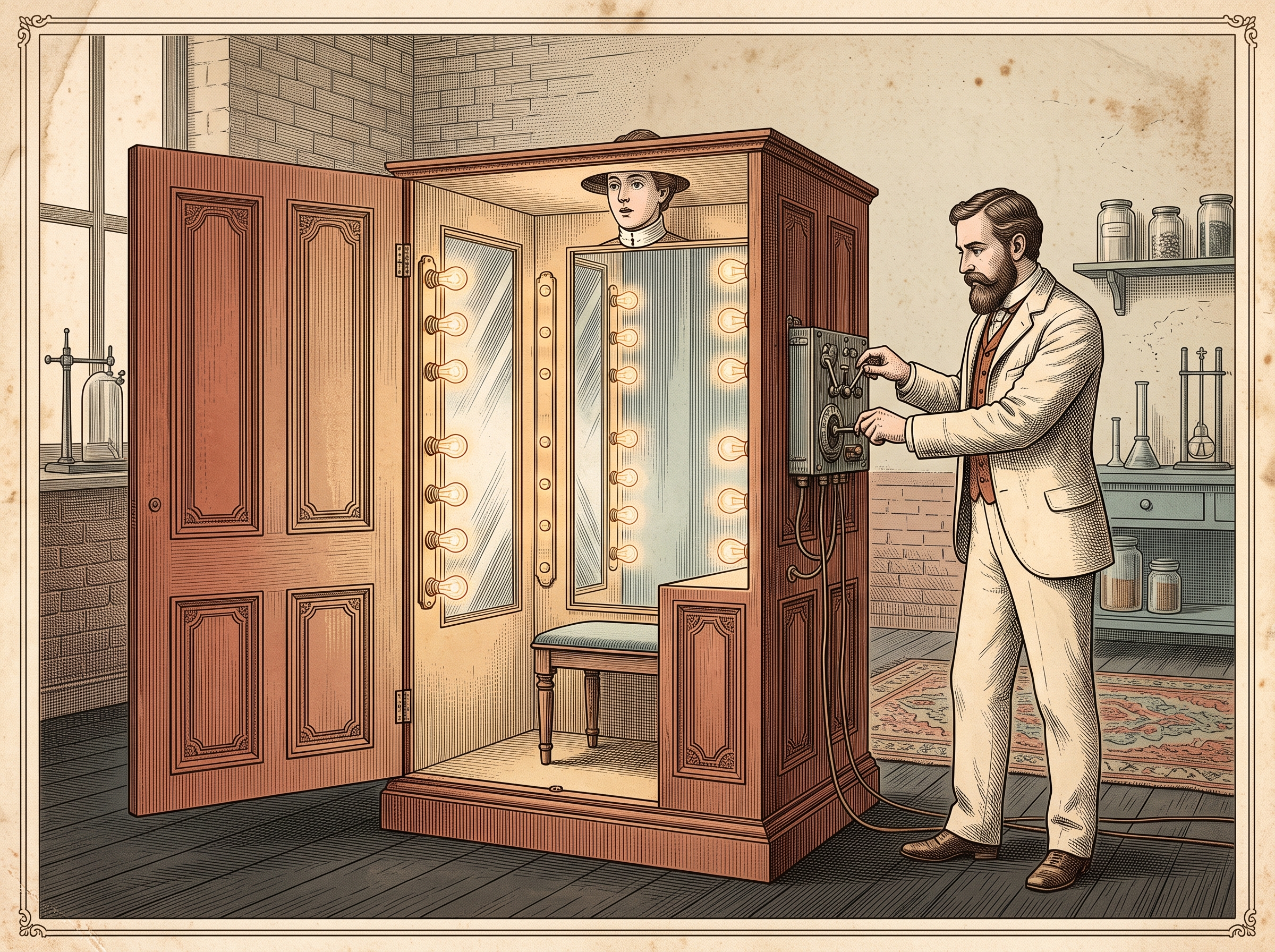
A patient steps into a wooden cabinet about the size of a phone booth. The door closes around their neck, so only their head sticks out of the top. Inside, 48 glowing light bulbs and a set of mirrors bounce heat onto every inch of their body until the sweat runs. The man who designed this box is the same doctor who later gave the world corn flakes. And according to him, the King of England liked his so much he had it installed at Buckingham Palace.
By the Curiosities Desk · · 5 read · Filed under Engineering · Today’s round
What happened?
In 1891, John Harvey Kellogg was running the Battle Creek Sanitarium in Michigan, a giant health resort that was part hospital, part spa, and part grand hotel. Kellogg loved machines. His patients could ride mechanical horses, sit in a chair that shook up to 60 times a second, and choose from dozens of different baths; a 1907 advertisement bragged of 46 kinds.
That year Kellogg built what he called the incandescent electric-light bath. Thomas Edison’s practical light bulb was barely a decade old, and Kellogg saw it as more than a lamp. Bulbs give off visible light, but they also give off a lot of infrared radiation, the invisible “heat rays” just beyond red on the spectrum. There was no practical way at the time to produce infrared on its own, so Kellogg simply surrounded the patient with bulbs.
The upright model, according to his own specifications, was a box 43 inches square and 54 inches tall. Its eight inner walls were lined with mirrors and fitted with 48 lamps in eight rows of six. The patient sat on a stool inside with their head poking out of the top. There was also a horizontal version, in which the patient lay on a little rolling bed that slid into the cabinet like a loaf going into an oven. Each cabinet shipped with 50 spare bulbs.
Kellogg showed the light bath at the 1893 World’s Columbian Exposition in Chicago. A visitor from Germany, whom historians have identified as the chemist Willibald Gebhardt, was impressed enough to travel to Battle Creek and then take the idea home. By 1899 a German company called Sanitas was manufacturing the “Kellogg light bath,” and it kept doing so until World War II. Light-bath institutes opened in cities across Europe.
Then came the royal endorsement. In his 1910 book Light Therapeutics, Kellogg wrote that King Edward VII had been “cured of a distressing gout” with the bath while in Hamburg, and afterward had light baths installed at Windsor Castle and Buckingham Palace. He added that Germany’s Kaiser Wilhelm II had them installed in his palaces too. That is Kellogg’s account, written by the man selling the idea; it has not been independently confirmed in the royal record, so it’s best read as a proud inventor’s claim rather than a settled fact.
The craze even went to sea. When the Olympic and Titanic were described in a 1911 special issue of the trade journal The Shipbuilder, their equipment list included two “electric baths,” placed right next to the ships’ Turkish baths.
Why was it strange?
The light bath sits at a funny crossroads. On one side was genuinely new engineering: electric light was cutting-edge technology, and Kellogg built a well-designed machine around it. On the other side was a big leap in medical promises.
Kellogg believed infrared rays were “not heat in the ordinary sense, but a form of energy” that turned into heat only once it hit body tissue. He claimed the bath improved circulation, flushed out toxins through sweat, and helped with kidney disease, high blood pressure, hardened arteries, diabetes, and more. Light-bath cabinets of the era were also sold as help for rheumatism and even meningitis.
In other words, the same man applied careful measurements to the cabinet and very little measurement to the cures.
Another treatment that history kept the receipt for: The Coffin That Waved a Flag If You Woke Up Buried — and Flunked Its Own Demonstration.
What did scientists learn?
Kellogg was right about one piece of physics. Infrared radiation really does carry energy that is absorbed by the body and felt as warmth, and an incandescent bulb really does put out most of its energy as infrared rather than visible light. A box of mirrors and bulbs is an efficient way to heat a person.
But warming someone up and making them sweat is not the same as curing kidney disease. Sweat is mostly water and salt; your kidneys and liver do almost all of the “detox” work. The Science Museum in London, which holds a light bath in its collection, describes the medical claims made for these cabinets as unfounded.
Meanwhile, real light medicine was emerging. In 1903 the Danish physician Niels Finsen won the Nobel Prize for using concentrated, filtered light to treat lupus vulgaris, a tuberculosis infection of the skin. Kellogg admired Finsen’s work. The lesson that separated the two approaches was testing: specific kinds of light, used for specific conditions, checked for real results.
The same thread — Quack Medicine — continues in The £50-a-Night Electric Bed That Promised Couples a Baby.
How does it affect us today?
Look closely at a modern infrared sauna and you’ll see the ghost of Kellogg’s box: an enclosed cabinet that warms the body with infrared instead of hot air. Historians trace those saunas directly back to his design.
Light therapy that does work is now a regular part of medicine. Hospitals place newborns with jaundice under blue lights, dermatologists treat psoriasis with carefully measured ultraviolet light, and bright-light boxes are used for seasonal affective disorder. Each of those treatments earned its place through clinical trials, the step the light-bath era mostly skipped.
Another odd chapter in medicine: The Airstream Trailer That Was Supposed to Save Earth From Moon Germs.
Fun fact
Kellogg’s light bath predates the breakfast cereal that made his family name famous. He and his brother, Will Keith Kellogg, stumbled onto flaked cereal in the mid-1890s, a few years after the bulb cabinet was already making patients sweat in Battle Creek.
Sources
- Bringing Light to the World: John Harvey Kellogg and Transatlantic Light Therapy — Austin E. Loignon, Journal of Transatlantic Studies (2022)
- Light Therapeutics (John Harvey Kellogg, 1910) — Wellcome Collection
- Electric light bath for light therapy in a seated position, 1890–1920 — Science Museum Group Collection
- The Electrical Equipment: Electric Baths — The Shipbuilder (1911), via Encyclopedia Titanica
- Light Therapy — Mütter Museum Collection Chronicles
If you’re thinking about trying heat or light therapy for a health condition, it’s worth talking it over with a doctor first. Some light treatments are well tested and genuinely helpful, and a professional can point you to the ones that fit.