Weird Medical History · Chemistry
The Dinner Party Where Three Doctors Sniffed Chloroform and Woke Up Under the Table
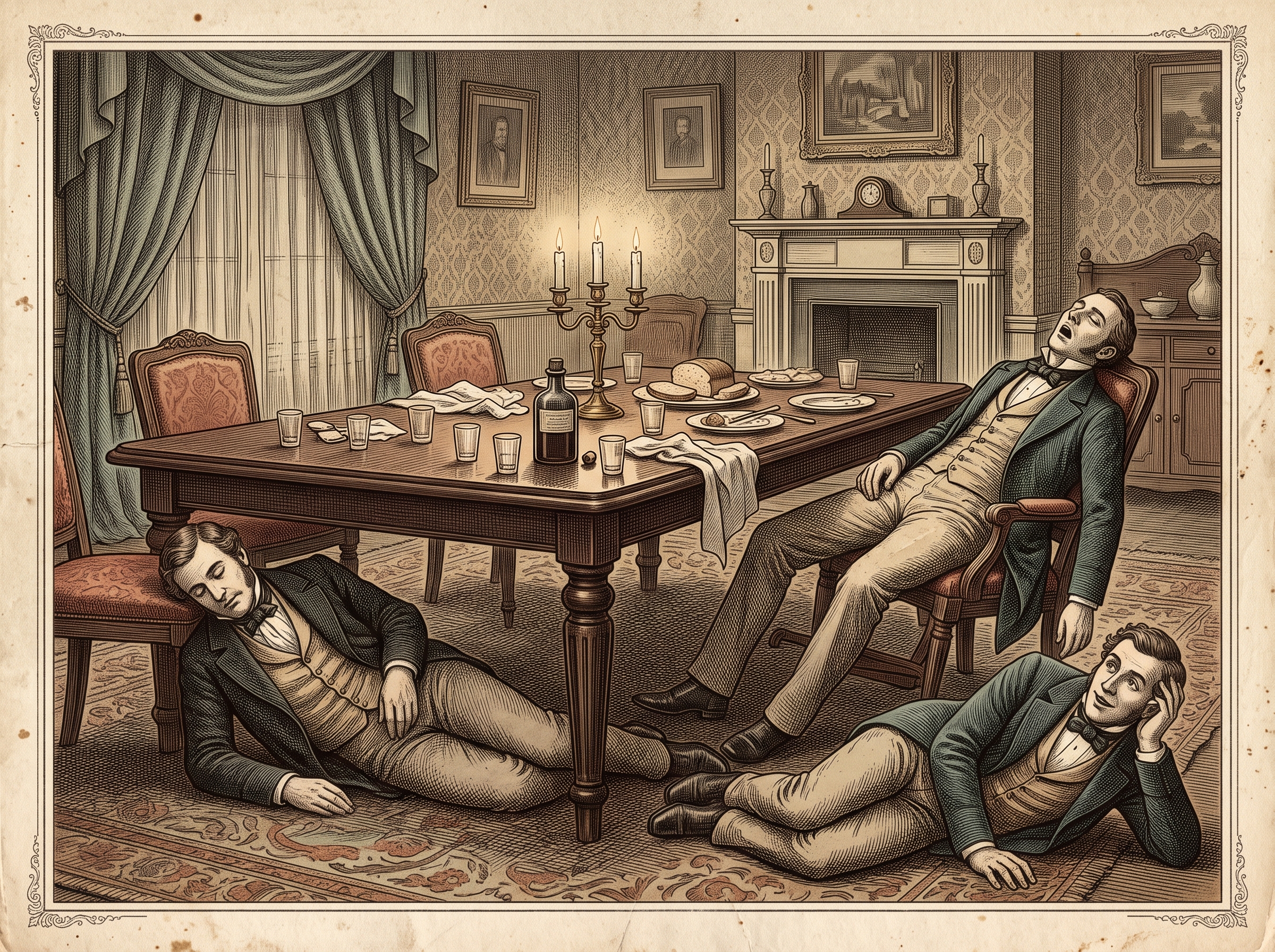
On the evening of November 4, 1847, in a dining room at 52 Queen Street, Edinburgh, physician James Young Simpson and two young doctors leaned over glasses of a sweet-smelling liquid and breathed in deeply. First came giddy laughter and unusually brilliant conversation. Then a crash. When Simpson opened his eyes, he was on the floor. One of his colleagues was snoring beside him, jaw hanging open. Simpson's first thought, by the most-repeated account, was not alarm but delight: this stuff was "far stronger and better than ether."
By the Curiosities Desk · · 5 min read · Filed under Chemistry · Today’s round
What happened?
In 1847, James Young Simpson was Professor of Midwifery at the University of Edinburgh, and he had a problem he couldn’t stop thinking about: pain. Ether anesthesia had been demonstrated publicly in Boston in October 1846, and by January 1847 Simpson was using it to ease childbirth. But ether had drawbacks. It smelled strongly, irritated the lungs, and had to be given in large amounts. Simpson wanted something better, and the only way he knew to test candidates was on himself.
So after dinner, Simpson and his assistants, Dr. George Keith and Dr. James Matthews Duncan, held what his daughter Eve later described as “an anaesthetic seance.” According to her biography, they poured volatile liquids, ones that evaporate easily, into tumblers or saucers, warmed them in hot water, and inhaled slowly to see what happened. Most samples did very little. Simpson’s neighbor, Professor James Miller, made a habit of stopping by the next morning to check that everyone was still alive.
One candidate had been suggested by David Waldie, a chemist from Linlithgow: a liquid then called “perchloride of formyle,” which we know as chloroform. Simpson had set it aside as unpromising. In Miller’s account, on November 4 Simpson dug the bottle out from under a pile of waste paper, and the three men tried it. The result was the scene in the hook: hilarity, chatter, and then all three on the floor. Simpson later joked in a letter, as quoted by The Scotsman, that they were “under the mahogany in a trice,” meaning under the dining table almost instantly.
The story has been polished over many retellings. National Museums Scotland notes that tales of the dinner “have been rather embroidered,” and Simpson had probably already sniffed chloroform before that night. Another famous detail, that his niece Agnes Petrie drifted off singing “I am an angel!”, comes from later family accounts and should be taken in the same spirit.
What happened next is well documented, though. Simpson moved remarkably fast. On November 8 he used chloroform during a birth. On November 10 he read a paper to the Medico-Chirurgical Society of Edinburgh, later published as Account of a New Anaesthetic Agent, as a Substitute for Sulphuric Ether in Surgery and Midwifery. On November 15, chloroform was used in three operations at Edinburgh’s Royal Infirmary. Simpson reported that “a hundred to a hundred and twenty drops” was usually enough, and that by the time he finished writing he had given it to about fifty people without a bad result.
Why was it strange?
Chloroform wasn’t new. Chemists had made it around 1831 and 1832: Eugène Soubeiran in France, Justus von Liebig in Germany, and Samuel Guthrie in the United States, all working independently. It had sat on shelves for sixteen years. Nobody had thought to breathe it in on purpose to see whether it could put a person to sleep.
What changed that was not a new molecule but a new question, tested in the least formal laboratory imaginable: a family dining room, with the experimenters as their own subjects. And luck mattered more than anyone realized. The University of Edinburgh’s own history notes that if Simpson and his assistants had taken a larger dose, they “would most likely have died.” Nobody that evening knew how narrow the gap was between a good night’s sleep and a fatal one.
The same thread — Anesthesia — continues in The Surgeon So Fast He Supposedly Killed Three People With One Amputation.
What did scientists learn?
They learned that chloroform is a powerful general anesthetic, a drug that causes a reversible loss of consciousness so a patient feels no pain. Compared with ether, it worked faster, needed far less liquid, and smelled pleasant rather than harsh. Within weeks it had largely replaced ether in Britain.
They also learned, painfully, how dangerous it could be. On January 28, 1848, a 15-year-old named Hannah Greener died after receiving chloroform for a minor operation on her toenail, the first recorded death from the new anesthetic. Others followed. In 1911, experiments by physiologist A. Goodman Levy showed that chloroform could throw the heart into fibrillation, a chaotic, ineffective rhythm. Doses that relaxed one patient could stop another’s heart, and chloroform was also later found to be hard on the liver.
Even today, scientists are still working out exactly how general anesthetics switch off consciousness. Researchers know these drugs act on proteins in nerve cell membranes, but the full picture is still being studied.
Another odd chapter in medicine: The Peasants Who Ate Arsenic in Front of a Room Full of Scientists — and Came Back the Next Day.
How does it affect us today?
Chloroform helped make anesthesia respectable. Some critics argued that relieving the pain of childbirth was unnatural, but that resistance softened after Queen Victoria received chloroform from Dr. John Snow during the birth of Prince Leopold in 1853. She called it “that blessed chloroform.”
Chloroform itself gradually fell out of use in the operating room as safer drugs and better equipment arrived, and it disappeared from mainstream practice in the mid-20th century. But its legacy is chemical as well as cultural. Today’s inhaled anesthetics, such as sevoflurane, are like chloroform in being small carbon-based molecules carrying halogen atoms such as fluorine or chlorine, now designed and dosed with far more precision. Chloroform is still common in laboratories as a solvent, though no longer in hospitals as a sedative.
Another treatment that history kept the receipt for: The Surgeon Who Threaded a Tube Into His Own Heart.
Fun fact
A popular story says the first baby delivered under chloroform was christened “Anaesthesia.” In fact, according to her family, the girl, born to Jane Carstairs, was baptized Wilhelmina. “Anaesthesia” was a nickname Simpson gave her, and he reportedly kept her portrait for years.
A note: chloroform is toxic and can stop the heart. Never inhale it or any other chemical to see what happens. If you or someone you know is struggling with inhalant use, a doctor or a local support line can help without judgment.
Sources
- Simpson, J. Y. “Account of a New Anaesthetic Agent, as a Substitute for Sulphuric Ether in Surgery and Midwifery.” Read to the Medico-Chirurgical Society of Edinburgh, November 10, 1847; Monthly Journal of Medical Science, 1848. (Primary source.)
- University of Edinburgh, Our History. “James Young Simpson’s Discovery of Anaesthetic Uses of Chloroform, 1847.”
- National Museums Scotland. “Chloroform inhalers.”
- “The drug-induced Edinburgh dinner parties that revolutionised medicine.” The Scotsman, 2016. (Draws on Eve Blantyre Simpson’s biography and Professor James Miller’s first-hand account.)
- McGill University Office for Science and Society. “The History of Chloroform.”