Weird Medical History · Medicine
The Surgeon So Fast He Supposedly Killed Three People With One Amputation
A leg amputation, the story goes, that ended with three deaths: the patient, the surgeon's assistant, and a spectator who never even touched the operating table. One knife. One patient. A body count of three. It is the only operation in medical folklore with a mortality rate of 300 percent — and it belongs to a real Scottish surgeon named Robert Liston, the fastest blade in nineteenth-century London.
By the Curiosities Desk · · 5 min read · Filed under Medicine · Today’s round
Part of Medicine, Before It Was Sure
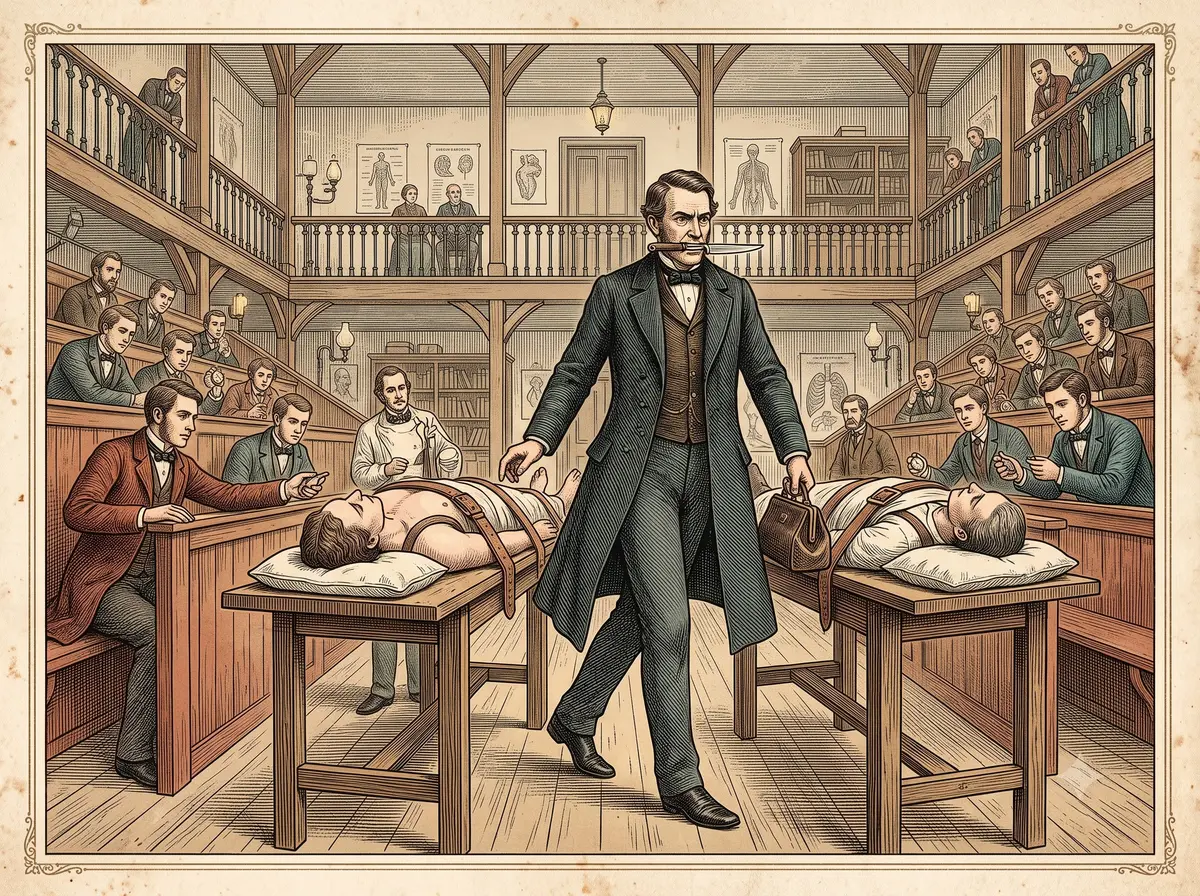
What happened: The Surgeon So Fast He Supposedly Killed Three People With One Amputation
Before anesthesia, surgery was a race against agony. The patient was awake, strapped down, and screaming; the surgeon’s only mercy was speed. And nobody was faster than Robert Liston.
Born in 1794 in the West Lothian village of Ecclesmachan, Liston trained in Edinburgh and eventually became the first Professor of Clinical Surgery at University College Hospital in London. He was six foot two, brusque, and famous for a piece of operating-room theater: he would turn to the medical students packed into the gallery, pocket watches in hand, and call out, “Time me, gentlemen!” Then he would go to work. He could take a leg off in about two and a half minutes — sometimes, by reputation, in mere seconds. To keep both hands free while he sawed, he was said to clamp the bloody knife between his teeth.
His most famous case, though, is the grisly one. As the surgical writer Richard Gordon told it in his 1983 book Great Medical Disasters, Liston was amputating a patient’s leg at his usual breakneck pace. Moving too fast, he sliced through the fingers of his young assistant. On the upswing, his blade slashed the coat of a distinguished spectator, who was so certain the knife had gutted him that he fainted on the spot. The patient later died of infection in the ward. So did the assistant, from his mangled fingers. And the terrified spectator, Gordon wrote, was “later discovered to have died from shock.” Three dead from a single operation.
Here is the important part, and Liston deserves to have it said plainly: there is very little evidence this triple-fatality ever happened. The tale first appears in Gordon’s book, written nearly 140 years after Liston’s era, and Gordon was a humorist as much as a historian. No contemporary record — no hospital log, no newspaper, no letter — has ever been found to confirm it. Sober academic accounts of Liston’s career simply don’t mention it. Historians now treat the 300-percent operation as apocryphal: a legend that grew up around a genuinely legendary surgeon.
What Liston unquestionably did do was change the course of medicine on one December morning. On December 21, 1846, at University College Hospital, he performed the first public operation in Europe using ether anesthesia. The patient, a butler named Frederick Churchill, breathed in ether administered by a student, and Liston amputated his diseased leg in roughly 28 seconds. Churchill woke a few minutes later, still expecting the horror to begin, and cried out, “Take me back! I can’t have it done!” — not realizing the leg was already gone. Liston turned to the room and delivered a line for the ages: “This Yankee dodge, gentlemen, beats mesmerism hollow,” a nod to the American dentist whose ether experiments had crossed the Atlantic.
Why it was strange: The Surgeon So Fast He Supposedly Killed Three People With One Amputation
We tend to imagine medical progress as a story of ever-gentler, ever-more-careful hands. Liston is the opposite image: a surgeon whose greatness was his violence — the sheer, blurring speed of it. In his world, a slow, thoughtful operation was a cruel one, and a careful surgeon might be a killer.
The 300-percent story sticks because it takes that logic to its absurd conclusion. It’s the rare piece of gallows humor that sounds like a Monty Python sketch yet points at something true: that a person could be so good at one thing — cutting fast — that the skill itself became dangerous to everyone in the room. That the punchline turns out to be mostly invented is its own lesson in how history gets exaggerated.
The same thread — Ether — continues in From Laughing Gas Parties to the Operating Room: A Short History of Anesthesia.
What scientists learned: The Surgeon So Fast He Supposedly Killed Three People With One Amputation
Speed wasn’t showmanship; it was survival math. Florence Nightingale later put the principle bluntly: with all else equal, “the danger is in a direct ratio to the time the operation lasts.” A shorter operation meant less blood loss and less shock, and shock killed. Liston’s low mortality — by some accounts he lost around one patient in ten when many surgeons lost one in four — came from finishing before his patients’ bodies gave out.
But 1846 revealed the ceiling of that whole approach. Ether meant a patient could sleep through the knife, which meant surgeons no longer had to be fast — they could be careful. The very skill that made Liston famous became, almost overnight, less essential. Two of the students who watched him work carried the moment forward: Joseph Lister, who would go on to pioneer antiseptic surgery, and James Young Simpson, who championed chloroform. Anesthesia and antisepsis, together, turned surgery from a sprint into a discipline.
Another odd chapter in medicine: The Dinner Party Where Three Doctors Sniffed Chloroform and Woke Up Under the Table.
How it reaches us today: The Surgeon So Fast He Supposedly Killed Three People With One Amputation
Every time you’re wheeled into an operating room and told to count backward, you’re living in the world Liston’s ether demonstration opened. Modern surgery — hours-long, meticulous, painless — exists precisely because doctors stopped needing to be quick and started being able to be thorough.
Liston left more concrete things, too. The “Liston splint,” which he designed to stabilize a broken thighbone, is still taught and still used by paramedics and emergency crews today. His locking artery forceps, the “bulldog” clamp, remain standard surgical instruments. Not bad for a man now best remembered for an operation that probably never happened.
Another treatment that history kept the receipt for: The Summer 400 People Couldn’t Stop Dancing.
Fun fact: The Surgeon So Fast He Supposedly Killed Three People With One Amputation
Liston’s name lives on in an annual prize. After his death in 1847, admirers established the “Liston Medal,” awarded to outstanding surgical students — a quiet, dignified legacy for the man the internet mostly knows as the surgeon with a 300-percent kill rate.
Sources: The Surgeon So Fast He Supposedly Killed Three People With One Amputation
- Robert Liston — Wikipedia (with citations to Richard Gordon’s Great Medical Disasters and the note that the “most famous case” is apocryphal)
- Andrew J. Jones, “Time me, gentlemen! The bravado and bravery of Robert Liston” — American College of Surgeons (PDF)
- Bill Thomas, “Saints and sinner: Robert Liston” — The Bulletin of the Royal College of Surgeons of England (2012)
- Matt Soniak, “‘Time Me, Gentlemen’: The Fastest Surgeon of the 19th Century” — The Atlantic / Mental Floss
- “A Yankee dodge”: the first British public demonstration of anaesthesia — Grand Rounds (2004) (PDF)
Related stories: The Surgeon So Fast He Supposedly Killed Three People With One Amputation
- From Laughing Gas Parties to the Operating Room: A Short History of Anesthesia — Party gas became surgical mercy, decades later than it should have
- The Family That Rang Bells and Blindfolded Mothers to Hide a Pair of Tongs — A family that hid its obstetric forceps for a century
- The Stone Age Skull Surgery With a Higher Survival Rate Than the Civil War’s — Neolithic skull surgery with better survival odds than Civil War hospitals