Science Through Time · Medicine
From Laughing Gas Parties to the Operating Room: A Short History of Anesthesia
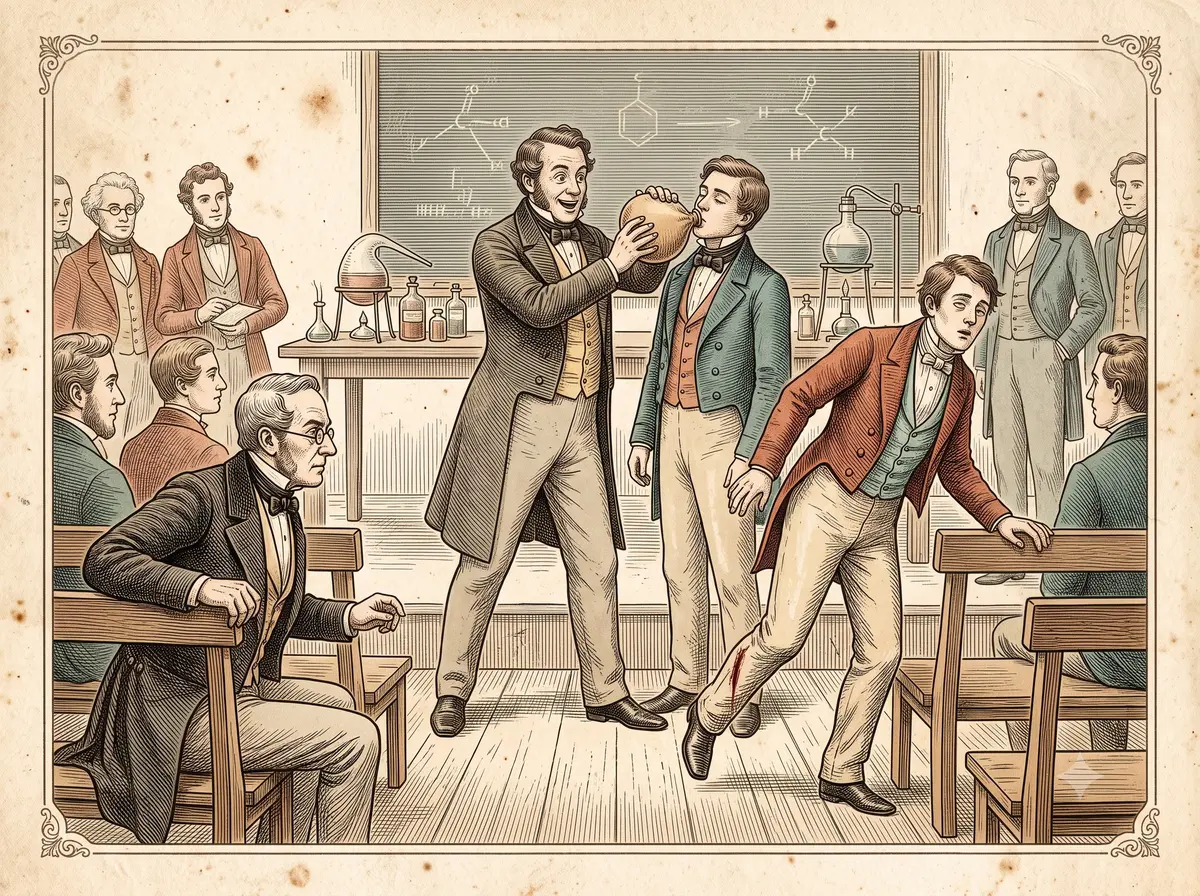
On the evening of December 10, 1844, a paying crowd packed Union Hall in Hartford, Connecticut, to watch strangers inhale laughing gas and make fools of themselves. A young man named Samuel Cooley took a dose, went careening around the room, and smashed his legs into a row of wooden benches. He kept going. He was bleeding and he hadn't noticed. In the audience, a dentist named Horace Wells stopped laughing and started thinking.
By the Curiosities Desk · · 5 min read · Filed under Medicine · Today’s round
What happened: Anesthesia
For most of human history, surgery meant being held down while it happened. Speed was the surgeon’s chief virtue, because the patient was awake for all of it.
The chemistry to fix this had been sitting on a shelf for decades. In 1800, the British chemist Humphry Davy published Researches, Chemical and Philosophical; Chiefly Concerning Nitrous Oxide, a book based largely on huffing the stuff himself. He noticed it dulled the pain of a toothache, and wrote a line that reads today like a message in a bottle: nitrous oxide “may probably be used with advantage during surgical operations in which no great effusion of blood takes place.”
Nobody acted on it. Instead, nitrous oxide and its cousin sulfuric ether became party drugs. Traveling showmen ran “laughing gas exhibitions”; medical students threw “ether frolics.” For forty years, the most effective painkillers in the world were used almost exclusively for entertainment.
The first person to connect the party to the operating table was a Georgia physician, Crawford Long. He had watched friends at ether frolics stagger into furniture and turn up bruised with no memory of the impact. On March 30, 1842, in his office in Jefferson, Georgia, Long soaked a towel in ether, held it over the face of a patient named James Venable, and cut a cyst out of his neck. Venable felt nothing. Long charged him two dollars — and then, fatefully, told almost no one outside his county.
Which brings us back to Union Hall. The gas that night was administered by Gardner Quincy Colton, a medical-school dropout turned showman. After Cooley’s collision, Wells asked Colton whether a person under gas might also sleep through a tooth extraction. The next morning, December 11, 1844, Wells found out by volunteering. Colton gave him the gas; his colleague John Riggs pulled one of Wells’s molars. Wells woke and said, by his own later account, that he hadn’t felt it so much as the prick of a pin — and that a new era in tooth-pulling had arrived.
He was right, and it destroyed him. In January 1845 Wells arranged a public demonstration in Boston before Harvard medical students. (It’s usually said to have happened at Massachusetts General Hospital; the anesthesia historian Rajesh Haridas has argued from period documents that it more likely took place in a Harvard Medical College lecture room.) Wells pulled the gas bag away too early. The patient groaned mid-extraction. The room jeered “humbug,” and Wells went home humiliated — even though the patient afterward said he’d felt almost nothing.
The credit went to a man who had watched Wells fail: his former student and business partner, William T. G. Morton, who switched to ether. On October 16, 1846, in the surgical amphitheater at Massachusetts General Hospital, Morton put a printer named Edward Gilbert Abbott to sleep while the surgeon John Collins Warren removed a tumor from Abbott’s neck. Abbott lay quiet. Warren turned to the gallery and said, “Gentlemen, this is no humbug.” Word reached London within weeks. The room is still called the Ether Dome.
Why it was strange: Anesthesia
The strangeness isn’t that anesthesia was discovered. It’s that it was discovered, published, and then ignored for the better part of half a century — while the same compounds were inhaled recreationally by thousands of people, several of whom were doctors.
The clue was hiding in the punchline. The whole appeal of a laughing gas show was watching someone bash into the furniture and pop back up grinning. Audiences saw that a hundred times and read it as comedy. Long and Wells looked at the identical scene and read it as data.
The same thread — Surgery — continues in The Surgeon So Fast He Supposedly Killed Three People With One Amputation.
What scientists learned: Anesthesia
Long and Wells had stumbled onto general anesthesia: a reversible, drug-induced state in which a patient is unconscious, still, and unable to form memories of the procedure. It is not sleep, and it isn’t simply blocking a nerve — inhaled anesthetics act broadly on the brain and spinal cord, and even now the precise mechanism is not fully settled science.
The nineteenth century learned the harder lesson second: dose is everything. Wells’s public failure was a dosing error, not a refutation. Too little gas and the patient wakes; too much and breathing stops. The specialty of anesthesiology exists because someone has to sit at the head of the table and manage that margin, minute by minute.
Another idea followed the long way: From a Milkmaid’s Blisters to mRNA: A Short History of the Vaccine.
How it reaches us today: Anesthesia
Anesthesia is what made modern surgery thinkable. Once a patient could lie still and unaware for an hour, surgeons could attempt operations that had been impossible when the clock ran on how long a person could endure. Open-chest, abdominal, and neurosurgical procedures all sit downstream of Ether Day.
Nitrous oxide, meanwhile, never left. It’s still in dental offices and delivery rooms, 180 years after a showman brought a bag of it to a Hartford lecture hall.
Another thread pulled across centuries: From Lamb’s Blood to Blood Types: A Short History of the Transfusion.
Fun fact: Anesthesia
Twelve days before Horace Wells died in 1848, at thirty-three, the Parisian Medical Society voted to credit him as the first to perform surgery without pain. The news never reached him. Hartford put up a statue anyway.
Wells’s final years involved chemical self-experimentation that badly harmed him, and he died by suicide. If any of this is close to home for you, talking to a doctor or a crisis line is a reasonable place to start.
Sources: Anesthesia
- Davy, H. Researches, Chemical and Philosophical, Chiefly Concerning Nitrous Oxide (1800) — Wood Library-Museum of Anesthesiology
- Haridas, R.P. “Horace Wells’ Demonstration of Nitrous Oxide in Boston,” Anesthesiology 119(5), 2013
- Ether & Ether Dome History — Massachusetts General Hospital
- Dr. Crawford W. Long and Anesthesia for Surgery — Georgia Historical Society
- The Death of Horace Wells — Countway Library, Harvard Medical School
Related stories: Anesthesia
- The Surgeon So Fast He Supposedly Killed Three People With One Amputation — The surgeon so fast his amputation supposedly killed three people
- The Family That Rang Bells and Blindfolded Mothers to Hide a Pair of Tongs — A family that hid its obstetric forceps for a century
- The Doctor Who Toured America in a ‘Lobotomobile’ — A doctor who toured America performing lobotomies out of a van