Science Through Time · Medicine
From a Lion-Headed Throne to the Cochlear Implant: A Short History of the Hearing Aid
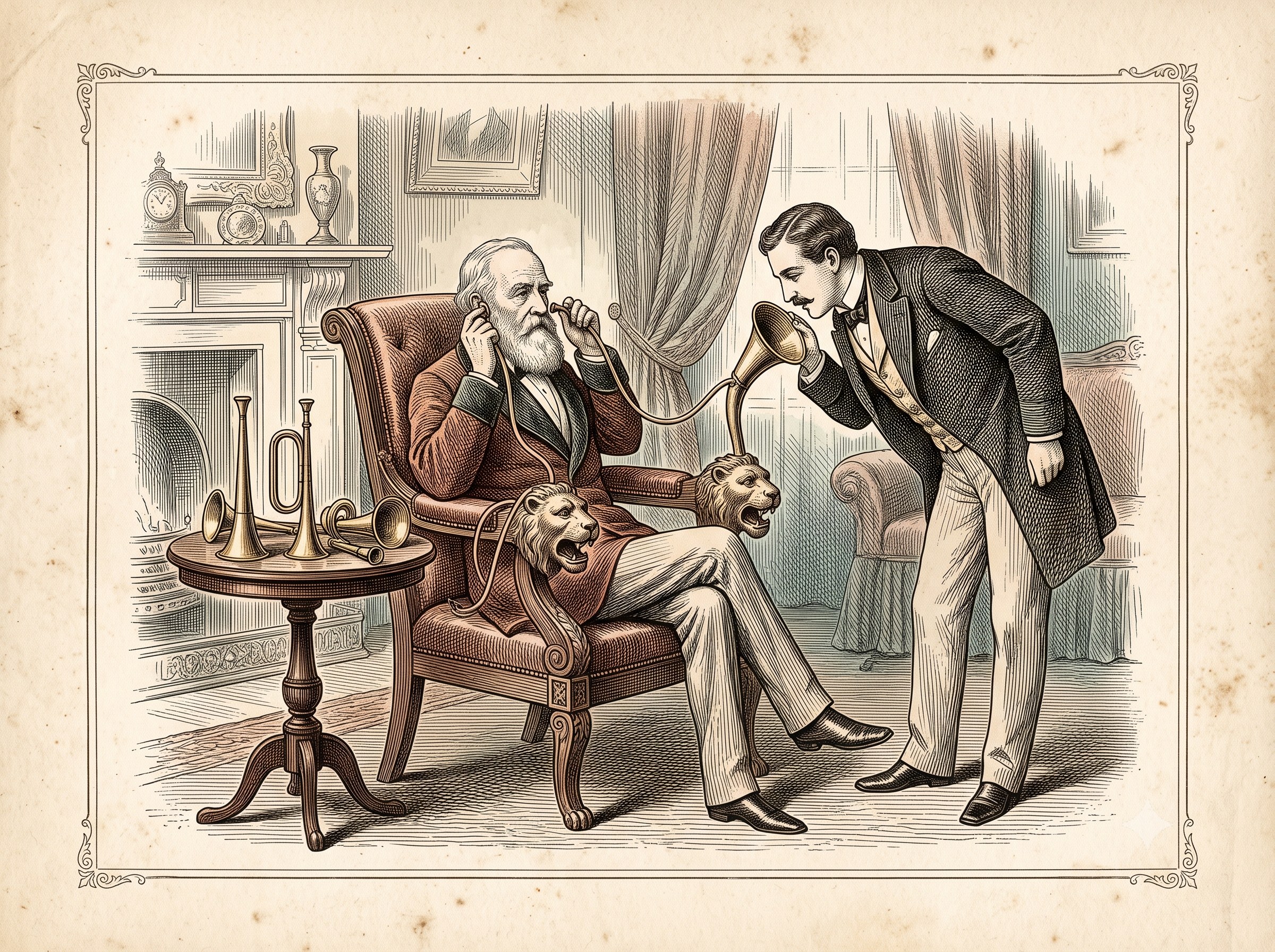
In a London workshop in the nineteenth century, an instrument maker built a chair whose arms ended in the open mouths of carved lions. The mouths were not decoration — they were funnels. To speak to the person in the chair, you leaned toward a lion's jaws and talked into them, and your voice ran down a hidden tube to his ear. For nearly a century the chair has been described as a throne built for a deaf Portuguese king. The chair is real. The king is the shaky part.
By the Curiosities Desk · · 5 min read · Filed under Medicine · Today’s round
What happened?
Before electricity, the only way to help someone hear more was to gather sound and funnel it into the ear. That is the whole principle of the ear trumpet: a wide bell narrowing to a tube, collecting sound waves over a larger area and delivering them to the eardrum. It amplifies nothing — it just stops sound from spreading out and getting lost.
By the early 1800s this simple idea had become a small industry, and London’s Strand was its center. Instrument makers competed with “gong metal ear trumpets,” concealed “ear caps” worn under a lady’s bonnet, and tabletop devices like the Soniferon, which stood on a pillar “like a lamp.” One aurist, John Harrison Curtis, designed an acoustic chair early in the century and put a model of it on public display.
The most famous customer of the era was Ludwig van Beethoven. In 1813 the inventor Johann Nepomuk Mälzel made him ear trumpets in several sizes — Beethoven needed different ones for different rooms — some fitted to a metal headband so he could keep his hands free to play. Four survive at the Beethoven-Haus in Bonn.
Then there is the throne. The lion-armed chair came from the workshop of Frederick Charles Rein, a Saxon-born instrument maker on the Strand whose firm dominated British hearing devices for decades. The story attached to it — that Rein made it in 1819 for King João VI of Portugal and Brazil, who was going deaf, and that courtiers had to kneel and address the lions — appears everywhere. But when the librarian H. Dominic W. Stiles went looking for evidence in the UCL Ear Institute and RNID archives, he found no contemporary proof of any of it: not the royal commission, not the king’s deafness, not even a Rein making acoustic instruments in London before about 1835. A 1933 book pictures the chair, dates it 1830, and calls it simply an “acoustic chair.” Not a throne. Rein most likely built it later in the century as a showpiece for his shop, and the royal biography grew around it afterward.
The jump from funnels to electronics came from the telephone: a carbon microphone could turn sound into a fluctuating electric current, and an earphone could turn it back. Now amplification was real. In 1898 a young Alabama engineer named Miller Reese Hutchison, who had studied ear anatomy trying to help a deaf childhood friend, began selling a carbon-transmitter hearing aid called the Akouphone for $400 apiece. His portable Acousticon followed in 1902, and Queen Alexandra, wife of Edward VII, said it restored much of her hearing. She invited him to the coronation.
Everything after that is a story of shrinking. Vacuum tubes brought stronger amplification in the 1920s — the 1921 Vactuphone was a tabletop device you had to sit beside. Then, in December 1952, Sonotone released the model 1010, a hybrid of two miniature tubes and a single transistor: the first commercial product of any kind built with a transistor. Within about two years, nearly every hearing aid on the market was fully transistorized.
And then medicine skipped past the ear entirely. A cochlear implant doesn’t amplify sound at all; it converts sound into electrical pulses delivered straight to the auditory nerve, bypassing the damaged inner ear. The FDA approved the first such device for deaf adults in the mid-1980s — the first device, it said, to replace a human sense.
Why was it strange?
For most of recorded history, the state of the art in hearing technology was a shaped tube — and the fanciest version was furniture. Sitting in the right chair was the treatment. It’s easy to laugh at lion-mouth armrests, but the acoustics were sound: gather a wide sample of a sound wave, funnel it down, deliver it to the ear. The chair was working at the absolute limit of what was possible before you could amplify a signal.
The stranger part is what happened to the story afterward. A perfectly good piece of nineteenth-century engineering got a king attached to it, and the king stuck — repeated in books, museums, and news articles for decades on the strength of one mid-twentieth-century secondary source.
Another thread pulled across centuries: From a Milkmaid’s Blisters to mRNA: A Short History of the Vaccine.
What did scientists learn?
Two different physical strategies, in order. The first is passive acoustic gain: an ear trumpet increases the sound energy reaching the eardrum by collecting it over a larger area. That’s free, but it’s capped — you cannot funnel your way past a badly damaged ear.
The second is transduction: turn sound into electricity, do something useful to it, then turn it back. Once engineers could do that, hearing help stopped being about geometry and became about signal processing. A modern aid doesn’t just make everything louder; it boosts the frequencies a particular ear has lost, compresses loud sounds so they don’t become painful, and suppresses steady background noise.
A cochlear implant pushes that one step further: if the ear’s hair cells are gone, skip them and stimulate the nerve directly. It’s worth being precise — an implant does not restore normal hearing. It gives a useful representation of sound, and learning to interpret it takes time and therapy.
Another idea followed the long way: From Lamb’s Blood to Blood Types: A Short History of the Transfusion.
How does it affect us today?
The Strand’s trade in “voice conductors” and hidden ear caps has a direct descendant: the modern argument over whether a hearing aid should be visible. Stigma shaped this technology from the start, and it still does.
The bigger recent change is who gets to buy one. In October 2022 the FDA created a category of over-the-counter hearing aids that adults with perceived mild to moderate hearing loss can buy without an exam or a prescription. In September 2024 it authorized the first over-the-counter hearing aid software — a feature that turns a compatible pair of Apple AirPods Pro into a hearing aid. The device that once required kneeling before a lion now ships as a software update.
A close cousin: From Laughing Gas Parties to the Operating Room: A Short History of Anesthesia.
Fun fact
Johann Nepomuk Mälzel, who built Beethoven’s ear trumpets, had a remarkable second and third act: he patented the metronome — the ticking box still setting tempo in music rooms today — and he bought and toured the world with the Mechanical Turk, the chess-playing “automaton” with a person hidden inside.
If hearing loss is something you’re dealing with, an audiologist can help you sort out what’s going on and what would help — and there are more affordable options now than there have ever been.
Sources
- H. Dominic W. Stiles, “Acoustic instrument makers in the Strand, acoustic ‘throne’ myths, & Frederick Charles Rein & Son,” UCL Ear Institute & RNID Libraries blog, 2016 — the archival investigation of the “throne” legend.
- Beethoven-Haus Bonn, Beethoven’s ear trumpets made by Johann Nepomuk Mälzel, 1813.
- Victor Rodriguez, “Miller Reese Hutchison,” Encyclopedia of Alabama, Auburn University.
- Computer History Museum, “1952: Transistorized Consumer Products Appear.”
- U.S. Food and Drug Administration, “FDA Authorizes First Over-the-Counter Hearing Aid Software” (2024); NIDCD, “Cochlear Implants.”