Science Through Time · Medicine
From a Milkmaid's Blisters to mRNA: A Short History of the Vaccine
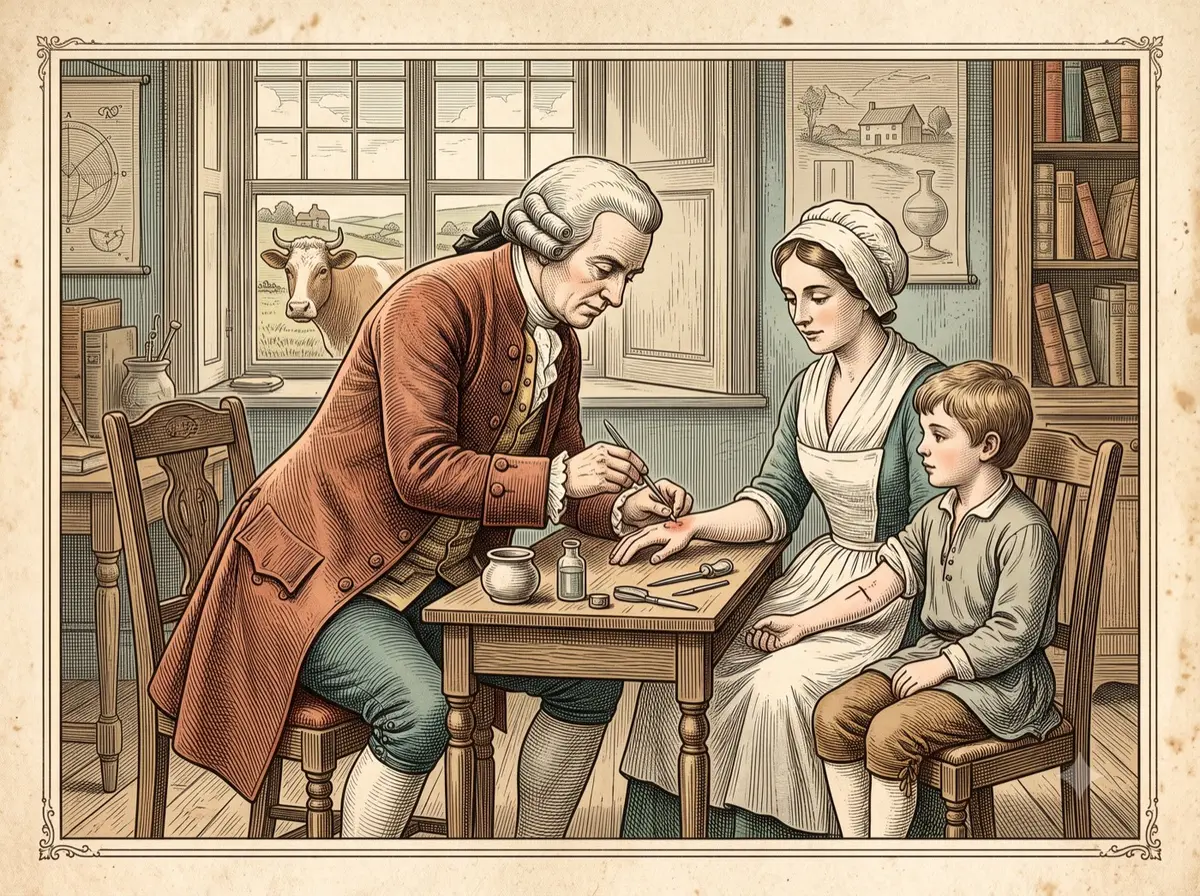
On May 14, 1796, a country doctor in Gloucestershire, England, scraped fluid from a blister on a milkmaid's hand and worked it into two shallow cuts on the arm of an eight-year-old boy. Six weeks later, he deliberately exposed that same boy to smallpox — one of the deadliest diseases in human history. The boy stayed healthy. By any modern standard, the experiment was reckless. It also worked, and it eventually helped erase a disease that had killed hundreds of millions of people.
By the Curiosities Desk · · 6 min read · Filed under Medicine · Today’s round
What happened: The Vaccine
The doctor was Edward Jenner. The boy was James Phipps, the son of his gardener. The milkmaid was Sarah Nelmes, who had caught cowpox — a mild disease of cattle that could pass to the people who milked them — from a cow named Blossom. Jenner took matter from a sore on Nelmes’s hand and inserted it into Phipps’s arm, a procedure Jenner would later call “vaccination,” from the Latin vacca, meaning cow.
Jenner didn’t invent the underlying idea from nothing. For centuries, healers in China and the Ottoman Empire had practiced variolation: taking material from a smallpox scab or sore and introducing it into a healthy person through the skin or nose, in hopes of triggering a milder case that left them immune. Lady Mary Wortley Montagu, wife of the British ambassador to Constantinople, learned about the practice there and had her own children variolated before popularizing it in England starting in 1721. Variolation worked — but it used live smallpox itself, so a small percentage of patients died from the very procedure meant to protect them.
Jenner’s insight was to substitute cowpox, a far milder disease, for smallpox. He’d spent more than a decade observing that dairy workers who’d had cowpox seemed to be spared during smallpox outbreaks — an idea also noted independently by a Dorset farmer, Benjamin Jesty, and a schoolteacher, John Fewster, years earlier. In July 1796, Jenner tested his hypothesis by variolating Phipps with real smallpox matter. Phipps didn’t get sick. Jenner repeated the experiment on more than 20 other people before publishing his findings in 1798.
The practice spread fast. Within a few years, physicians across Europe and the Americas were vaccinating patients against smallpox, and by 1853 Britain had made it compulsory for infants. In 1885, French chemist Louis Pasteur pushed the concept further, using a weakened form of the rabies virus to treat nine-year-old Joseph Meister after he was bitten multiple times by a rabid dog — the first use of the method against a disease other than smallpox. Pasteur borrowed Jenner’s word “vaccine,” out of respect, even though his rabies treatment had nothing to do with cows.
From there the idea kept expanding: vaccines against diphtheria, tetanus, and whooping cough by the early 20th century; Jonas Salk’s polio vaccine in 1955; and, in 2020, vaccines against COVID-19 built on an entirely new platform — messenger RNA, or mRNA — that didn’t use a weakened virus at all.
Why it was strange: The Vaccine
Jenner deliberately gave a healthy child one disease in order to protect him from a different, deadlier one — using nothing more than field observation, decades before anyone knew viruses existed or understood how the immune system worked. Germ theory wouldn’t arrive for another 60-plus years.
It’s also worth separating legend from fact here. The popular version of the story — that a milkmaid told Jenner, in a single conversation, that she couldn’t catch smallpox because she’d already had cowpox — is a simplified, romanticized account added later by Jenner’s biographer, John Baron. The real story is less tidy and more interesting: rural folklore about milkmaids and cowpox already existed, other observers like Jesty and Fewster had noticed the pattern and even acted on it earlier, and Jenner spent years methodically testing the idea before he risked it on Phipps.
Another thread pulled across centuries: From a Lion-Headed Throne to the Cochlear Implant: A Short History of the Hearing Aid.
What scientists learned: The Vaccine
Jenner’s experiment demonstrated, without the vocabulary to explain why, the core principle of immunology: exposing the body to a weakened or related version of a pathogen — a disease-causing microbe — trains the immune system to recognize and fight the real, dangerous version later, without the person having to survive the actual disease first.
Pasteur generalized that principle. He showed that a pathogen didn’t need to be a naturally mild relative of the target disease, like cowpox is to smallpox — it could be the same pathogen, deliberately weakened, or “attenuated,” in the lab. That opened the door to building vaccines against diseases with no convenient mild cousin.
mRNA vaccines, built on decades of research by scientists including Katalin Karikó and Drew Weissman, work differently still. Instead of injecting any form of the virus, they deliver genetic instructions that tell a person’s own cells how to briefly build one harmless piece of the virus, enough for the immune system to learn to recognize it. Karikó and Weissman’s key discovery, published in 2005 after their manuscript was initially rejected by two major journals, showed how to modify mRNA so the body wouldn’t destroy it before it could do its job — work that won them the 2023 Nobel Prize in Physiology or Medicine.
Another idea followed the long way: From Crushed Oyster Shells to Nylon: A Short History of the Toothbrush.
How it reaches us today: The Vaccine
Smallpox is the only human disease ever eradicated worldwide — the World Health Organization certified its eradication in December 1979 and formally declared it in May 1980, ending a disease that, by one widely cited estimate, killed roughly 300 million people in the 20th century alone. The basic strategy Jenner stumbled into — train the immune system safely, ahead of time — now underlies routine vaccination programs against dozens of diseases. And the mRNA platform, built on research that sat overlooked for years for lack of funding and interest, let scientists design and test COVID-19 vaccines in under a year, a process that previously took a decade or more. Researchers are now testing the same platform against flu, RSV, and some cancers.
A close cousin: From Laughing Gas Parties to the Operating Room: A Short History of Anesthesia.
Fun fact: The Vaccine
Vaccination had its skeptics from day one. In 1802, English caricaturist James Gillray published a print called “The Cow-Pock,” showing newly vaccinated patients at a London hospital sprouting cow horns, tails, and even miniature cattle from their bodies. It was satire aimed at anti-vaccination pamphlets of the era — nobody actually grew a cow out of their arm — but it captures how strange and frightening the idea looked to people encountering it for the first time.
If you have questions about vaccines or your own health, a doctor or your local public health department is the best source of current, personalized guidance.
Sources: The Vaccine
- Edward Jenner, FRS FRCPE — History of Vaccines timeline
- World Health Organization — History of smallpox vaccination
- NPR — “The Milkmaid Who Supposedly Inspired The Smallpox Vaccine Was A Myth”
- Institut Pasteur — The history of the first rabies vaccination in 1885
- The Nobel Prize — Press release, Physiology or Medicine 2023 (Karikó and Weissman)
Related stories: The Vaccine
- From Lamb’s Blood to Blood Types: A Short History of the Transfusion — Lamb’s blood, dead patients, and the discovery of blood types
- The Baby-Blue Blood of the Horseshoe Crab That Keeps Every Vaccine Safe — The crab blood that screens nearly every vaccine for contamination
- The Moldy Petri Dish That Almost Got Thrown Away — A contaminated petri dish that nearly went in the bin