Science Through Time · Medicine
From Crushed Oyster Shells to Nylon: A Short History of the Toothbrush
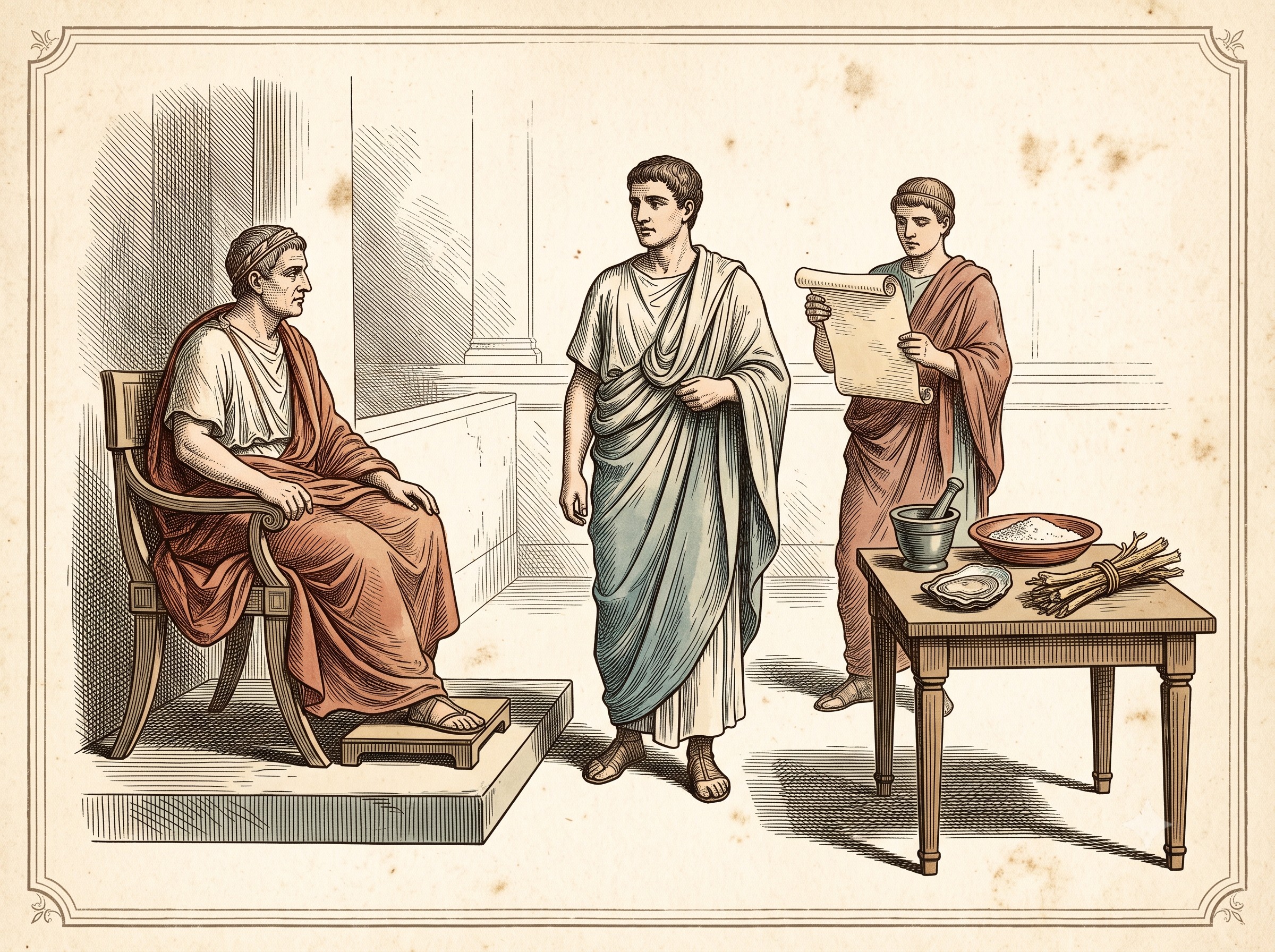
Around AD 158, in a Roman courtroom in North Africa, a writer named Apuleius stood trial for sorcery — a charge that could get a man executed. The prosecution laid out its evidence. Among the exhibits was a poem he had written about tooth powder. Apuleius had to stand up and explain, at length, to a Roman proconsul, that toothpaste is not witchcraft.
By the Curiosities Desk · · 5 min read · Filed under Medicine · Today’s round
What happened?
He won, incidentally, and his defense speech survives — which means one of the better-documented moments in early dental hygiene is a man arguing that cleaning your teeth is normal.
It was, and had been for a very long time. Long before anything with a handle and bristles, people used chew sticks: a twig, one end frayed by chewing into a soft brush of fibers. They turn up in Egyptian tombs, and across Africa, Arabia, and South Asia the miswak — usually a stick of the arak tree — is still in daily use.
The Romans put their effort into the powder rather than the brush. Pliny the Elder catalogued the ingredients: burnt bone, hooves, horns, crushed crab, eggshells, and the shells of oysters and the murex sea snail, ground fine and sometimes bound with honey. To this went astringents — myrrh, natron, ground hartshorn — and, less encouragingly, powdered pumice. The goal wasn’t just whiteness; it was to tighten loose teeth, firm the gums, and dull toothache. Today’s toothpaste is a recognizable descendant: an abrasive, usually silica, plus astringents and flavor.
And then there’s the urine. Catullus, in his thirty-ninth poem, mocks a man named Egnatius for his relentless white smile and explains it by claiming that Celtiberians — people from what is now Spain — brush their teeth with their own urine. Apuleius repeats the sneer two centuries later; Strabo and Diodorus mention it too. Here’s the honest version: none of these authors was Celtiberian, none appears to have witnessed it, and every retelling is a joke about foreigners. Urine does contain urea, which breaks down into ammonia, which genuinely cleans — Romans used stale urine to launder wool. But whether anyone rinsed with it is unproven, and the story has the hallmarks of an ancient urban legend.
The bristle brush comes from China. In the 1980s, archaeologists in Chengdu pulled bone toothbrush handles out of Tang dynasty refuse pits, dating to roughly a thousand years ago — flat bone handles with two neat rows of drilled holes at the head, where tufts of animal hair were once anchored. That is, structurally, the object in your bathroom right now.
Europe got there far later. The usual story credits an Englishman, William Addis, with the first mass-produced toothbrush around 1780. The colorful part — that he invented it in Newgate Prison, drilling holes in a bone saved from his dinner and threading it with bristles begged from a guard — is repeated everywhere but rests on family tradition, not documents. Treat it as legend. What’s solid is the business: Addis built a brush company that outlived him by centuries. The first American toothbrush patent went to H. N. Wadsworth on November 7, 1857 — U.S. Patent No. 18,653, for a brush with a curved row of bristles.
Every one of those brushes used animal hair, usually boar bristle, and animal hair is a poor material for the job. It’s porous, so it soaks up moisture and harbors bacteria. It goes soft when wet. It falls out. On February 24, 1938, the Weco Products Company of Chicago began selling “Dr. West’s Miracle-Tuft,” the first toothbrush with bristles of DuPont’s new synthetic fiber, nylon. It cost fifty cents and came with a promise no boar-bristle brush could make: no shedding.
The tool was finally right. The habit still wasn’t. Toothbrushes had been sold in America for over a century, and most Americans didn’t use one regularly — brushes and paste were an expense many households simply skipped. What changed that was the U.S. Army. During the Second World War, soldiers brushed daily as a matter of standing orders, and millions came home with the habit already installed.
Why was it strange?
The strange thing about the toothbrush is the gap. The object is at least a thousand years old. The routine — twice a day, everybody, without thinking about it — is about eighty.
We tend to assume that once a good tool exists, people use it. The toothbrush says otherwise. For a millennium the technology sat there, essentially finished, while adoption waited on things that have nothing to do with invention: cost, plumbing, a synthetic fiber from a chemical lab, and, in the end, a war.
The same thread — Pliny the Elder — continues in From a Beach Bonfire to a Cake in a Battery Jar: A Short History of Glass.
What did scientists learn?
The reason brushing works isn’t chemical. It’s mechanical.
The film on your teeth is a biofilm — a dense, structured community of bacteria bound in a self-made matrix that shields them from mouthwash, saliva, and antibiotics alike. You can’t reliably dissolve it. You have to physically scrub it off, which is exactly what a few thousand nylon filaments dragged across a tooth surface do.
That reframes the whole history. Pliny’s burnt oyster shell worked because it was an abrasive; the frayed twig worked because it was a brush. And nylon mattered for a specific reason: a synthetic filament can be made to a controlled diameter and stiffness, with a rounded tip. Boar bristle can’t. That consistency is what let dentists eventually recommend soft bristles — hard ones abrade enamel and push gums back — instead of hoping for the best.
Another idea followed the long way: From a Sponge on a Stick to the Flush Toilet: A Short History of the Toilet.
How does it affect us today?
The electric version arrived in 1954, when the Swiss engineer Philippe-Guy Woog built the Broxodent, largely for patients whose hands couldn’t manage the motion. It plugged straight into wall current — a startling thing to hold in a wet mouth. Squibb brought it to the United States at the end of the decade.
Nylon’s other legacy is less charming. A modern toothbrush is a fused lump of plastic and nylon, effectively unrecyclable, and billions are thrown away every year. Bamboo handles and replaceable heads are attempts to unpick a problem created in 1938 by solving a different one.
Another thread pulled across centuries: From a Lion-Headed Throne to the Cochlear Implant: A Short History of the Hearing Aid.
Fun fact
In 2003, the Lemelson-MIT Invention Index asked Americans which single invention they could not live without, offering five choices: toothbrush, automobile, personal computer, cell phone, and microwave. The toothbrush won — 42 percent of adults and 34 percent of teenagers — beating the car into second place and leaving the computer, the phone, and the microwave tied at the bottom.
A note: routine dental care is genuinely one of the cheapest forms of preventive medicine, and the current ADA guidance is simple — brush twice a day with fluoride toothpaste and clean between your teeth once a day. If cost is the barrier, dental schools and community health centers often provide low-cost care.
Sources
- Apuleius, Apologia 6, and Roman tooth powder — “Dentifricium,” Smith’s Dictionary of Greek and Roman Antiquities (1875), with Pliny and Catullus citations, LacusCurtius/University of Chicago
- “Who invented the toothbrush and when was it invented?” — Library of Congress, Everyday Mysteries
- “On this date in 1938” (Dr. West’s Miracle-Tuft and the first nylon bristles) — Hagley Museum and Library, DuPont archives
- “Toothbrush beats out car and computer as the invention Americans can’t live without” — Lemelson-MIT Invention Index, MIT News, January 21, 2003
- “How toothbrushing became a part of everyday health” — American Dental Association