Science Through Time · Chemistry
From a Beach Bonfire to a Cake in a Battery Jar: A Short History of Glass
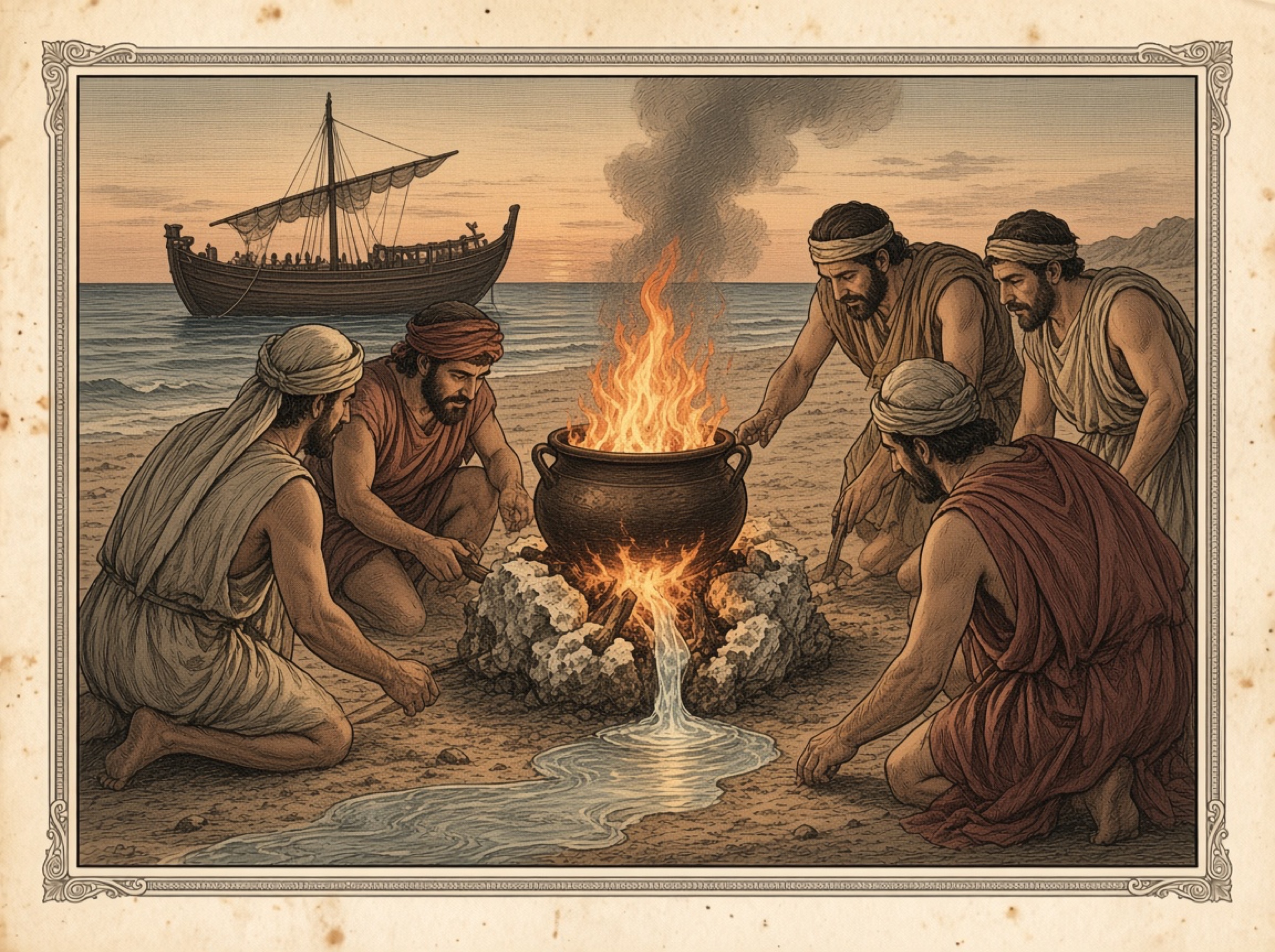
Around AD 77, the Roman writer Pliny the Elder passed along a story about some sailors carrying a cargo of natron — a natural soda mineral — who stopped on a beach in Phoenicia to cook dinner. Finding no stones to prop up their cooking pots, they used lumps of their cargo instead. As the fire roared, the soda melted into the sand, and "a strange translucent liquid flowed forth in streams." That, Pliny wrote, was the origin of glass. It's a wonderful story. It is also almost certainly not true.
By the Curiosities Desk · · 5 min read · Filed under Chemistry · Today’s round
What happened?
Real glass is far older than Pliny’s sailors. Archaeologists trace the first true human-made glass to Mesopotamia, the land between the Tigris and Euphrates rivers, in the second half of the third millennium BC — roughly 4,500 years ago. The earliest pieces were beads. Glass vessels came about a thousand years later, often built up around a removable core of clay.
The recipe, though, was close to what Pliny described. Most ancient glass is three ingredients: sand (silica), a “flux” such as soda to lower the melting point, and lime to make the result stable. Pliny’s beach, near the mouth of the River Belus by modern-day Acre, really was prized for glassmaking sand. And the Romans really did make their glass with Egyptian natron.
Pliny is careful about one more glass story, and it’s a good one. He reports that in the reign of the emperor Tiberius (AD 14–37), someone invented a way to make glass flexible, and the inventor’s workshop was destroyed so that gold, silver, and copper wouldn’t lose their value. Pliny adds, a little dryly, that the tale had been repeated often rather than proven. The novelist Petronius, writing around the same time, put a gorier version in the mouth of a boastful dinner host in his comic novel the Satyricon: a craftsman throws an unbreakable glass bowl on the floor in front of Caesar, hammers out the dent, admits no one else knows the secret — and is beheaded on the spot. No such glass has ever turned up. Treat it as legend.
What the Romans did have was a genuine revolution. Glassblowing — inflating a gob of molten glass on the end of a tube — was invented in the coastal Levant late in the first century BC. Suddenly glass could be made fast and cheap.
Glass had one stubborn weakness, and Pliny named it: it “cannot bear heat unless cold fluid is first poured into it.” Heat one part of ordinary glass faster than another and it cracks.
Nearly two thousand years later, that problem landed in a kitchen in Corning, New York. In 1908, Corning Glass Works’ research director, Eugene Sullivan, had developed a borosilicate glass called Nonex for railroad lanterns, which had to stay hot inside while freezing rain hit them outside. In 1913, the company’s new physicist, Jesse Littleton, came home with the sawed-off bottom of a borosilicate battery jar. His wife, Bessie, had broken her ceramic baking dish, and she baked a sponge cake in the jar instead. It came out evenly baked and perfectly browned. That glass had too much lead in it for kitchen use, but once Corning reformulated it, Pyrex went on sale in 1915.
Why was it strange?
Because glass is a material people have been making for about 4,500 years, and for most of that time nobody could explain what it actually was. It shatters like a solid, yet its atoms are jumbled like a liquid’s.
And some of its biggest leaps came from sideways places: a myth about a cooking fire, a fable about a dented bowl, a cake baked in lab equipment, and a railroad lantern so durable, Corning later said, that it hurt repeat sales.
The same thread — Pliny the Elder — continues in From Crushed Oyster Shells to Nylon: A Short History of the Toothbrush.
What did scientists learn?
Glass is an amorphous solid: a material whose atoms are locked in place but never line up into the neat, repeating pattern of a crystal. When molten sand cools slowly, its atoms have time to organize into crystals. When it cools quickly, they freeze mid-shuffle. Soda helps by breaking up the silica network so it melts at a temperature ancient furnaces could actually reach.
Pliny’s cracking problem is called thermal shock. Glass expands as it heats. If one side heats faster than the other, the two sides try to expand by different amounts, and the stress tears the glass apart. Adding boron oxide, as the German glassmaker Otto Schott did in 1893, shrinks that expansion dramatically. That’s why borosilicate glass can go from a hot oven to a cool counter.
Strength turned out to be about flaws, not weakness. According to Corning, glass usually breaks when tiny surface scratches meet a pulling force; flawless glass can be stronger than steel. In the 1960s, Corning made a glass called Chemcor by soaking it in a bath of hot molten salt. Small sodium atoms left the surface and larger potassium atoms squeezed in, packing the outer layer into compression so cracks struggled to start. Chemcor was meant for phone booths, prison windows, and windshields, but never caught on as a full product line.
Elsewhere in chemistry: The Roman Cup That Was Accidentally Nanotechnology.
How does it affect us today?
In 2005, Corning began developing a strong, thin cover glass for phones and other mobile devices, using its long experience with that salt-bath trick as a starting point. The result, Gorilla Glass, appeared on the first generation of smartphones in 2007. It’s often described as Chemcor pulled off a shelf, but Corning says it is a different glass recipe with new processes behind it — an inheritance rather than a reissue. The company says Gorilla Glass has since covered more than 8 billion devices.
Borosilicate glass, meanwhile, became the backbone of the chemistry lab. According to the American Chemical Society, Pyrex flasks grew penicillin mold during its first mass production in the 1940s. The 200-inch mirror of the Hale Telescope at Palomar Observatory was cast from a 20-ton Pyrex disk — at the time, the largest piece of glass in the world.
Another thread pulled across centuries: From Frog Legs to Lithium: A Short History of the Battery.
Fun fact
Pyrex was born partly because Corning’s railroad lantern glass worked too well. According to a Corning business director interviewed by the American Chemical Society’s C&EN in 2015, Nonex lasted so long that customers rarely needed to reorder it — so the company’s scientists went looking for other things the glass could do. One of them turned out to be a sponge cake.
Sources
- Pliny the Elder, Natural History, Book 36, chapters 65–66 (English translation) — the natron-on-the-beach legend, the flexible-glass story, and the warning about heat.
- Corning Museum of Glass, Origins of Glassmaking — the Mesopotamian origins of glass.
- “Pyrex At 100”, Chemical & Engineering News, American Chemical Society, 2015 — Nonex, the Littletons’ sponge cake, and Pyrex in labs and telescopes.
- Corning Incorporated, Corning’s History of Chemically Strengthening Glass — Chemcor, ion exchange, and how Gorilla Glass differs.
- Petronius, Satyricon, “Trimalchio’s Feast” (trans. A. S. Kline) — the fictional unbreakable glass bowl.