Science Through Time · Chemistry
From Matches You Lit With Your Teeth to the Safety Match: A Short History of the Match
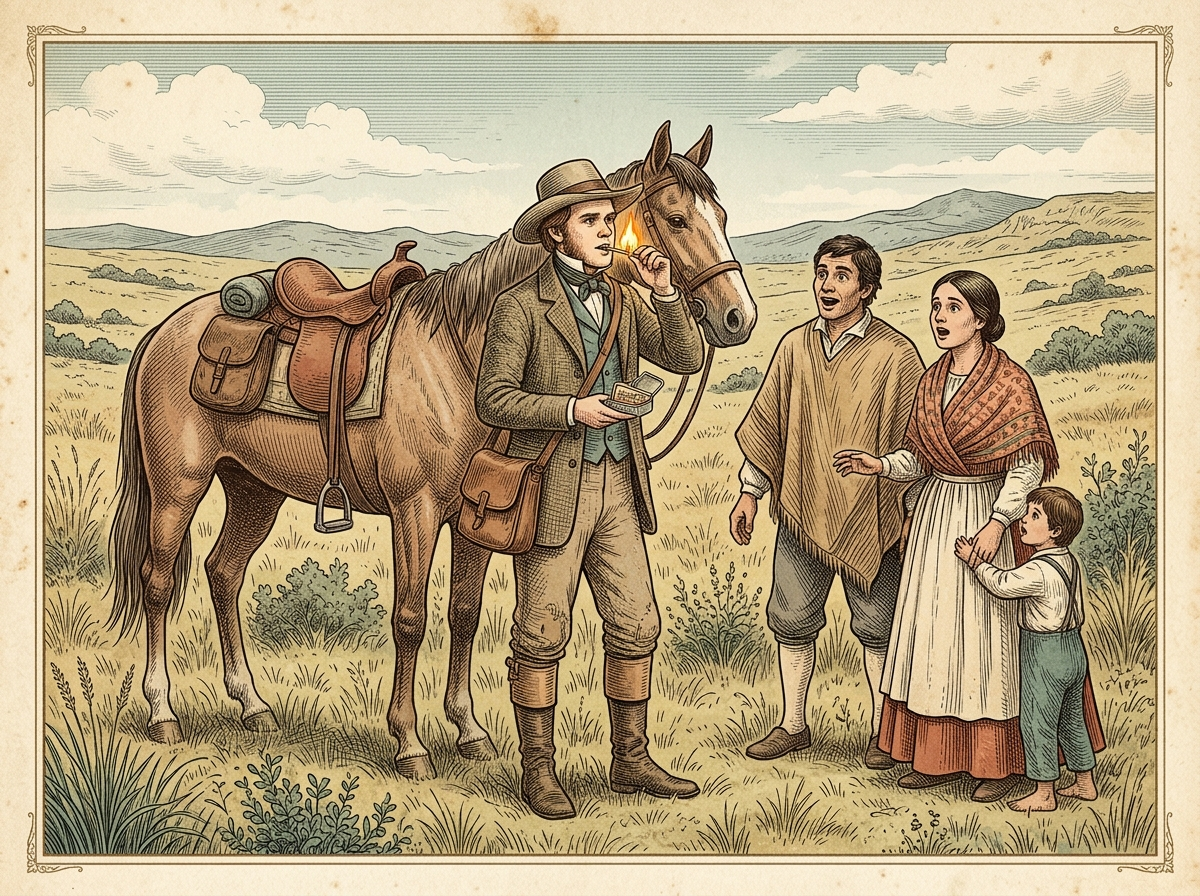
On a ride inland from Maldonado, Uruguay, in 1833, a young Charles Darwin put a small paper-wrapped match between his teeth and bit down. The glass inside cracked, and the match burst into flame. Word spread that a stranger could make fire with his mouth. Whole families gathered to watch, and one man offered him a dollar for a single match.
By the Curiosities Desk · · 5 min read · Filed under Chemistry · Today’s round
What happened?
For most of human history, making fire was a chore. You struck flint against steel to throw sparks onto a scrap of tinder, or you kept embers alive overnight and hoped they lasted.
Chemistry changed that in a hurry. In 1805, Jean Chancel in Paris made a splint tipped with a mixture that flared when you dipped it into a bottle of sulfuric acid — effective, if you didn’t mind carrying acid around.
In 1828, the London inventor Samuel Jones patented a cleverer version: a tiny glass bead of acid wrapped in paper coated with an igniting mixture. Break the bead — with pliers or, as Britannica notes, with your teeth — and the acid soaked the coating and set it alight. These “Promethean” matches, named for the mythical thief of fire, are what Darwin carried on the voyage of HMS Beagle.
But the real breakthrough had already happened, in a pharmacy in the north of England. John Walker, born in 1781 and trained as a surgeon’s apprentice before becoming a “chymist and druggist,” ran a shop at 59 High Street in Stockton-on-Tees. The story told by his biographers is that in 1826 he was mixing a flammable paste when he scraped the dried stirring stick on his hearth, and it caught fire.
Walker turned that accident into a product. His sales ledger records that on 7 April 1827 he sold 100 “Sulphurata Hyperoxygenata Friction” lights to a local solicitor, Mr. Hixon, for one shilling, plus twopence for the tin. The three-inch wooden splints were tipped with equal parts antimony sulfide and potassium chlorate, held together with gum and starch. Each tin came with a folded piece of glass paper: you pinched the match head inside the fold and pulled it out quickly.
Walker was encouraged to patent his invention and refused. He is said to have remarked, “I doubt not it will be a benefit to the public, so let them have it” — a lovely line, though it comes to us secondhand. He had stopped making matches by about 1830, and others quickly sold friction matches of their own, often under the name “lucifers.”
The next leap was a dangerous one. In the early 1830s, the Frenchman Charles Sauria made matches using white phosphorus. They lit on almost any rough surface, and these “strike-anywhere” matches took over the world. They also poisoned the people who made them. In 1839, a Vienna doctor diagnosed the first case of “phossy jaw,” in which phosphorus fumes caused the jawbone to die and rot. In 1888, women and girls at the Bryant & May match factory in London went on strike over their working conditions, and the “matchgirls’ strike” became a landmark in labor history.
The fix came from Sweden. In 1844, the chemist Gustaf Erik Pasch took the phosphorus off the match entirely and put a safer form, red phosphorus, on a separate striking surface. His matches were too expensive and his factory closed in 1848, but the Lundström brothers of Jönköping improved the design, and their “safety match” won a medal at the 1855 Paris World’s Fair. White phosphorus matches were banned under the Berne Convention of 1906; Britain’s ban took effect in 1910, and in 1912 the United States taxed white phosphorus matches at two cents per hundred, effectively pricing them out of existence.
Why was it strange?
People made fire the same basic way for thousands of years, and then, within about forty years, went from bottles of acid to the matchbox we still use. Along the way, the man who made the first practical friction match chose to give it away, and the most successful match of the century turned out to be poison. The eventual solution wasn’t a new miracle chemical. It was splitting the old chemistry in two, so that neither half could cause trouble alone. Walker’s ingredients also echo an earlier oddity: phosphorus itself was first isolated by The Alchemist Who Boiled Urine Looking for Gold and Found Phosphorus.
What did scientists learn?
Every match is a tiny, controlled chemical reaction. It needs a fuel (such as sulfur or antimony sulfide), an oxidizer — a chemical that supplies oxygen, like potassium chlorate — and a small push of energy to get started. Friction provides that push by turning motion into heat.
The challenge is finding the right trigger. White phosphorus ignites at barely above room temperature, which made it a superb trigger and a terrible thing to keep in a pocket or a factory. Red phosphorus is an allotrope of the same element — the same atoms arranged in a different structure — and it is far more stable and much less toxic. In a safety match, the oxidizer sits in the match head while red phosphorus sits in the striker on the box, mixed with powdered glass for grit. When you strike, friction converts a trace of red phosphorus into a more reactive form, which ignites and sets off the head. Keep the two apart and nothing happens. Chemists building better batteries face a similar balancing act between energy and stability, as told in From Frog Legs to Lithium: A Short History of the Battery.
How does it affect us today?
The matchbox in your kitchen drawer is essentially the Lundströms’ 1855 design. Strike-anywhere matches survive too, but they now use a nontoxic compound called phosphorus sesquisulfide instead of white phosphorus.
The match also left a mark on how we protect workers. The 1906 Berne Convention was one of the first international agreements to ban a substance to protect the people who handled it. Doctors still invoke phossy jaw today: when a rare jawbone side effect was linked to certain modern bone drugs, a 2005 paper in the Medical Journal of Australia drew the comparison directly. Darwin’s fire-making trick is another reminder of how a single object can feel like magic, as in The Melted Candy Bar That Invented the Microwave.
Fun fact
The matches weren’t Darwin’s only crowd-pleaser in Uruguay. His pocket compass caused “unbounded astonishment,” because locals couldn’t believe a stranger could find his way to places he had never been.
A note: phossy jaw is a reminder that workplace chemicals can affect health. If you work with hazardous materials and have concerns, an occupational health service or your doctor is a good place to start.
Sources
- Charles Darwin, The Voyage of the Beagle, Chapter III (1839; public domain) — the Promethean matches lit by biting, the family audiences, the dollar offer, and the compass.
- John Walker (1781–1859): Biography, John Walker friction-match online exhibition — Walker’s career, the 7 April 1827 ledger entry, and his refusal to patent.
- What was the chemical composition of Walker’s match heads?, John Walker online exhibition — antimony sulfide and potassium chlorate, the splints, and the glass-paper striker.
- “Samuel Jones”, Encyclopaedia Britannica — Jones’s 1828 acid-bead match.
- Snus & Tändsticksmuseum (Stockholm), The Safety Match — Pasch’s red phosphorus, the Lundström brothers, and the 1855 Paris medal.