Science Through Time · Chemistry
From a Barrel That Exploded on Purpose to the Red Can on Your Wall: A Short History of the Fire Extinguisher
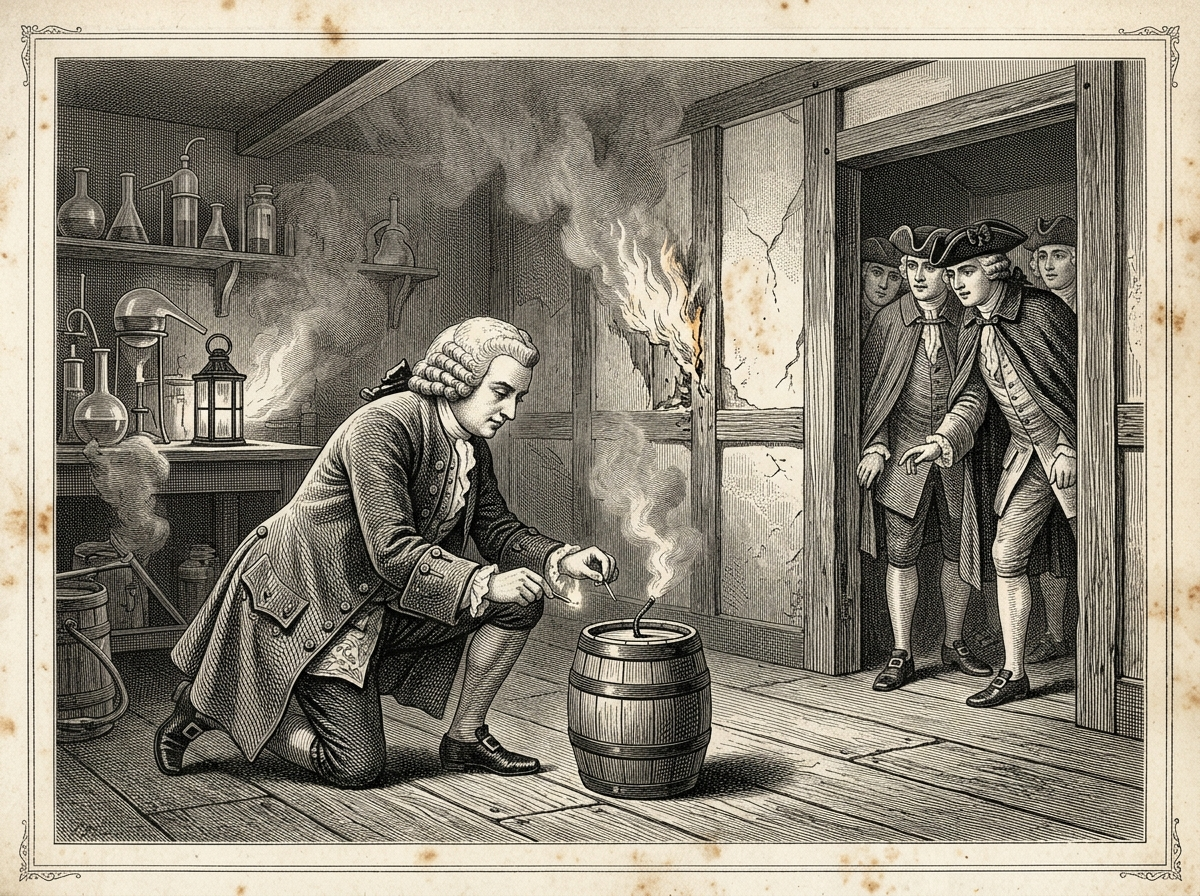
In 1723, a London chemist named Ambrose Godfrey staged two full-sized demonstrations of a fire extinguisher, and several members of the Royal Society came to watch the first. His machine was a wooden cask of treated water with a pewter chamber of gunpowder tucked inside. You lit the fuse, and the cask blew itself apart, flinging water across the flames. Godfrey's own pamphlet the next year named the method plainly: *Extinguishing Fires by Explosion and Suffocation*.
By the Curiosities Desk · · 5 min read · Filed under Chemistry · Today’s round
What happened?
For most of history, fighting a fire meant buckets, hand pumps, and a lot of neighbors. Godfrey, a German-born chemist who had once worked as Robert Boyle’s laboratory assistant, wanted something that could act fast. His patented cask held water “impregnated with a certain preparation” meant to be an enemy to fire, and the gunpowder charge spread it in an instant. In November 1729, a London newspaper, Bradley’s Weekly Messenger, credited one of his machines with stopping a real fire.
The next big step was quieter. By 1816, the Englishman George William Manby, better known for a mortar that fired lifelines to sinking ships, was demonstrating a copper vessel he called the “Extincteur.” It held 3 gallons of pearl ash (potassium carbonate) solution, kept under compressed air. Open the valve, and the pressure pushed out a jet of liquid. That is the basic idea of nearly every portable extinguisher since: a container, an agent that fights fire, and stored pressure to get it out.
Then the Victorians did something charming and slightly alarming. From around 1880, homes and workplaces hung up “fire grenades”: decorative glass bottles, often bright blue, filled with about a pint of liquid. In a fire, you grabbed one from its wall rack and threw it at the base of the flames, hoping the glass would shatter in the right place. The Henry Ford museum holds a royal-blue example from the Harden Hand Fire Extinguisher Company of Chicago, molded with patent dates of 1871 and 1883. Some grenades hung from ceiling brackets, where heat would break the glass and release the contents like a simple sprinkler. With only a pint inside, how much good they did is uncertain.
Meanwhile, chemists were building extinguishers that made their own pressure. In 1866, France’s François Carlier patented a “soda-acid” design. Later American versions held a vial of sulfuric acid above a solution of sodium bicarbonate (baking soda). Flip the can over, the acid spills in, and the reaction makes carbon dioxide gas, which drives the water out of the nozzle. In 1904, the Russian inventor Aleksandr Loran used a similar trick to make foam: two solutions that, when mixed, frothed into a blanket that floated on burning oil.
In 1910 and 1911, the Pyrene Manufacturing Company patented a new liquid and a small hand-pumped extinguisher to spray it: carbon tetrachloride, known as “carbon tet.” It didn’t conduct electricity and turned into a heavy vapor that smothered flames. Grenades were soon filled with it too. In 1924, the Walter Kidde Company built a carbon dioxide extinguisher for Bell Telephone, which needed something safe to use on switchboard fires.
Why was it strange?
The first extinguisher fought fire with an explosion, and later ones fought fire with glassware you threw like a baseball. But the strangest twist came from the chemistry that seemed like a miracle. Carbon tet is toxic on its own, and when heated, it can break down into phosgene, the same gas used as a chemical weapon in World War I. A liquid sold to protect people in fires could, in a fire, produce something deadly. Carbon tet extinguishers were withdrawn in the 1950s. The chemist who later helped create a whole family of “safe” refrigerant chemicals has a similarly complicated legacy, told in The Chemist Who Put Lead in Gasoline and Holes in the Ozone.
What did scientists learn?
Fire needs three things, often called the fire triangle: fuel, heat, and oxygen. Early extinguishers attacked heat and oxygen. Water soaks up heat as it warms and turns to steam. Carbon dioxide and foam push oxygen away, which is what Godfrey meant by “suffocation.”
Carbon tet taught chemists something new. At first it was thought to work mainly by crowding out oxygen. Later research showed that certain compounds containing chlorine or bromine actually interrupt the chain reaction inside a flame — the rapid back-and-forth of short-lived molecular fragments that keeps burning going. That insight is why fire scientists now often speak of a fire “tetrahedron,” adding the chain reaction as a fourth side. It led to halons, bromine-based agents developed in the late 1940s and 1950s, which were extremely effective and less toxic than carbon tet. Fire chemistry runs on the same balance of fuel and oxidizer as the match, as told in From Matches You Lit With Your Teeth to the Safety Match: A Short History of the Match.
How does it affect us today?
Halons turned out to have a hidden cost: the bromine in them damages the ozone layer. Under the 1987 Montreal Protocol, nations agreed to limit them, and the United States ended production and import of new halons on January 1, 1994. Recycled halon is still used where nothing else will quite do, including on civil aircraft.
The red can on your wall is the descendant of all these experiments. Most modern home extinguishers use dry chemical powder, pushed out by stored pressure just as Manby’s was. Some even carry a modern version of the soda-acid recipe: sodium bicarbonate is a common extinguishing powder. Each label lists the kinds of fire it’s rated for, a quiet record of three centuries of lessons. And the long road from Godfrey’s lab to your kitchen started with phosphorus, a story told in The Alchemist Who Boiled Urine Looking for Gold and Found Phosphorus.
Fun fact
The man who invented the exploding fire extinguisher made his living selling one of the most flammable substances known. Ambrose Godfrey’s main business was manufacturing white phosphorus, which can ignite on its own in air, and he became known for the best phosphorus available.
A note: if you have an extinguisher at home, check that its pressure gauge reads in the green and that everyone knows where it is. Your local fire service can advise on the right type for your home.
Sources
- Ambrose Godfrey, An Account of the New Method of Extinguishing Fires by Explosion and Suffocation (London, 1724), first-edition description by Nigel Phillips Rare Books — the gunpowder cask, the two 1723 demonstrations, and the Royal Society audience.
- The Henry Ford, Harden Glass Fire Grenade, circa 1885 — the Chicago grenade, its patent dates, and how it was thrown.
- Sophie Walter, London Fire Brigade Museum, “The beauty and danger in Victorian glass fire grenades”, Museum Crush (2020) — grenade contents, racks and ceiling brackets, and carbon tetrachloride’s phosgene risk.
- U.S. Patent 1,105,263, Joseph W. Durkee for the Pyrene Manufacturing Company (filed 1911) — the hand-pumped carbon tet extinguisher.
- U.S. Environmental Protection Agency, Halons Program — the January 1, 1994 end of new halon production and continued use of recycled halon on aircraft.