Science Gone Wrong · Chemistry
The Chemist Who Put Lead in Gasoline and Holes in the Ozone
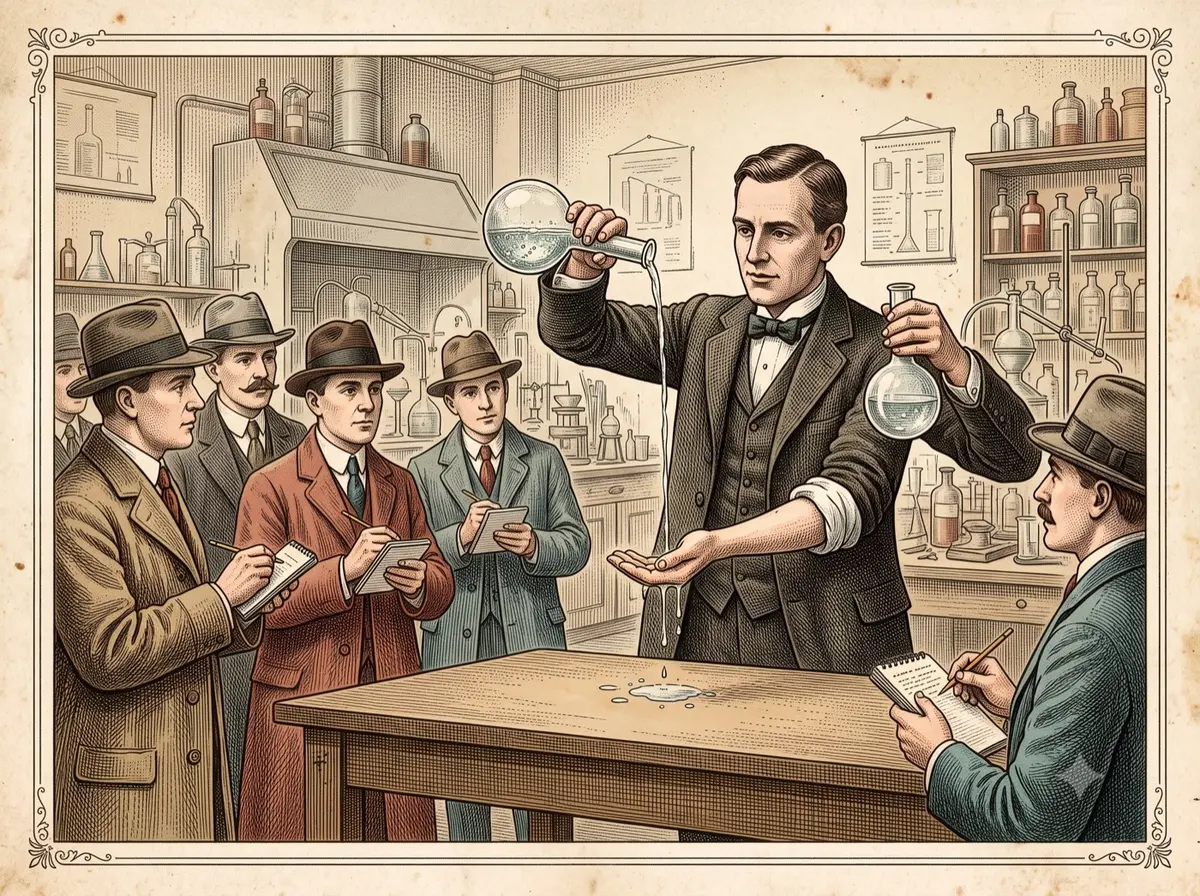
In October 1924, a chemist stood before a room of reporters, unscrewed a flask of a clear liquid, poured it over his bare hands, and then held the open container under his nose and breathed in for a full minute. The liquid was tetraethyl lead. He wanted everyone to see it was perfectly safe. What he did not mention was that he had spent part of the previous year recovering from lead poisoning caused by the very same compound.
By the Curiosities Desk · · 6 min read · Filed under Chemistry · Today’s round
Part of When the Experiment Left the Lab
What happened: Leaded Gasoline
Thomas Midgley Jr. was born in 1889 and trained as a mechanical engineer at Cornell, but he made his name as a chemist inside the research empire of Charles Kettering at General Motors. In the early 1920s, car engines had an irritating problem called “knock” — a premature, rattling detonation of fuel that wasted power and could damage the engine. Midgley was assigned to find a chemical that would stop it.
After years of testing one additive after another, in December 1921 his team found that a tiny amount of tetraethyl lead, blended into gasoline, made knock vanish. It worked beautifully. General Motors, DuPont, and Standard Oil formed a company to sell it, and made a marketing decision that tells you they understood the danger: they called the additive “Ethyl” and kept the word “lead” off the label entirely.
Lead is a potent neurotoxin, and the people who manufactured the concentrated additive paid first. Workers at the production plants began to hallucinate, convulse, and lose their minds; one plant was nicknamed “the House of Butterflies” because so many workers were tormented by visions of insects. At Standard Oil’s Bayway refinery in New Jersey, a cluster of poisonings in October 1924 killed five men in days. It was against this backdrop that Midgley held his hand-washing press conference to insist the product was safe.
That was not the end of his career — it was the warm-up. A few years later, Kettering handed Midgley a new problem. The refrigerators of the late 1920s ran on gases like ammonia, sulfur dioxide, and propane, which were variously toxic or explosive; leaks sometimes killed whole families in their sleep. Midgley was asked to invent a refrigerant that was safe. In 1928 he and his team synthesized dichlorodifluoromethane — a chlorofluorocarbon, soon sold under the name Freon. To prove it was nontoxic and nonflammable, he reportedly took a lungful of the gas and slowly exhaled it across a lit candle, snuffing out the flame. The compound seemed like a miracle: stable, cheap, and harmless to breathe.
Midgley died in 1944, celebrated and decorated, never knowing that both of his great inventions would later be recognized as environmental catastrophes.
Why it was strange: Leaded Gasoline
The strangeness isn’t that one experiment went wrong. It’s that one quiet, well-meaning chemist managed, in a single career, to release two of the most damaging substances of the twentieth century — and that in each case the danger was the flip side of the very property that made the invention brilliant. Tetraethyl lead worked because lead is chemically useful and persistent; that persistence is exactly why it accumulated in soil, air, and children’s blood for decades. Freon was prized because it was so stable it reacted with nothing; that same stability let it drift, intact, all the way up to the stratosphere, where it would do its damage. Midgley didn’t cut corners out of malice. He solved the problems he was given, brilliantly, and the solutions were poison on a planetary scale.
Another time it went sideways: The Molecule So Foul a Waitress Sprayed Deodorant at the Chemists Who Made It.
What scientists learned: Leaded Gasoline
The lead story unraveled slowly, then all at once. Geochemist Clair Patterson, while trying to measure the age of the Earth in the 1950s, kept finding his samples contaminated with lead — and traced the source to the leaded gasoline saturating the modern environment. His work, and the public-health research that followed, established that there is no safe level of lead exposure, and that the low-level lead breathed in from car exhaust was lowering children’s IQs across entire populations.
The Freon story broke in 1974, when chemists Mario Molina and F. Sherwood Rowland published a paper predicting that CFCs, once they floated into the upper atmosphere and were broken apart by sunlight, would release chlorine atoms that destroy ozone — the thin layer of gas that shields life from the sun’s ultraviolet radiation. A single chlorine atom can chew through thousands of ozone molecules. In 1985, scientists confirmed a vast seasonal “hole” in the ozone over Antarctica. Molina, Rowland, and Paul Crutzen shared the 1995 Nobel Prize in Chemistry for the work.
Another good intention with a bad landing: The Weedkiller That Made New Zealand’s Trousers Explode.
How it reaches us today: Leaded Gasoline
Both of Midgley’s inventions have now been deliberately undone — a rare case of the world recognizing a mistake and reversing it. The 1987 Montreal Protocol phased out CFCs worldwide, and the ozone layer is slowly healing; it is projected to recover over the coming decades. Leaded gasoline was banned for ordinary cars in the United States by 1996, and in 2021 the United Nations announced that the last country still selling it had finally stopped, ending a roughly century-long experiment in poisoning the air. The cleanups stand as proof that global environmental harm can be measured, agreed upon, and rolled back — the template for how humanity now thinks about problems like the ozone hole’s larger cousin, climate change.
A close cousin: The Minister Who Sold Gold From Seawater — With a Diver Hiding Under the Wharf.
Fun fact: Leaded Gasoline
Midgley’s life ended with one last invention turning on him. Disabled by polio in his early fifties, he rigged an elaborate system of ropes and pulleys to hoist himself out of bed without help. In 1944 he became tangled in the contraption and died of strangulation, at age 55 — killed, like so much else he touched, by one of his own devices. The environmental historian J.R. McNeill later wrote that Midgley “had more impact on the atmosphere than any other single organism in Earth’s history.”
Sources: Leaded Gasoline
- Encyclopaedia Britannica, “Thomas Midgley, Jr.” — https://www.britannica.com/biography/Thomas-Midgley-Jr
- Science History Institute, “Thomas Midgley Jr.” — https://www.sciencehistory.org/education/scientific-biographies/thomas-midgley-jr/
- U.S. EPA, history of the leaded gasoline phase-out — https://www.epa.gov/history/milestones-epa-and-environment
- UN Environment Programme, “Era of leaded petrol over” (2021) — https://www.unep.org/news-and-stories/press-release/era-leaded-petrol-over-eliminating-major-threat-human-and-planetary
- NobelPrize.org, 1995 Nobel Prize in Chemistry (Crutzen, Molina, Rowland) — https://www.nobelprize.org/prizes/chemistry/1995/summary/
A note: this story touches on poisoning and death. It’s history, not health advice — but if you’re concerned about lead exposure in your own home or water, your local public health department can point you to testing and resources.
Related stories: Leaded Gasoline
- The Chemist Who Fed the World and Gassed the Trenches — The man who fed billions and invented gas warfare
- The Radioactive Tonic That Dissolved a Millionaire’s Jaw — A radium tonic that dissolved a millionaire’s jaw
- The Watch Painters Who Glowed in the Dark — The watch painters who licked radium brushes and glowed