Science Gone Wrong · Chemistry
The Weedkiller That Made New Zealand's Trousers Explode
A pair of trousers hangs drying in front of a farmhouse fire in Taranaki, New Zealand. No one is wearing them. No one is anywhere near them. Then, with a bang, they explode. The farmer, Richard Buckley, grabs the burning garment and hurls it out onto the lawn — where, according to newspaper accounts of the era, it keeps popping with small explosions in the grass. Across 1930s New Zealand, this scene repeated itself in farmhouse after farmhouse: trousers detonating on washing lines, smoldering in saddles, and igniting on the men wearing them. The culprit wasn't sabotage. It was a weedkiller the government had recommended.
By the Curiosities Desk · · 5 min read · Filed under Chemistry · Today’s round
Part of When the Experiment Left the Lab
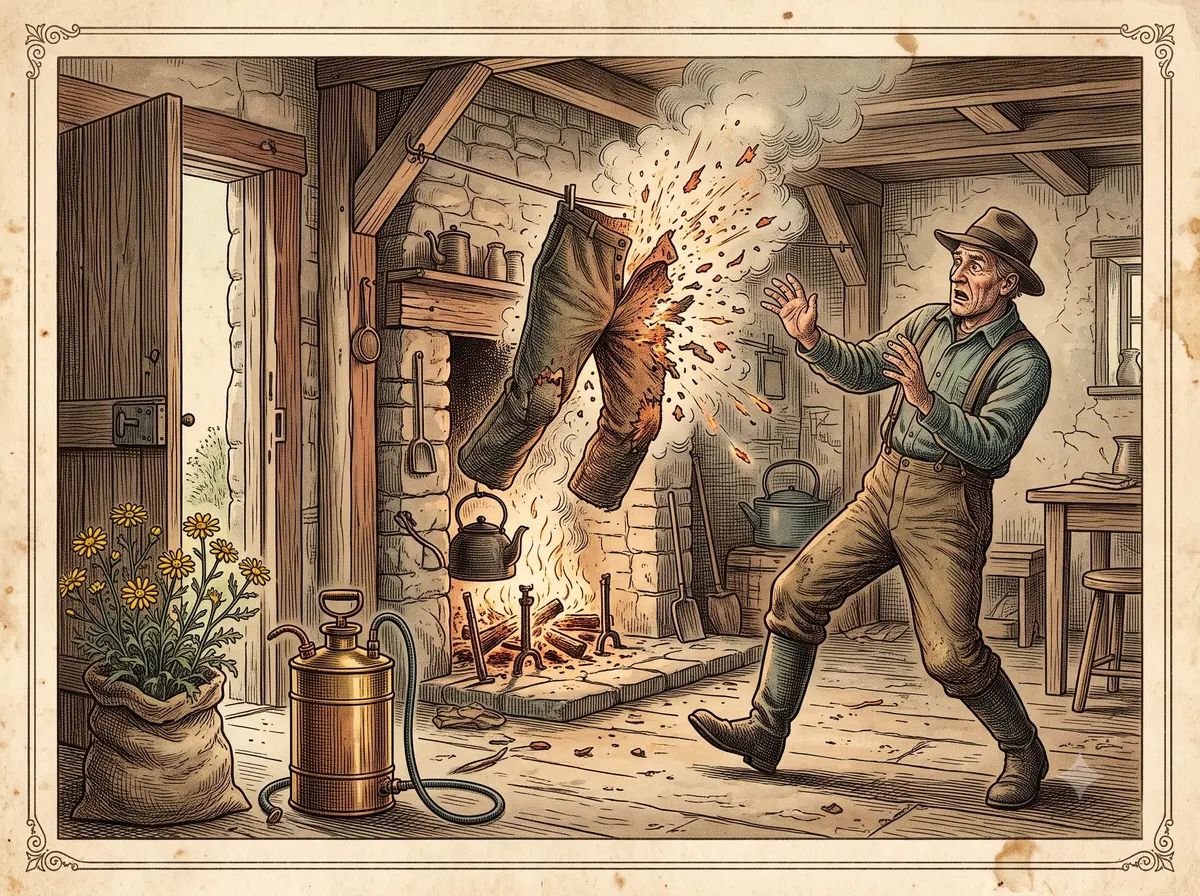
What happened: The Weedkiller That Made New Zealand's Trousers Explode
The story starts with a plant. Ragwort — Jacobaea vulgaris, a European weed with cheerful yellow flowers — arrived in New Zealand in the 19th century and found paradise. It’s poisonous to cattle and horses, though sheep can graze it with relative impunity, and for decades sheep did exactly that, keeping the weed in check.
Then farming changed. In the early 20th century, New Zealand’s booming dairy industry converted pasture after pasture from sheep to cows. Cows, sensibly, refuse to eat a plant that poisons them. Freed from its woolly predators, ragwort spread across the country’s dairyland, crowding out the grass the cows actually needed. By 1930 farmers were desperate, and the Department of Agriculture had an answer: sodium chlorate, a chemical herbicide that a 1930 article had praised as a ragwort killer. The government encouraged farmers to mix it with water and spray it on the weeds.
It worked. The ragwort died. But sodium chlorate has a second personality that the spray instructions did not advertise. It is a powerful oxidizer — a chemical that aggressively feeds combustion, the same family of compounds used in fireworks and match heads. As farmers sprayed, the solution soaked into their work clothes. The water evaporated; the chlorate stayed, crystallizing into the wool and cotton fibers. Each treated pair of trousers had quietly become something close to slow-burning fuse material, ready to ignite from a flame, radiant heat, or even a sharp impact.
The most famous casualty belonged to Richard Buckley, a farmer from the Hawera district, whose trousers went off in 1931 while drying in front of his fire — the incident that gave the whole episode its name. He escaped unharmed. Others were less lucky. Contemporary reports collected by historian James Watson describe trousers bursting into flame on a rider whose saddle friction warmed them, laundry igniting on the line, and men badly burned when the clothes they were wearing caught. A handful of farmers died — one man fatally burned after he struck a match in his unelectrified farmhouse, simply trying to check on his baby in the dark.
The panic faded as word spread and farmers learned to handle the chemical warily, wash contaminated clothing, and keep it far from flame. The exploding-trousers era became a strange national memory — until 2004, when Watson, a historian at Massey University, published a scholarly account in the journal Agricultural History with one of the great academic titles: “The Significance of Mr. Richard Buckley’s Exploding Trousers.” It won him the 2005 Ig Nobel Prize for Agricultural History.
Why it was strange: The Weedkiller That Made New Zealand's Trousers Explode
Weedkillers are supposed to be dangerous to weeds. The idea that a government-recommended farm chemical could turn a man’s laundry into an incendiary device violates a basic assumption — that the hazard of a product lives in the bottle, not in your wardrobe three days later. Stranger still, the trousers didn’t need anyone to do anything wrong. Farmers followed the instructions, sprayed the weeds, and went home. The danger assembled itself invisibly, in the fibers of drying cloth.
And the deeper strangeness is the chain of causation. The explosions weren’t really caused by a chemical, or even by a weed. They were caused by an economic shift: New Zealand switched from sheep to dairy cows, cows wouldn’t eat ragwort, ragwort exploded across the landscape, and the emergency fix exploded across farmers’ laundry lines. That’s Watson’s actual scholarly point — the trousers were collateral damage from technological change in farming.
Another time it went sideways: The Chemist Who Put Lead in Gasoline and Holes in the Ozone.
What scientists learned: The Weedkiller That Made New Zealand's Trousers Explode
The chemistry is a textbook lesson in oxidizers. Ordinary cloth burns slowly because combustion has to pull oxygen from the surrounding air. Impregnate that cloth with sodium chlorate and the fuel and the oxygen supply are packed together in the same material, so ignition is faster, hotter, and startlingly violent. In 2006, the television show MythBusters tested the scenario and confirmed it: cotton clothing treated with sodium chlorate and dried ignited vigorously from flame, radiant heat, and impact. Strictly speaking, chemists would call the result a rapid combustion rather than a true detonation — but if it happens in your trousers, “explosion” is the word you’ll use.
The episode also became an early, vivid case study in what safety researchers now treat as routine: a chemical’s hazards follow it out of the container, into clothing, skin, and homes, and instructions need to account for how people actually live and work.
Another good intention with a bad landing: The Minister Who Sold Gold From Seawater — With a Diver Hiding Under the Wharf.
How it reaches us today: The Weedkiller That Made New Zealand's Trousers Explode
Sodium chlorate’s fire-feeding behavior eventually caught up with it worldwide — many countries have since restricted or withdrawn it as a home and farm herbicide, in part because of exactly the fire and contamination risks New Zealand discovered the hard way. Modern pesticide labels, with their warnings about contaminated clothing and instructions to wash work garments separately, are the direct descendants of lessons like this one. Ragwort, for its part, is still in New Zealand — now managed with modern herbicides and biological controls like the cinnabar moth and the ragwort flea beetle, which eat the weed without setting anyone’s laundry on fire.
A close cousin: The Navy That Swapped Lemons for Limes — and Forgot How to Cure Scurvy.
Fun fact: The Weedkiller That Made New Zealand's Trousers Explode
When New Scientist published a 2011 anthology of history’s oddest scientific mishaps, the exploding trousers won the title slot: the book is called Farmer Buckley’s Exploding Trousers and Other Odd Events on the Way to Scientific Discovery.
A small practical note from the modern era: oxidizing chemicals — including some pool and garden products — can still make fabric flammable. If a label says to wash contaminated clothing promptly, that instruction has history behind it.
Sources: The Weedkiller That Made New Zealand's Trousers Explode
- Watson, James. “The Significance of Mr. Richard Buckley’s Exploding Trousers: Reflections on an Aspect of Technological Change in New Zealand Dairy Farming between the World Wars.” Agricultural History 78, no. 3 (2004): 346–360
- “Trousers Explode.” Evening Post, 21 April 1933 — Papers Past, National Library of New Zealand
- “Dr Watson and the exploding trousers.” Massey University News, 10 October 2005 (archived)
- Ig Nobel Prize winners, 2005 — Improbable Research
- Grundhauser, Eric. “The Bizarre Case of New Zealand’s Exploding Pants.” Atlas Obscura, 20 September 2017
Related stories: The Weedkiller That Made New Zealand's Trousers Explode
- The Molecule So Foul a Waitress Sprayed Deodorant at the Chemists Who Made It — A stench so foul a waitress sprayed the chemists with deodorant
- The Chemical That Sets Fire to Sand — and the Rocket Chemist Who Recommended Running Shoes — A chemical that sets sand, asbestos, and test engineers on fire
- The Day a 25-Foot Wave of Molasses Flooded a Boston Neighborhood — A storage tank burst and sent a molasses wave through Boston