Impossible Inventions · Chemistry
The Chemical That Sets Fire to Sand — and the Rocket Chemist Who Recommended Running Shoes
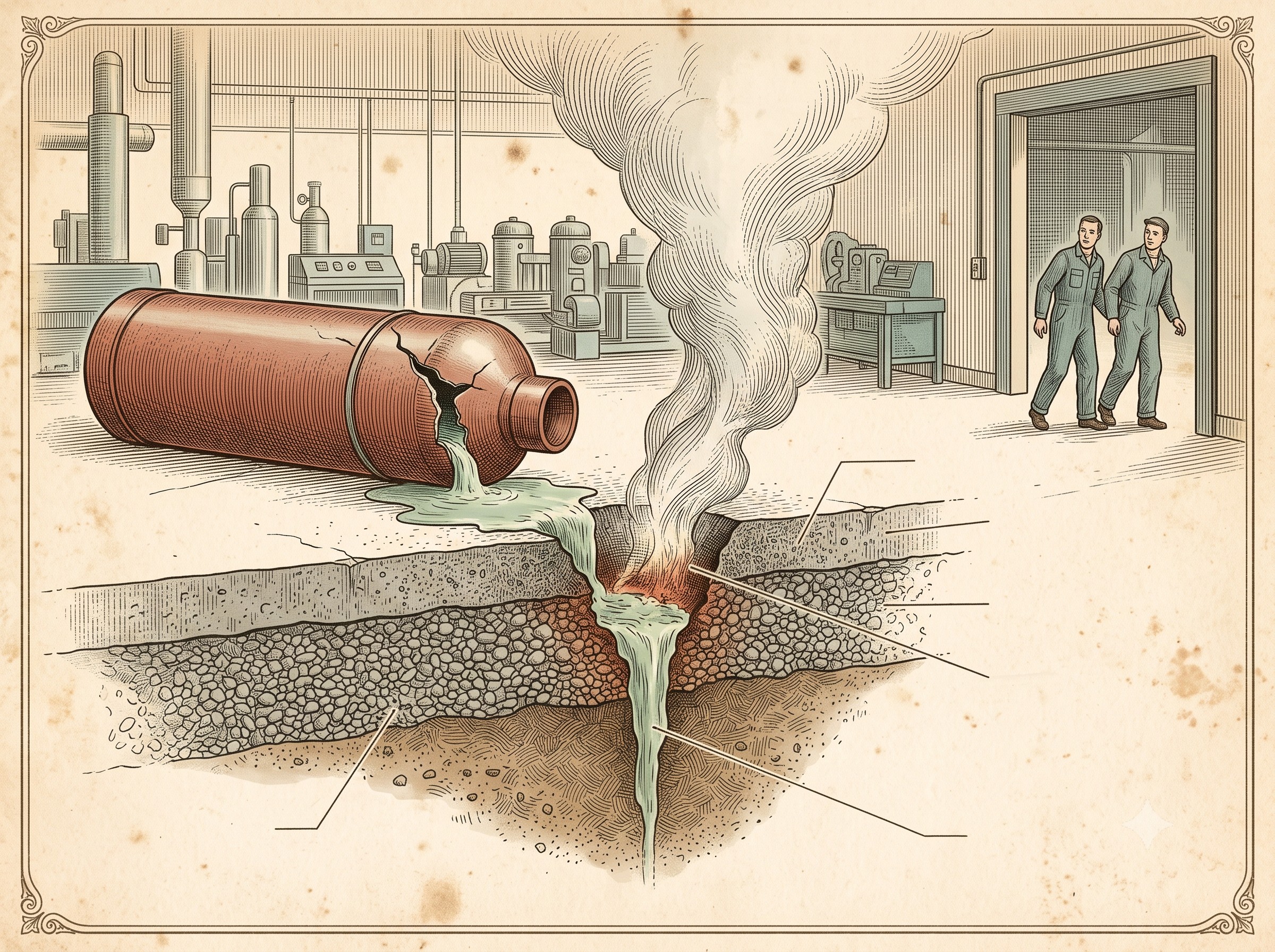
A one-ton steel cylinder cracked open on the floor of a Louisiana chemical plant. What poured out did not puddle, or evaporate, or burn in any of the ways a spilled chemical is supposed to burn. It set the concrete on fire. Then it ate a foot down through the slab, kept going three more feet into the gravel underneath, and filled the building with fumes that would have burned anyone who tried to get close enough to stop it.
· 5 min read · Filed under Chemistry
What happened?
The substance was chlorine trifluoride — one chlorine atom holding three fluorines in a lopsided T-shape. It was first made in 1930 by the German chemists Otto Ruff and H. Krug, who pushed fluorine gas over chlorine and distilled out the result. At room temperature it is a colorless gas; under modest pressure it becomes a pale greenish-yellow liquid. In practice it is one of the most aggressive oxidizers ever handled at industrial scale — an oxidizer being the partner in a fire that strips electrons from the fuel, the role oxygen usually plays.
Chlorine trifluoride plays that role better than oxygen does. It will burn things that have already burned in oxygen, including ash. It ignites sand, glass, and asbestos on contact.
Nazi Germany noticed. Under the code name N-Stoff (“substance N”), the compound was investigated for military use by the Kaiser Wilhelm Institute from shortly before the war. Tests against mock-ups of France’s Maginot Line fortifications suggested it worked as an incendiary and a poison gas at the same time. From 1938, construction began at Falkenhagen, east of Berlin, on a partly buried 14,000-square-meter munitions plant intended to turn out 50 tonnes of N-Stoff a month alongside the nerve agent sarin.
It never got close. By the time the Red Army overran the site in 1945, the factory had produced perhaps 30 to 50 tonnes in total, at a cost of more than 100 Reichsmarks per kilogram. N-Stoff was never used in the war. The plant had a stranger second life: from 1965 the Warsaw Pact ran its main command bunker outside the USSR out of those same tunnels, and handed the empty concrete back to Germany in 1993.
After the war, American rocket engineers took a serious look at chlorine trifluoride as a storable propellant oxidizer, and Rocketdyne published a full Air Force handling manual for it in 1961. The chemist John D. Clark, who spent his career developing liquid rocket propellants, later recorded the working experience in his memoir Ignition! — and it is Clark who describes the Louisiana spill. A one-ton cylinder at a General Chemical facility had been chilled with dry ice to make filling easier; the cold appears to have made the steel brittle, and the cylinder split. Roughly 900 kilograms went onto the floor and, by Clark’s account, burned through about 30 centimeters of concrete and 90 centimeters of gravel beneath it.
Why was it strange?
Most dangerous chemicals are dangerous in a way you can plan around. You keep them cold, or dry, or away from sparks. Chlorine trifluoride removes the planning.
The problem is that it converts the ordinary categories of fire safety into nonsense. “Fireproof” means “has already reacted with oxygen and has nothing left to give” — which is exactly the class of material chlorine trifluoride is happiest to attack. Asbestos, sand, and firebrick are not shields; they are fuel. Water is not a suppressant; it reacts explosively, producing hydrofluoric and hydrochloric acid as hot vapor. Carbon dioxide extinguishers are counterproductive. The 1961 Rocketdyne manual lists essentially one usable response: flood the space with nitrogen or a noble gas like argon, then keep the surroundings cool and wait for it to finish.
And yet it can be stored — in steel, copper, nickel, or aluminum — for the same reason aluminum foil doesn’t burst into flame in air. The metal reacts instantly and builds a microscopically thin fluoride skin that shields everything underneath. The entire containment strategy is a coat of corrosion a few molecules thick.
What did scientists learn?
Fluorine sits at the far end of the periodic table’s appetite for electrons; it is the most electronegative element there is. Bolt three fluorines onto a chlorine and you get a molecule that is straining to hand them off to almost anything. That makes chlorine trifluoride hypergolic — it ignites on contact with a fuel, no spark required — with essentially every fuel anyone tested, and with a good deal of the laboratory furniture besides.
For rocketry, that sounded ideal. Hypergolic propellants don’t need an ignition system, and unlike liquid oxygen, chlorine trifluoride can be stored at room temperature — useful for a missile that has to sit in a silo for years. The engineering lesson was that thermodynamic performance is only half of a propellant’s score. The other half is whether people can pump it, weld near it, ship it, and clean it up afterward. On that second axis chlorine trifluoride failed badly enough that its paper advantages never mattered, and it was abandoned as a rocket oxidizer.
The deeper takeaway — passivation, the trick of letting a material grow its own protective corrosion layer — turned out to be far more useful than the propellant ever was, and is now standard practice across chemical engineering.
How does it affect us today?
Chlorine trifluoride never went away; it just found work where its ferocity is the point. Several hundred tonnes are made each year, most of it for the semiconductor industry, where it cleans chemical-vapor-deposition chambers: silicon residue builds up on the walls, and chlorine trifluoride strips it off as a gas without anyone having to dismantle the machine. It doesn’t even need a plasma to activate it — the chamber’s own heat is enough. It also converts uranium into the hexafluoride used for enrichment.
So the chemical that defeated a wonder-weapon program and a rocket program is now a tightly regulated janitor inside the machines that make the chip in your phone.
Fun fact
Clark’s assessment in Ignition! is probably the most-quoted passage in the history of propellant chemistry. After noting that chlorine trifluoride is hypergolic “with such things as cloth, wood, and test engineers, not to mention asbestos, sand, and water,” he described what happens if the protective fluoride film on a tank ever gets scrubbed away and the operator faces a metal-fluorine fire: “For dealing with this situation, I have always recommended a good pair of running shoes.”
A note: chlorine trifluoride is severely toxic and causes deep chemical and thermal burns. It is handled only under industrial controls by trained people — this is a story about that history, not a suggestion to go looking for the stuff.
Sources
- Rocketdyne, Chlorine Trifluoride Handling Manual, AF/SSD-TR-61-9 (September 1961) — the primary handling document, including fire-control procedure
- Otto Ruff and H. Krug, “Über ein neues Chlorfluorid — ClF₃,” Zeitschrift für anorganische und allgemeine Chemie 190 (1930): 270–276 — the original synthesis
- John D. Clark, Ignition! An Informal History of Liquid Rocket Propellants (Rutgers University Press, 1972), p. 214 — the “running shoes” passage and the account of the one-ton spill
- Benno Müller-Hill, “A poisonous present,” Nature 438 (2005): 427 — review of Florian Schmaltz’s study of Kaiser Wilhelm Institute chemical-weapons research, including N-Stoff
- NIOSH Pocket Guide to Chemical Hazards: Chlorine trifluoride (#0117) — current exposure limits and hazard data
Related stories
- The Molecule So Foul a Waitress Sprayed Deodorant at the Chemists Who Made It — A stench so foul a waitress sprayed the chemists with deodorant
- Greek Fire: The Byzantine Weapon That Burned on Water — and Whose Recipe Died With the Empire — A Byzantine weapon that burned on water, its recipe lost forever
- The Weedkiller That Made New Zealand’s Trousers Explode — A weedkiller that turned New Zealand’s farm trousers into fire hazards