Impossible Inventions · Chemistry
The Car Henry Ford Tried to Grow From Soybeans — and the Axe He Swung to Prove Plastic Was Tough
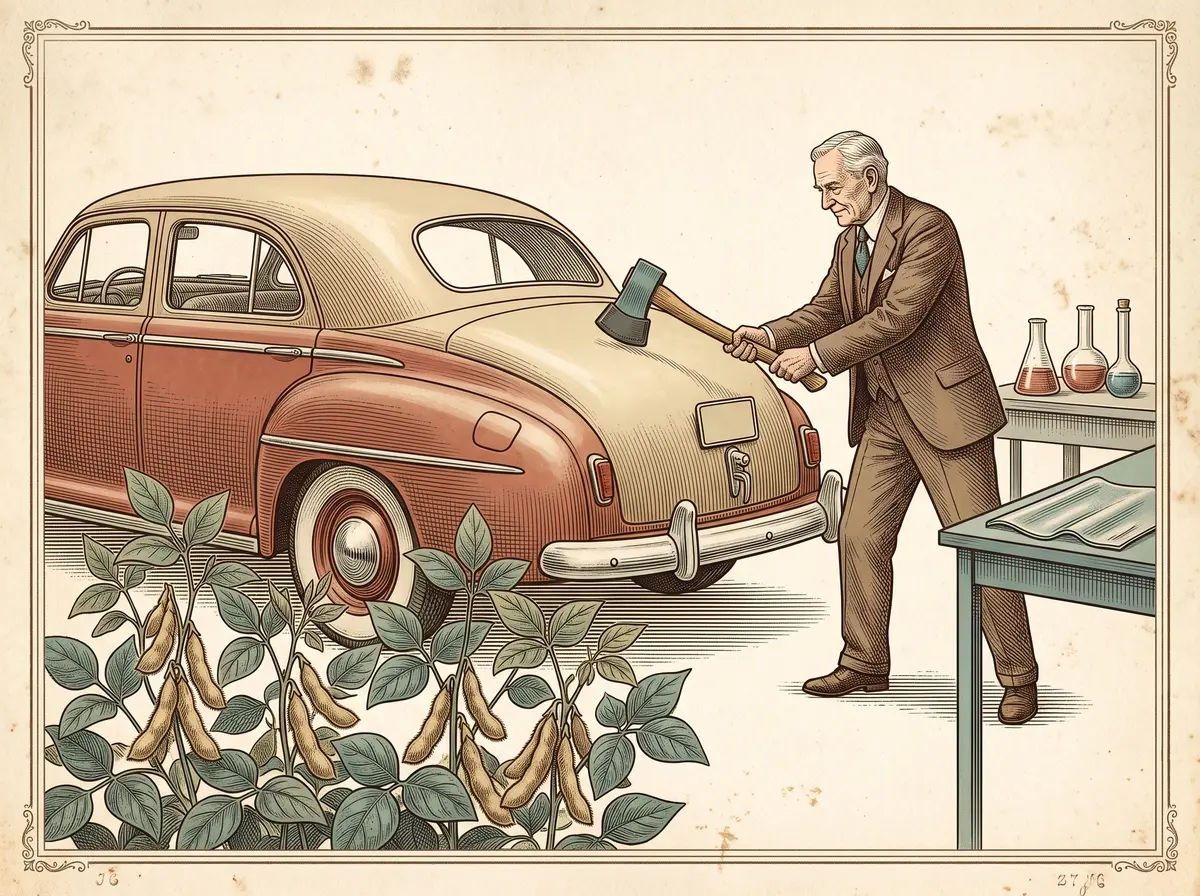
On November 2, 1940, a photographer caught Henry Ford, then 77 years old and one of the richest men in the world, winding up like a lumberjack and bringing an axe down on the trunk of his own car. He wasn't angry at it. He was showing off. The trunk lid was made of plastic his chemists had pressed from soybeans, and Ford wanted the world to see it bounce back.
By the Curiosities Desk · · 5 min read · Filed under Chemistry · Today’s round
What happened: The Car Henry Ford Tried to Grow From Soybeans — and the Axe He Swung to
Henry Ford grew up on a Michigan farm, and he never stopped believing that farmers and factories should need each other. By the late 1920s his company was advertising a dream of “Transforming Crops into Motor Car Materials.” In 1931 Ford began pouring money into soybean research, and his team built a dedicated soybean laboratory in Greenfield Village, the history park he had founded in Dearborn. The idea had a name at the time: chemurgy, the effort to turn farm crops into raw materials for industry.
The lab was busy. Soybean oil went into the enamel paint on Ford cars. Ground soybean meal was molded into small plastic parts like gearshift knobs and horn buttons. At the 1934 Century of Progress world’s fair in Chicago, Ford even hosted an all-soybean dinner to show the crop’s range. By the late 1930s, chemist Robert A. Boyer was overseeing experiments to press soy-based plastic into sheets thick and hard enough to stand in for steel.
That’s where the axe comes in. A plastic rear deck lid was fitted to Ford’s personal car, and in 1940 he took a swing at it for the cameras. According to The Henry Ford museum, which holds the photograph, the sharp edge of the axe was covered with a rubber boot, and the axe reportedly flew about 15 feet out of his hands on the rebound. One detail often gets lost in the retelling: the car in the famous picture is not the “Soybean Car.” It’s Ford’s own car wearing one experimental panel.
The full car came next. Ford first gave the job to E.T. “Bob” Gregorie of the Styling Department, then moved it to the soybean lab under Lowell E. Overly, a tool-and-die designer, with Boyer assisting. On August 13, 1941, Ford unveiled the result at Dearborn Days, a local community festival. It was a sleek prototype built on a tubular steel frame, with 14 plastic panels bolted on in place of a steel body. The museum puts its weight at about 2,000 pounds, roughly 1,000 pounds lighter than a comparable steel car. Ford claimed the plastic body would make cars safer and could survive a rollover without being crushed.
Four months later, the United States entered World War II. Civilian car production was suspended, a second plastic car was abandoned partway through construction, and the project never restarted. The prototype itself is gone. According to Overly, Gregorie destroyed it.
Why it was strange: The Car Henry Ford Tried to Grow From Soybeans — and the Axe He Swung to
We picture plastic as a petroleum product. Ford was trying to make it from something you could plant in spring and harvest in fall, at a time when the American auto industry ran on steel. The pitch wasn’t only engineering. It was economics and a little bit of philosophy: if a car could be partly grown, every new car sold would also be a sale for an American farmer.
And then there’s the mystery. Nobody is completely sure what the car was made of. No record of the formula survives. A 1941 New York Times report described a material derived from soybeans, wheat, and corn. Another account says the blend included hemp, flax, and ramie. Overly, who actually built it, later described it as “soybean fiber in a phenolic resin with formaldehyde used in the impregnation.” Phenolic resin was itself a synthetic plastic made from chemicals usually sourced from coal tar, which suggests the “soybean car” may have been less soybean than its name implies. (This gap is also why internet claims that Ford built a car “made of hemp” are better treated as an unproven tradition than a documented fact.)
If you like stories where a carmaker goes to the fields for parts, Ford also backed The 12-Foot Weed Thomas Edison Bred to Make Car Tires.
What scientists learned: The Car Henry Ford Tried to Grow From Soybeans — and the Axe He Swung to
Plastics are polymers: very long molecules built from small repeating units linked into chains. Soybeans are rich in two useful raw materials, oil and protein. Proteins are natural polymers already, and with heat, pressure, and chemical help, soy protein and soy fiber can be bound into a hard, moldable material.
The catch is that a “bioplastic” is rarely a single ingredient. Plant fibers add strength, the way straw strengthens a mud brick, but they usually need a binding resin to hold them together and keep out moisture. Overly’s description fits that pattern: plant fiber suspended in a synthetic resin, a composite (a material made of two or more different components working together). Ford’s lab showed that farm material could share the load in a car body. It also showed how hard it is to make a crop do the whole job alone.
For another plastic whose recipe was never written down, see Starlite: The Fireproof Plastic a Hairdresser Invented and Took to His Grave.
How it reaches us today: The Car Henry Ford Tried to Grow From Soybeans — and the Axe He Swung to
Ford’s soybeans came back to the factory, just not as body panels. In late 2007 the 2008 Ford Mustang became the first vehicle to use soy-based polyurethane foam in its seat cushions and seat backs. Since 2011, according to the company, every Ford vehicle built in North America has used soy foam in its seats, and by 2017 it had gone into roughly 18.5 million vehicles.
The bigger idea has aged well, too. Automakers now experiment with plant-fiber composites made with flax, hemp, and kenaf in door panels and trims, chasing the same goals Ford named in 1941: lighter cars and less dependence on scarce materials.
Another lab material that found its real calling somewhere unexpected: The Secret Rubber Substitute That Became Silly Putty.
Fun fact: The Car Henry Ford Tried to Grow From Soybeans — and the Axe He Swung to
Ford didn’t stop at cars. On his 78th birthday, July 30, 1941, two weeks before the Soybean Car’s debut, he posed for photographs in a suit made from soybean protein fibers.
Sources: The Car Henry Ford Tried to Grow From Soybeans — and the Axe He Swung to
- Soybean Car — The Henry Ford (unveiling date, weight, 14 panels, Overly quote, fate of the prototype, axe details)
- Henry Ford Hitting Soybean Plastic Trunk with an Axe, 1940 — The Henry Ford digital collections (primary photograph, dated November 2, 1940)
- Henry Ford: Soybeans — The Henry Ford expert set (1928 ad campaign, 1931 research start, 1934 soybean dinner, Robert Boyer)
- Henry Ford Wearing Soybean Suit on His 78th Birthday, July 30, 1941 — The Henry Ford digital collections
- Ford Motor Company Celebrates 10-Year Anniversary of Soybean-Based Foam — Ford press release via Sustainable Brands (2008 Mustang, soy foam in every North American Ford since 2011)