Impossible Inventions · Chemistry
The Sewing Machine Salesman San Diego Hired to Make Rain — Who Filled the Reservoir and Never Got Paid
On New Year's Day 1916, a thin, neatly dressed sewing machine salesman climbed a wooden tower beside a half-empty reservoir in the mountains east of San Diego and began evaporating a secret mixture of twenty-three chemicals into the sky. The city had promised him $10,000 if the reservoir filled. Twenty-seven days later it had filled and was pouring over the spillway, another of the city's dams had disintegrated, and a rumor reached him that a party was forming to come up the mountain and lynch him.
By the Curiosities Desk · · 6 min read · Filed under Chemistry · Today’s round
What happened?
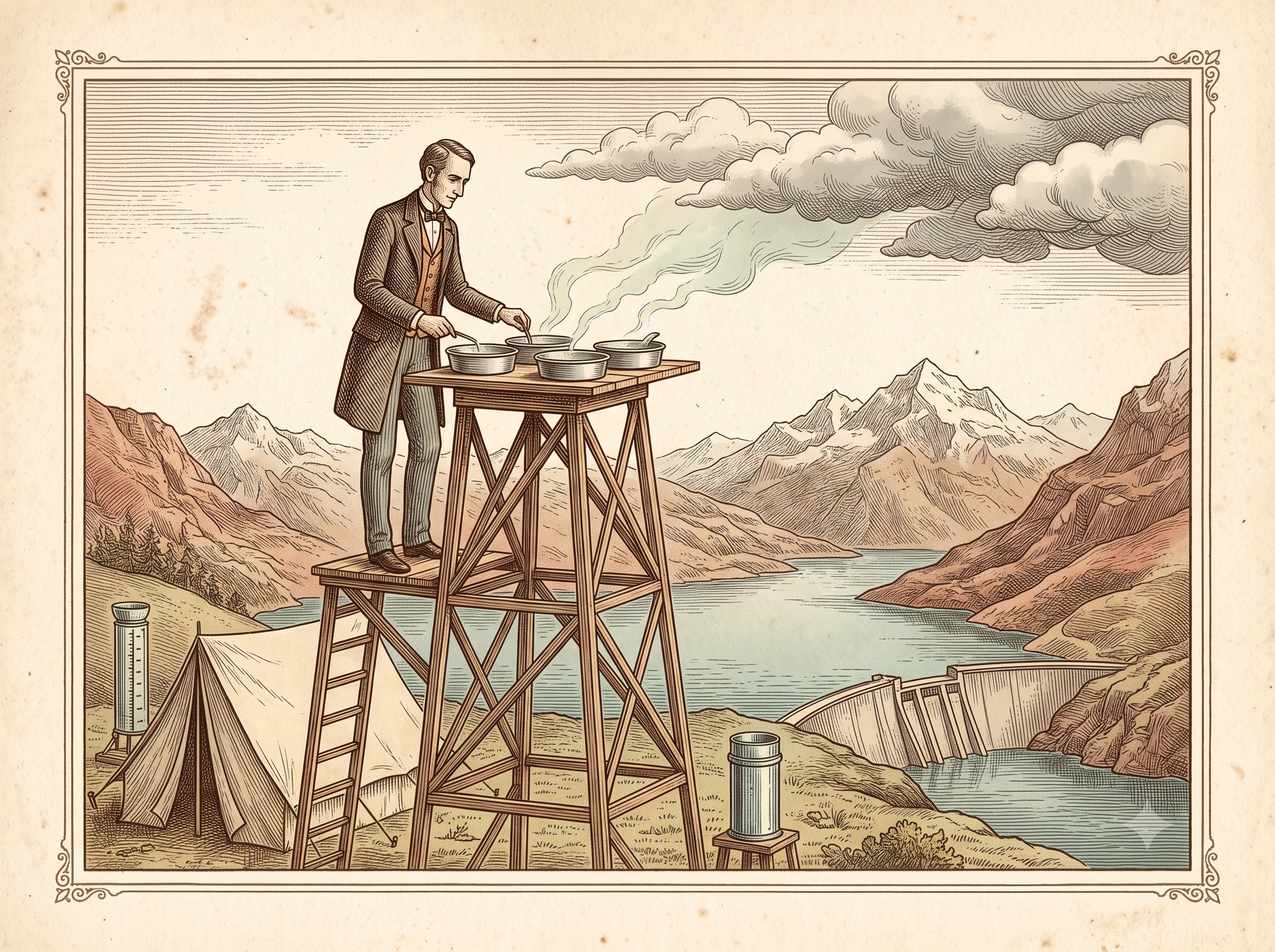
Charles Mallory Hatfield sold New Home sewing machines in Los Angeles — city manager of the agency, $125 a month, suit always pressed. He had also spent a decade of spare hours in public libraries poring over rainfall tables, convinced he could coax water out of the air. He called himself not a rainmaker but a “moisture accelerator”: he did not make rain, he insisted, only released it when conditions already leaned that way. The method was a tower, shallow galvanized pans on a platform at the top, and a blend of twenty-three chemicals he would never name.
By 1915 he had worked contracts across the West and claimed hundreds of successes. That December, San Diego was worried about water — not desperately short, but growing fast and thin on reserves. On the 13th the city council voted four to one to accept the simplest of the offers Hatfield had drafted for himself, without a lawyer: fill Morena Reservoir by December 20, 1916, and collect $10,000. No rain, no pay.
It looked free. Morena had been built in 1897 and had never once been full — fifteen billion gallons of capacity holding about five. “Heads the city wins, tails Hatfield loses,” Councilman Walter Moore explained. Asked whether the deal would be legal, City Attorney Terence Cosgrove reportedly grinned and said that if Hatfield filled Morena, he supposed there would be no doubt about it. The council told him to draw up a written contract. He never did.
Hatfield didn’t wait. He and his youngest brother Joel built their tower beside the lake and were working by January 1, raking the ground beneath the platform each day so nobody could identify the residue.
Rain reached Morena on January 5. On the 10th it turned serious; on the 14th it came down in torrents and kept on. On the 17th the San Diego River spread a mile wide across Mission Valley. On the 18th the Tijuana River destroyed the Little Landers, a utopian smallholding colony near the border, and two women drowned. More than two hundred bridges went out; trains stopped running for thirty-two days. When the dam keeper’s wife remarked mid-storm that it was sure raining now, Hatfield told her: “You haven’t seen anything yet. Wait two weeks and it will really rain.”
The storms paused, then resumed on the 26th. At 5:05 p.m. on January 27, the Lower Otay Dam disintegrated and sent a wall of water — witnesses said forty feet high — down the valley. The coroner’s first estimate was fifty dead; later counts settled near twenty. The National Weather Service still calls January 1916 the most destructive and deadly weather event in San Diego County’s history. Morena Dam survived by five inches, because its keeper, Seth Swenson, cut off by a dead phone line, disobeyed orders to hold every drop and rowed out at midnight to open two submerged outlet valves.
Hearing the rumor about the lynching party, Hatfield and Joel walked the sixty miles to San Diego. On February 17 he told the council that the essence of his contract was to fill Morena, that it had been done, and that he would like his $10,000. Cosgrove asked how much water he claimed to have put in. Four billion gallons, Hatfield said, if not more. Cosgrove pointed out that filling the reservoir meant ten billion. By his own arithmetic Hatfield had come up short — and there was no signed contract anyway. The council refused to pay.
Why was it strange?
The city’s real problem wasn’t the arithmetic. Damage claims were already approaching $3.5 million, and if San Diego admitted Hatfield had caused the rain, it had admitted hiring the man who caused the flood. So the city attorney’s office made him an offer close to perfect as a piece of legal comedy: they would recommend paying the full $10,000 if he signed a statement accepting responsibility for the flood. He could have the money or the innocence, not both. He refused.
Two damage suits against the city eventually went to trial on change of venue, and courts in Orange and San Bernardino counties ruled the rains were an act of God. That single finding cleared Hatfield of liability and destroyed his claim in the same stroke: if God made the rain, the city owed him nothing. Hatfield’s own suit sat on the docket for nearly twenty-two years and was dismissed in 1938 for lack of prosecution.
The same thread — Pseudoscience — continues in The Motor That Ran for Twenty-Six Years on a Secret Room Full of Compressed Air.
What did scientists learn?
Meteorologists were unimpressed at the time, and their reasons hold up. The 1918 U.S. Geological Survey report documented that the storms soaked Riverside, San Bernardino, Los Angeles, and Ventura counties too — a system far larger than one tower could plausibly stir. Hatfield’s terms also quietly stacked the odds: he had a full year to succeed, and chose to start on January 1, in the middle of Southern California’s rainy season.
The deeper lesson is about what a testable claim looks like. Hatfield offered no mechanism, no control case, and no way to be wrong. Any rain counted as success; a dry spell just meant conditions weren’t favorable. The Bulletin of the American Meteorological Society filed his profession under “pseudo-scientific trickery.”
Real weather modification arrived thirty years later, and it looked nothing like a secret formula. On November 13, 1946, General Electric chemist Vincent Schaefer dropped three pounds of dry ice from an aircraft into a supercooled cloud near Schenectady, New York — supercooled meaning droplets still liquid below freezing, waiting for something to crystallize around. Within five minutes the cloud turned to ice and snow fell. His colleague Bernard Vonnegut then found that silver iodide, whose crystal structure closely resembles ice, works as the same kind of seed.
Another machine that should not have worked: Starlite: The Fireproof Plastic a Hairdresser Invented and Took to His Grave.
How does it affect us today?
Cloud seeding is now a real, modest, heavily caveated technology. Dozens of programs operate across the American West and abroad, and a 2020 study in the Proceedings of the National Academy of Sciences — from the SNOWIE experiment over Idaho’s Payette Basin — used radar and snow gauges to quantify seeded snowfall for the first time. The effect was measurable and real. It was also small, and it required clouds that were already there.
Hatfield’s other legacy is legal. The question San Diego dodged in 1916 — if you pay someone to change the weather, who owns the consequences? — now sits inside state permitting rules and liability law for weather modification, and it resurfaces every time a dry region proposes seeding a storm that someone downwind was counting on.
Another invention that refused to stay on paper: The Chemical That Sets Fire to Sand — and the Rocket Chemist Who Recommended Running Shoes.
Fun fact
Nobody ever found out what was in the twenty-three chemicals. Hatfield died in January 1958 without telling anyone, and his brother Paul, who had helped mix it, kept the secret another sixteen years. The only surviving description of the stuff comes from bystanders near his towers, who said the fumes smelled like Limburger cheese.
Sources
- Thomas W. Patterson, “Hatfield the Rainmaker,” The Journal of San Diego History, Winter 1970 — the definitive archival account, built on contemporary San Diego Union reporting, city council records, and interviews with the Morena dam keepers and Hatfield’s brother Paul.
- H. D. McGlashan and F. C. Ebert, Southern California Floods of January, 1916 (U.S. Geological Survey Water-Supply Paper 426, 1918) — the primary hydrological survey, showing the storms covered five counties.
- David Emery, “Did San Diego Hire a ‘Rainmaker’ to End a Drought in 1916?” Snopes, 2018 — sorts the documented record from the meme version, and quotes Hatfield’s own 1919 description of his method.
- Katja Friedrich et al., “Quantifying snowfall from orographic cloud seeding,” PNAS 117:10 (2020), 5190–5195 — the SNOWIE results quantifying seeded snowfall with radar and gauges.
- Clark C. Spence, The Rainmakers: American “Pluviculture” to World War II (University of Nebraska Press, 1980) — the standard scholarly history of the trade Hatfield worked in.
This story involves loss of life. If it brings up difficult feelings, it’s okay to step away — the history keeps.