Impossible Inventions · Chemistry
Starlite: The Fireproof Plastic a Hairdresser Invented and Took to His Grave
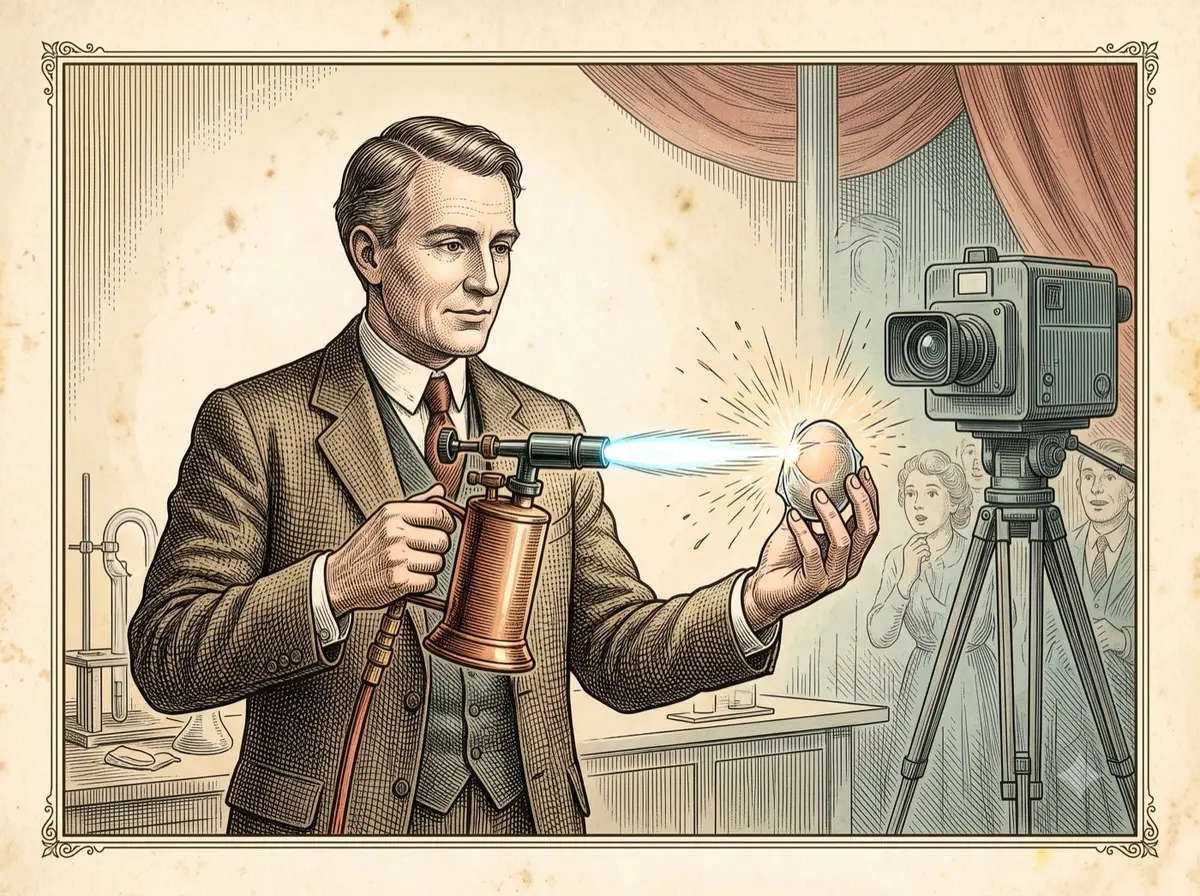
On a 1990 episode of the BBC's *Tomorrow's World*, a hairdresser from Hartlepool named Maurice Ward pointed an oxyacetylene blowtorch — a flame hot enough to cut steel — straight at an egg coated in a plastic he called Starlite. He held it there for five minutes. Then he cracked the egg open. It was still raw, and still cold enough to hold in his bare hand. What Starlite was made of, he never published. It behaved as an intumescent plastic: heat swelled it into a carbon foam. As far as anyone can prove, the ingredient list died with him in 2011.
By the Curiosities Desk · · 7 min read · Filed under Chemistry · Today’s round
Part of Built to Do the Impossible
What happened: Starlite Made Of? He Never Said
Ward wasn’t a chemist. He cut hair for a living and tinkered with plastics as a hobby, having picked up a used extruder — a machine that forces plastic through a mold — from the chemical company ICI in the early 1980s. One early batch, mixed for a job making Citroën car parts, didn’t work out and sat forgotten in granules.
Then, in August 1985, a Boeing 737 caught fire on the runway at Manchester Airport. Fifty-five people died in under a minute, most from toxic smoke rather than flame. The tragedy stuck with Ward. “It interested me because it was an air disaster on the ground, and because it was the smoke and toxicity that killed people, not the fire,” he later told The Daily Telegraph. He returned to his failed plastic granules and started experimenting, mixing up to twenty formulations a day — batches he nicknamed his “gubbins.”
Eventually one worked. He extruded it into a sheet, hit it with a blowtorch, and watched the heat simply fail to get through. His eight-year-old granddaughter, Kimberly, came up with the name: Starlite.
Word spread slowly until the Tomorrow’s World demonstration made Ward briefly famous. Sir Ronald Mason, then the Ministry of Defence’s Chief Scientific Adviser, arranged for samples to be tested, and went from skeptic to convert. “I started this path with Maurice very sceptical,” he told a reporter in 1993. “I’m totally convinced of the reality of the claims. We don’t still quite understand how it works, but that it works is undoubtedly the case.” A Ministry of Defence report in Jane’s International Defence Review that same year noted the material seemed to grow more effective the more heat was applied to it.
Interest kept growing. Ward let organizations including the Atomic Weapons Establishment and ICI test samples — but always refused to let anyone keep one afterward, worried it would be reverse-engineered. In 1994, NASA engineer Rosendo “Rudy” Naranjo discussed Starlite’s potential on a Dateline NBC segment, and Boeing, then a lead Space Shuttle contractor, reportedly explored whether it could replace flammable cabin materials. None of it became a contract, a patent, or a product. Ward insisted on keeping 51 percent ownership of any deal and believed the invention was worth billions; deals fell through again and again. By his death in 2011, Starlite had never been manufactured commercially, and the formula was known, by most accounts, only to Ward and a couple of family members. In 2013, Thermashield, LLC said it had bought Ward’s notes, samples, and equipment from his family and was trying to reconstruct the material.
What was Starlite made of?
No verified recipe exists. Ward never patented a formula, never published an ingredient list, and would not leave samples behind after a test. The public record can say how Starlite behaved. It cannot give a bill of materials.
Starlite is an intumescent. Under a flame it swells and chars into a low-density carbon foam, full of trapped air, that blocks heat from whatever sits underneath. Fire-retardant paints on steel beams work the same general way. The claim that made the material famous was the extremity: a kitchen-mixed sheet keeping a raw egg cold under an oxyacetylene torch for five minutes.
Ward talked about mixing up to twenty formulations a day — his “gubbins” — from materials a hairdresser could buy. He never named the full list. After he died in 2011, Thermashield, LLC said it had bought his notes, samples, and equipment from the family and was trying to reconstruct the material. No independently verified commercial product has followed. In 2018 a YouTuber, Ben Cusick, published an unofficial analog using cornstarch, baking soda, and PVA glue, later refined with flour, sugar, and borax. His versions held up against a torch on camera and failed when the heat got more serious, including as a crucible in an induction furnace. That is a guess at a class of recipe, not Ward’s formula.
So the direct answer to “what was Starlite made of” is: an intumescent plastic whose composition is still a secret. Anything more specific than that is reconstruction, not the recipe.
Why it was strange: Starlite Made Of? He Never Said
An untrained inventor, working with a hardware-store extruder, apparently built something that stumped scientists at a national defense laboratory — then refused, for commercial reasons, to let anyone find out how. That alone is an unusual shape for an invention story. But it’s worth separating the solid parts from the legend that grew up around it. A 2024 forensic investigation by The Aurora Press found some of Starlite’s most dramatic claims don’t hold up: a widely circulated NASA endorsement document turned out to be falsified, the Atomic Weapons Establishment says in a Freedom of Information response that it never tested the material, and a persistent story about a simulated nuclear-blast test at White Sands Missile Range with the British SAS is contradicted by U.S. defense records, which turned up no such files. What does check out are the Ministry of Defence’s own scientists vouching for the material’s thermal performance in BBC interviews, and the journalists and engineers who watched the blowtorch-and-egg demonstration firsthand. Something real happened in Ward’s workshop — but decades of retelling have piled unverified, and in places fabricated, claims on top of it.
Another invention that refused to stay on paper: The Chemical That Sets Fire to Sand — and the Rocket Chemist Who Recommended Running Shoes.
What scientists learned: Starlite Made Of? He Never Said
The Ministry of Defence’s own analysis suggested the effect partly came from scattering heat off that expanding, ablative layer, making the material more reflective the longer it burned. None of that requires new physics. Fire-retardant intumescent paints, built on similar chemistry, already existed. What made Starlite compelling was the apparent extremity of a kitchen-mixed sheet, not a new kind of matter. A home recipe that survives a camera is a different bar from one that survives aerospace conditions — which is why Cusick’s unofficial analog, useful as a demonstration, is not a solution to the missing formula.
Another machine that should not have worked: The Sewing Machine Salesman San Diego Hired to Make Rain — Who Filled the Reservoir and Never Got Paid.
How it reaches us today: Starlite Made Of? He Never Said
Starlite itself never shipped a single commercial product. Its real legacy is a cautionary tale about over-guarded intellectual property: an invention that might have improved aircraft cabin safety or heat shielding sat undeveloped for decades because its inventor trusted no one enough to let it leave his sight. Meanwhile, the broader field of intumescent fireproofing — the fire-retardant paints on steel building beams, the char-forming coatings in some vehicle and aircraft interiors — kept advancing without him, built by labs willing to publish and license their work. Thermashield, LLC says it continues trying to bring a Starlite-based product to market, but no independently verified commercial version exists yet.
A close cousin: The Roman Cup That Was Accidentally Nanotechnology.
Fun fact: Starlite Made Of? He Never Said
According to Ward’s youngest daughter, Nicola McDermott, Starlite was “natural” enough that it had been fed to dogs and horses with no ill effects — though, as with much about this material, there’s no independent lab study confirming it.
Sources: Starlite Made Of? He Never Said
- “Starlite.” Wikipedia, cross-referenced with underlying citations.
- “Maurice Ward.” Wikipedia, cross-referenced with underlying citations.
- George, Rose. “Starlite, the nuclear blast-defying plastic that could change the world.” The Daily Telegraph, 15 April 2009.
- Fisher, Richard. “The power of cool: Whatever became of Starlite?” New Scientist, 9 May 2012.
- Drane, Phillip. “Chemistry | Starlite: A Forensic Investigation.” The Aurora Press, 8 July 2024.
Related stories: Starlite Made Of? He Never Said
- Greek Fire: The Byzantine Weapon That Burned on Water — and Whose Recipe Died With the Empire — A Byzantine weapon that burned on water, its recipe lost forever
- The Aircraft Carrier Britain Tried to Build Out of Ice — Britain’s plan for a warship made of ice and sawdust
- The Cylinder That Weighed Too Much and Became Teflon — A gas cylinder that weighed too much held the first Teflon