Impossible Inventions · Engineering
The Aircraft Carrier Britain Tried to Build Out of Ice
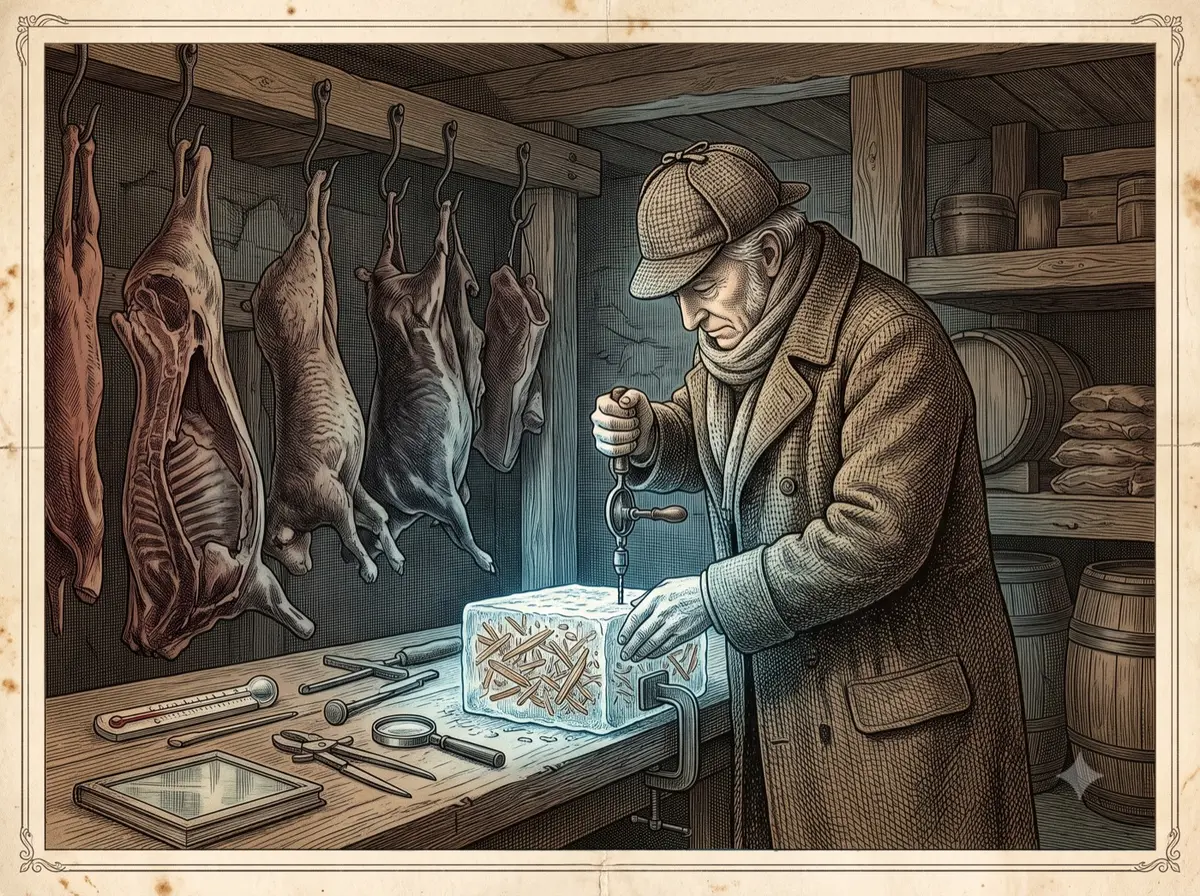
In a meat locker beneath London's Smithfield Market, behind a screen of frozen animal carcasses, a refugee scientist was quietly testing a material no navy had ever used. His job: find out whether Britain could win the Battle of the Atlantic by building the largest ship in history out of frozen water.
By the Curiosities Desk · · 6 min read · Filed under Engineering · Today’s round
Part of Built to Do the Impossible
What happened: Project Habakkuk
By 1942 German U-boats were strangling Britain’s Atlantic supply lines. The most dangerous stretch was the mid-Atlantic “air gap,” a band of ocean too far from any coast for land-based patrol planes to reach. Convoys crossing it had no air cover at all.
An eccentric British inventor named Geoffrey Pyke had an answer. Pyke worked at Combined Operations Headquarters under Lord Louis Mountbatten, who considered him a genius. Steel and aluminium were desperately scarce, so Pyke proposed something else: ice. Ice could be manufactured for roughly one percent of the energy needed to make the same mass of steel. Why not level the top of an enormous iceberg into a runway, hollow out the inside for hangars, and float an unsinkable airbase right into the gap?
Mountbatten passed the idea to Winston Churchill, who was enthusiastic. The project got a code name drawn from the Book of Habakkuk, whose verse 1:5 promises “a work in your days, which ye will not believe, though it be told you.” The spelling wandered between “Habakkuk” and “Habbakuk” in the wartime files, but the ambition never wavered.
There was an obvious problem: plain ice is brittle, and natural icebergs tend to roll over without warning. The fix came from a new material called pykrete, named after Pyke himself: a frozen mixture of about 14 percent wood pulp and 86 percent water. The pulp made the ice dramatically stronger, slower to melt, and buoyant enough that it would not sink. The task of proving it fell to Max Perutz, an Austrian-born scientist who ran his secret experiments in a refrigerated chamber under Smithfield meat market.
The plans grew staggering. The final design, Habakkuk II, would have been about 2,000 feet long and 300 feet wide, with a displacement of roughly 2.2 million tons, by far the largest vessel ever conceived. It was to carry up to 150 aircraft, be driven by 26 electric motors mounted in external pods (internal engines would have melted the hull), and bristle with anti-aircraft guns. In Canada’s Jasper National Park, a team built a working prototype on Patricia Lake, about 60 by 30 feet and 1,000 tons, kept frozen by a single one-horsepower motor. The work was done by conscientious objectors who were never told what they were building.
Why it was strange: Project Habakkuk
Set aside the engineering for a moment and just sit with the premise: a serious wartime committee, backed by the Prime Minister, planned to send sailors and bomber crews into the North Atlantic aboard a floating block of reinforced ice the length of six football fields.
The strangeness ran deeper than scale. Pyke argued from a genuinely clever insight, that the energy cost of a material matters as much as its strength, which is a thoroughly modern way to think. And the demonstrations were theatrical. By several accounts, at the 1943 Quebec Conference a block of pykrete was used to wow the assembled admirals: a pistol shot shattered ordinary ice, but the bullet fired at pykrete ricocheted and zipped around the room. Field Marshal Alan Brooke’s diary records the bullet buzzing “round our legs like an angry bee”; in Perutz’s version, the ricochet caught Brooke in the shoulder. A weapon meeting interrupted by a bouncing bullet is not how most material-science demos end.
The same thread — World War II — continues in The Bomb Three Pigeons Were Trained to Steer.
What scientists learned: Project Habakkuk
The science of pykrete itself held up. It really was far tougher than plain ice and far slower to melt, because as the surface thawed it left behind a soggy, insulating layer of wood pulp that shielded the cold interior. You could machine it like wood and cast it like metal.
The trouble was everything around the ice. Perutz discovered that pykrete suffers from “plastic flow”: like a glacier, it slowly deforms under its own weight. A ship-sized block would gradually sag unless chilled to about −16 °C (3 °F), which meant wrapping the whole hull in insulation and threading it with a vast network of refrigeration ducts. As the Admiralty piled on requirements, a torpedo-proof hull 40 feet thick, a 7,000-mile range, a steerable rudder over 100 feet tall that nobody could figure out how to mount, the costs ballooned from an estimated £700,000 to £2.5 million, and the refrigeration plant alone threatened to consume more steel than simply building a conventional carrier. The lesson was a hard one in systems engineering: a cheap, clever material does not make a cheap, clever machine once you account for everything it has to carry.
Another machine that should not have worked: The Rocket-Powered Wheel That Chased Britain’s Admirals Into Barbed Wire.
How it reaches us today: Project Habakkuk
Habakkuk was quietly killed at the end of 1943, declared “impractical because of the enormous production resources required.” The reasons were ordinary and decisive: escort carriers were rolling off shipyards, new long-range aircraft and drop tanks let planes patrol farther, and Portugal granted the Allies airfields in the Azores. The mid-Atlantic gap simply closed on its own.
Yet the story keeps resurfacing because the underlying idea won’t quite die. Pykrete has been revisited by engineers and TV science shows as a model for cheap, energy-efficient construction, and modern researchers studying ice composites still cite Perutz’s wartime measurements. The broader vision, durable floating platforms far out at sea, lives on in concepts like the U.S. military’s “mobile offshore base.” And Max Perutz went on to win the 1962 Nobel Prize in Chemistry for revealing the structure of hemoglobin, carrying the same patience he’d used to measure how slowly frozen wood pulp sags.
Another invention that refused to stay on paper: The Wooden Flying Boat That Flew Once, for 26 Seconds — and Was Kept Ready to Fly for 29 More Years.
Fun fact: Project Habakkuk
The Patricia Lake prototype was so well insulated by its own melting pulp that after the project was abandoned it took three hot Canadian summers to fully melt. The metal scaffolding and refrigeration parts eventually sank, and they still rest on the lake bed today, a popular site for scuba divers visiting the wreck of a ship that was made almost entirely of ice.
Sources: Project Habakkuk
- Max F. Perutz, I Wish I’d Made You Angry Earlier: Essays on Science, Scientists, and Humanity (Oxford University Press, 2002) — firsthand account by the scientist who tested pykrete. https://global.oup.com/academic/product/i-wish-id-made-you-angry-earlier-9780198590279
- M. F. Perutz, “A Description of the Iceberg Aircraft Carrier and the Bearing of the Mechanical Properties of Frozen Wood Pulp upon Some Problems of Glacier Flow,” Journal of Glaciology, 1948. https://doi.org/10.1017/S0022143000007796
- “Project Habakkuk,” Wikipedia (cross-referenced against its cited sources). https://en.wikipedia.org/wiki/Project_Habakkuk
- Stephen Battersby, “Shiver me timbers: The coolest warship ever made,” New Scientist, 22 December 2012. https://doi.org/10.1016/S0262-4079(12)63270-9
- Paul Collins, “The Floating Island,” Cabinet Magazine, no. 7, 2002. https://www.cabinetmagazine.org/issues/7/collins.php
Related stories: Project Habakkuk
- The Bomb Full of Sleeping Bats That Burned Down Its Own Air Base — Bats carrying tiny incendiaries burned down the base that built them
- The Nuclear Landmine Britain Planned to Keep Warm With Live Chickens — Britain proposed keeping a buried nuclear mine warm with live chickens
- Starlite: The Fireproof Plastic a Hairdresser Invented and Took to His Grave — A hairdresser’s fireproof plastic that died with him