Impossible Inventions · Engineering
The Concentration Helmet That Needed Its Own Oxygen Tank
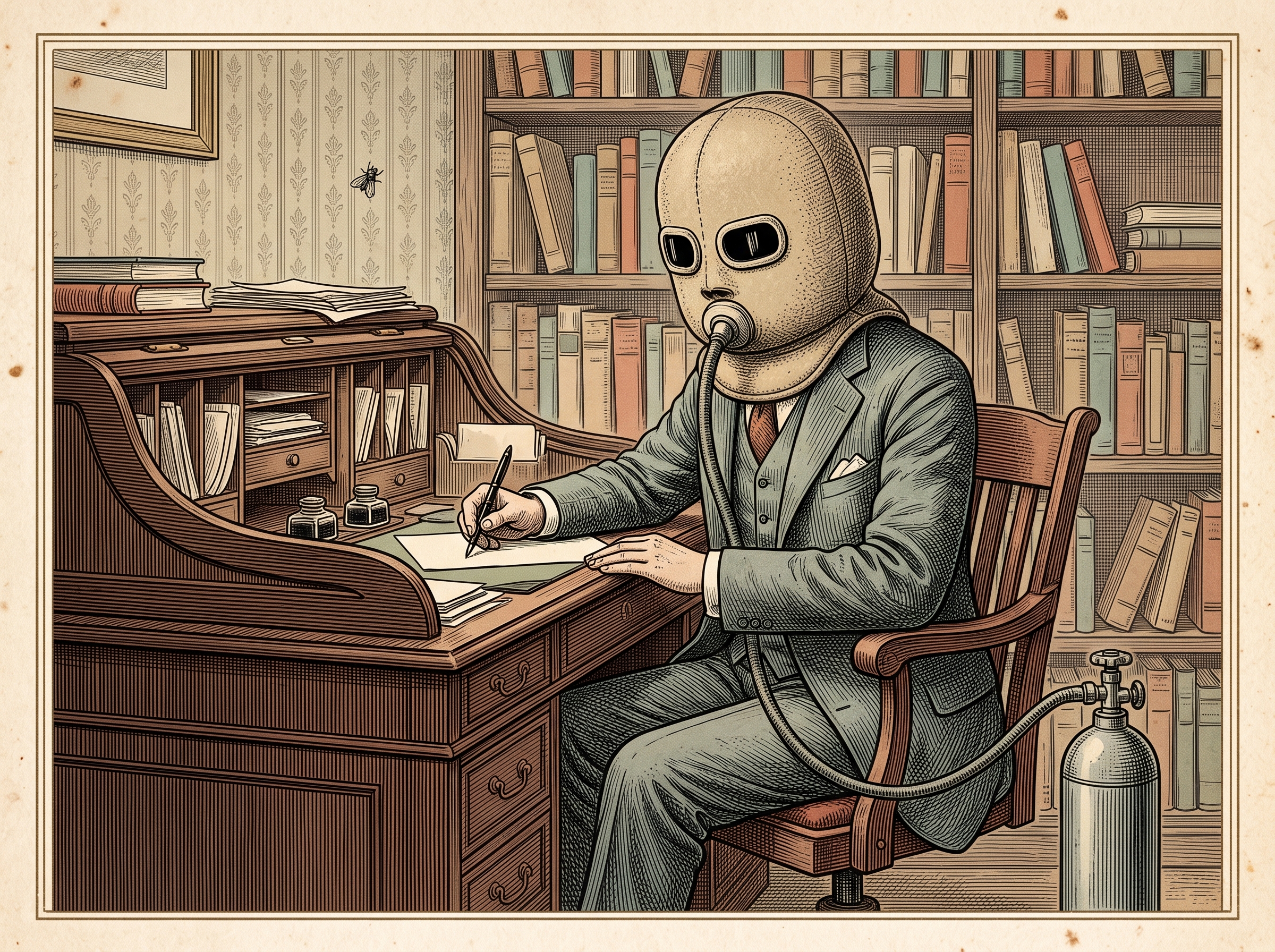
In July 1925, the magazine *Science and Invention* ran a photograph of its own editor, Hugo Gernsback, sitting at his desk with a pen in his hand and his entire head sealed inside a padded helmet. Two narrow slits let him see the sheet of paper in front of him and nothing else. A rubber hose ran from the helmet to a small oxygen tank. He wasn't diving, flying, or fighting a fire. He was trying to concentrate.
By the Curiosities Desk · · 5 read · Filed under Engineering · Today’s round
What happened?
Hugo Gernsback was born in Luxembourg in 1884 and came to the United States in 1904 to sell an improved dry-cell battery he had designed. He went on to build a small publishing empire around electricity and radio, starting with Modern Electrics in 1908, and later Science and Invention, a magazine that mixed real technology news with bold predictions about the future.
Running magazines meant a lot of thinking on deadline, and Gernsback found it hard. In his July 1925 article, titled simply “The Isolator,” he wrote that he found it “almost impossible to keep his mind on a subject for five minutes without disturbance.”
He was precise about what was distracting him. Street noise filtered through closed windows. Someone slammed a door. A telephone rang somewhere. And even in total silence, he admitted, “you are your own disturber practically fifty per cent. of the time”: you lean back, study the wallpaper pattern, watch a fly crawl along the wall, or notice a curtain swaying.
So he built a helmet to remove all of it at once.
The first version was made of wood, lined with cork inside and out, and covered with felt. Three pieces of glass let the wearer see out, and a baffle (a barrier that lets air pass but blocks a straight path for sound) sat in front of the mouth so he could breathe. Gernsback rated it about 75 percent effective at blocking noise and blamed the solid wood, which carries sound. A second design then under construction dropped the wood entirely in favor of an air gap, which he expected would push the figure to 90 or 95 percent.
Sound was only half the problem, though. To stop his eyes from wandering, he painted the outer glass of the eye windows completely black, then scratched two small white lines through the paint. Looking through those slits, the wearer could see almost nothing except the page directly in front of him.
Then came the snag. Gernsback reported that after about fifteen minutes inside the helmet, the wearer became “more or less drowsy,” which he noted was not helpful for hard thinking. His fix was the oxygen tank, connected by a tube, which he said “livens the subject considerably.” He concluded that the Isolator “will be found to be a great investment.”
The article closed with a cutaway drawing of the “ideal office or study” for concentrated work. As far as the historical record shows, the Isolator never became a commercial product.
Why was it strange?
The Isolator is funny because it takes a completely ordinary complaint, “I can’t focus,” and answers it with the equipment of a deep-sea diver. But underneath the comedy is a surprisingly careful piece of observation.
Gernsback didn’t just say noise was distracting. He split distraction into two kinds: sounds coming in from outside, and a restless mind looking for something else to do. He then engineered a separate fix for each. The padded shell handled the ears. The blacked-out glass handled the eyes.
The drowsiness is the twist that gives the story its punchline: a sealed helmet built to sharpen thinking turned out, after a quarter of an hour, to make its wearer sleepy. Gernsback didn’t explain why. The most likely reason, based on basic physiology, is that the wearer was rebreathing his own exhaled air. In a small, closed space, carbon dioxide builds up quickly, and elevated carbon dioxide is well known to cause drowsiness and headaches. In other words, the helmet worked so well at sealing out the world that it also sealed out fresh air.
The same thread — Noise — continues in The Computer Pioneer Who Declared War on London’s Organ Grinders.
What did scientists learn?
The Isolator wasn’t a scientific experiment, and Gernsback’s efficiency percentages were his own estimates, not laboratory measurements. Still, the problems he was wrestling with are real engineering ones.
First, sound travels through solids. A rigid wooden shell vibrates and passes noise straight through to the head. Layered materials with air gaps between them block sound much better, because energy is lost each time a sound wave crosses from one material into another. That is the same principle behind double-glazed windows and recording-studio walls, and it is exactly the change Gernsback planned for his second helmet.
Second, any enclosure that seals out sound tends to seal out air too. Ventilation is one of the hardest parts of designing soundproof spaces, from recording booths to space suits, because the openings that let air in also let noise in.
Third, Gernsback noticed that blocking sound wasn’t enough on its own. Our eyes are drawn to movement, so a crawling fly or a swaying curtain can break a train of thought just as surely as a door slam. Narrowing the field of view was his low-tech way of removing that second channel.
Another invention that refused to stay on paper: The Mechanical Duck That Fooled Paris With Fake Poop.
How does it affect us today?
A century later, people are still trying to build Gernsback’s helmet, just in lighter materials. Noise-cancelling headphones handle the ears. Full-screen “focus modes” on computers act a bit like his painted glass, narrowing what the eyes can wander to.
The debate he joined is still going too. In a 2018 study published in Philosophical Transactions of the Royal Society B, Harvard researchers Ethan Bernstein and Stephen Turban tracked employees at two companies before and after they moved into open-plan offices. Face-to-face interaction dropped by roughly 70 percent, and people sent more emails and instant messages instead. Workers, it seems, will build their own isolators when the walls come down.
Gernsback himself is remembered far more for his other bet. In 1926 he launched Amazing Stories, often described as the first magazine devoted entirely to what he called “scientifiction.” Science fiction’s best-known prize, the Hugo Award, is named after him.
Another machine that should not have worked: Greek Fire: The Byzantine Weapon That Burned on Water — and Whose Recipe Died With the Empire.
Fun fact
Gernsback never gave up on strapping gadgets to his face. In 1963, nearly four decades after the Isolator, he posed for Life magazine wearing a pair of “television goggles” he had designed.
Sources
- Hugo Gernsback, “The Isolator,” Science and Invention, vol. 13, no. 3 (July 1925), reprinted in Grant Wythoff, ed., The Perversity of Things: Hugo Gernsback on Media, Tinkering, and Scientifiction (University of Minnesota Press, 2016)
- Encyclopaedia Britannica, “Hugo Gernsback”
- Ethan S. Bernstein and Stephen Turban, “The impact of the ‘open’ workspace on human collaboration,” Philosophical Transactions of the Royal Society B (2018)
- The Encyclopedia of Science Fiction, “Gernsback, Hugo”