The Scientist Behind It · Engineering
The Computer Pioneer Who Declared War on London's Organ Grinders
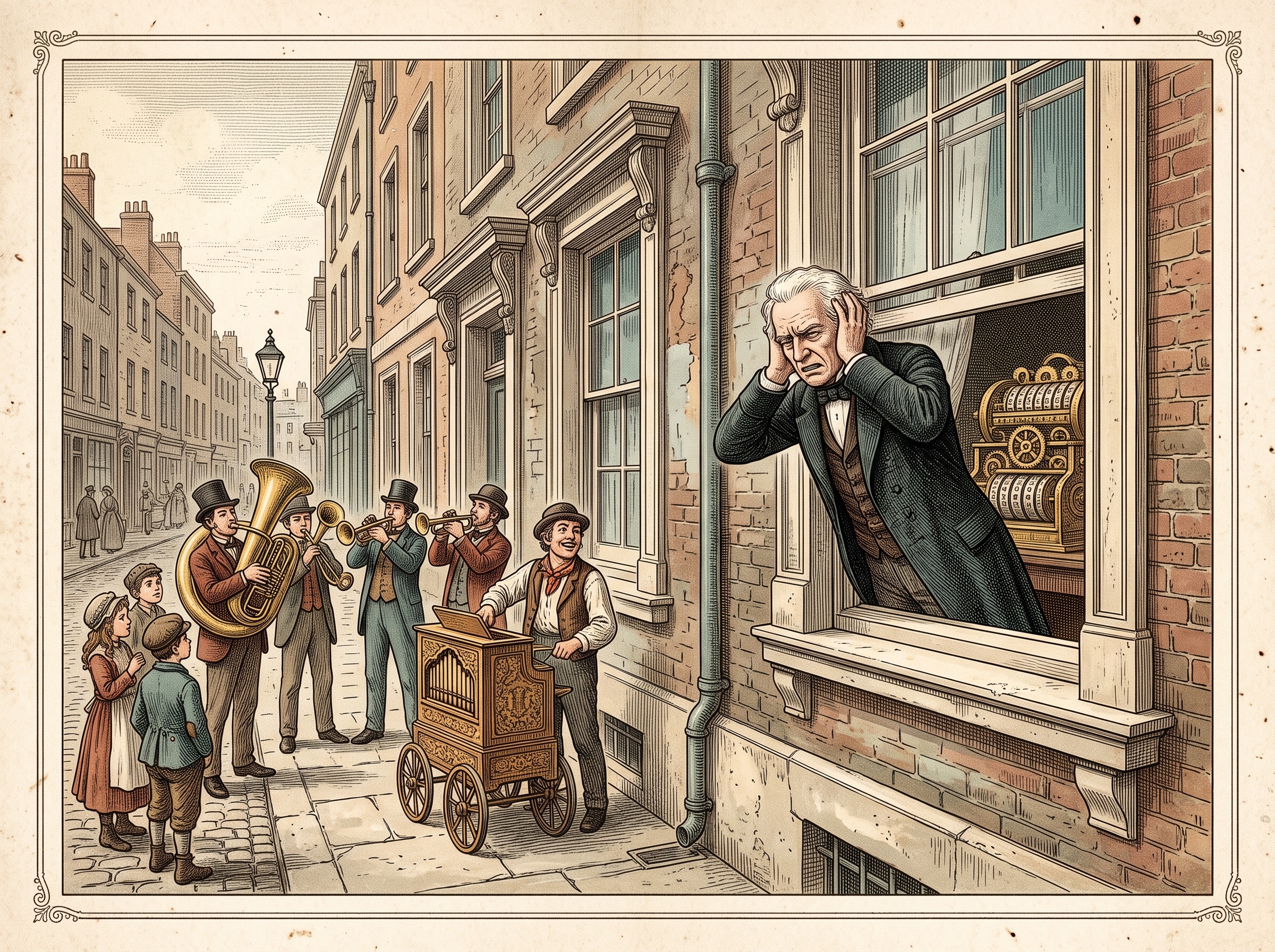
In 1864, Charles Babbage, the mathematician who designed the first programmable computer, sat down to write his memoirs and devoted an entire chapter to an enemy he believed had stolen a quarter of his working life. It wasn't a rival scientist or a stingy government. It was the organ grinder outside his window. He listed the "instruments of torture" by name, starting with organs, brass bands and fiddles and ending with "the human voice in various forms."
By the Curiosities Desk · · 5 min read · Filed under Engineering · Today’s round
What happened?
By the 1860s, Charles Babbage was one of the most famous thinkers in Britain. Since the 1820s he had been designing calculating machines: first the Difference Engine, a hand-cranked brass machine meant to compute mathematical tables without human error, and then the Analytical Engine, a design that could be programmed with punched cards and is now recognized as the conceptual ancestor of the modern computer. These machines required long, unbroken stretches of concentration. And Babbage lived at 1 Dorset Street, in London’s busy Marylebone district, where concentration was hard to come by.
Victorian London was loud. Street musicians, many of them poor immigrants, worked the residential streets, cranking barrel organs and hurdy-gurdies or playing in small brass bands, hoping residents would pay them to play, or to stop. Babbage would not pay. Instead he went to the law. Under the Metropolitan Police Act of 1839, a householder could ask a constable to move a street musician along for “reasonable cause,” and Babbage tried to use it again and again, pursuing musicians to the police station and into the magistrates’ courts.
It did not go smoothly. In his 1864 book, Passages from the Life of a Philosopher, Babbage recorded that a brass band once played outside “for five hours” with only brief pauses, and that he was disturbed by music “after eleven and even after twelve o’clock at night.” When he walked to the police station to complain, crowds of children and adults sometimes followed him, shouting. “In one case,” he wrote, “there were certainly above a hundred persons.” He received anonymous threatening letters. According to historian Paul Simpson’s account of the campaign, his opponents also put up placards in nearby shop windows, broke his windows and threw dead cats into his garden.
Babbage pressed on. He tallied what the noise cost him and concluded that “one-fourth part of my working power has been destroyed by the nuisance against which I have protested.” He compiled a list of the people he called “Encouragers of Street Music,” including tavern keepers, servants, children and “visitors from the country.” And in one exchange he recounted, a sarcastic magistrate asked whether an organ could really injure a man’s brain. Babbage’s reply: “no man having brain ever listened to street musicians.”
He was not alone. In 1864 Michael Thomas Bass, a brewer and Member of Parliament for Derby, introduced a bill to tighten the law, and published a collection of supporting letters. Charles Dickens joined other writers and artists in signing a letter that described themselves as “driven nearly mad” by street music. Babbage contributed his own material to the campaign.
The debate in the House of Commons on June 29, 1864, as recorded in Hansard, the official parliamentary record, shows that not everyone was sympathetic. One opponent, Sir John Shelley, called the bill “simply ridiculous” and claimed it had been brought forward by people like “Mr. Babbage, who was now commencing a crusade against the popular game of tip-cat,” a street game played by children. The Home Secretary, Sir George Grey, pointed out a real problem with the existing law: in Babbage’s own cases, one magistrate had ruled that being engaged in “abstruse calculations” was reasonable cause to move a musician on, while another had ruled that it was not.
The bill passed anyway. The Metropolitan Police Act 1864 received royal assent on July 25, 1864.
Why was it strange?
We tend to picture great inventors locked away in quiet workshops, wrestling with ideas. Babbage’s papers show something more human: a brilliant engineer losing his temper, filling notebooks with complaints and fighting a years-long legal battle over barrel organs. He became better known to many Londoners for that fight than for his engines, a fact he described with some bitterness as “an unenviable celebrity, not by anything I have done.”
There was a sad irony in it, too. Babbage spent his life trying to remove human error and interruption from calculation, and he never finished building a full engine. Whether or not organ grinders deserve any of the blame, he clearly believed they did.
The same thread — Noise — continues in The Concentration Helmet That Needed Its Own Oxygen Tank.
What did scientists learn?
Babbage’s complaints were dismissed as eccentric at the time, but his central claim, that noise is not just irritating but harmful, has held up. He argued that street music fell hardest on the sick and on people doing “intellectual” work, and he even tried to estimate how many ill people lived on his street using sickness statistics from benefit societies.
Modern research supports a version of this. Studies of noise and cognition show that unpredictable sounds, especially speech and music, disrupt tasks that depend on short-term memory and focused reasoning more than steady background noise does. The World Health Organization now treats environmental noise as a public-health issue, linking long-term exposure to sleep disturbance, stress and heart disease. Babbage’s tally was not a controlled study, but his instinct to measure the cost of noise rather than just complain about it was a scientist’s instinct.
Another scientist, told from the human side: The Engineer Who Built a Flip Table to Shake a Gold Coin Out of His Own Windpipe.
How does it affect us today?
The 1864 Act was one of the earliest laws to treat quiet as something residents had a right to expect. Historians doubt it actually made London much quieter, and street musicians remained a fixture of the city. But the principle that a neighbor’s noise can be a legal nuisance runs through modern noise ordinances, quiet hours and building regulations.
Babbage’s machines got their own vindication. In 1991, London’s Science Museum completed a working Difference Engine No. 2, built from his original plans, and it calculated exactly as he said it would.
Another person who would not drop the question: The Movie Star Who Patented a Secret Weapon the Navy Rejected.
Fun fact
When Babbage died in October 1871, his obituary in The Times noted that he had reached an age, “spite of organ-grinding persecutors, little short of 80 years.” The organ grinders got the last word, even in print.
Sources
- Charles Babbage, Passages from the Life of a Philosopher (1864), Chapter XXVI, “Street Nuisances” (Project Gutenberg): https://www.gutenberg.org/ebooks/57532
- Hansard, House of Commons debate on the Street Music (Metropolis) Bill, 29 June 1864, vol. 176: https://api.parliament.uk/historic-hansard/commons/1864/jun/29/bill-90-committee
- The Times obituary of Charles Babbage, October 1871 (MacTutor History of Mathematics archive, University of St Andrews): https://mathshistory.st-andrews.ac.uk/TimesObituaries/Babbage/
- Paul Simpson, “The History of Street Performance: ‘Music by Handle’ and the Silencing of Street Musicians in the Metropolis,” Gresham College lecture: https://www.gresham.ac.uk/node/12995
- The Public Domain Review, “Charles Babbage’s Observations on Street Nuisances (1864)”: https://publicdomainreview.org/collection/observations-on-street-nuisances-charles-babbage/