The Scientist Behind It · Engineering
The Engineer Who Built a Flip Table to Shake a Gold Coin Out of His Own Windpipe
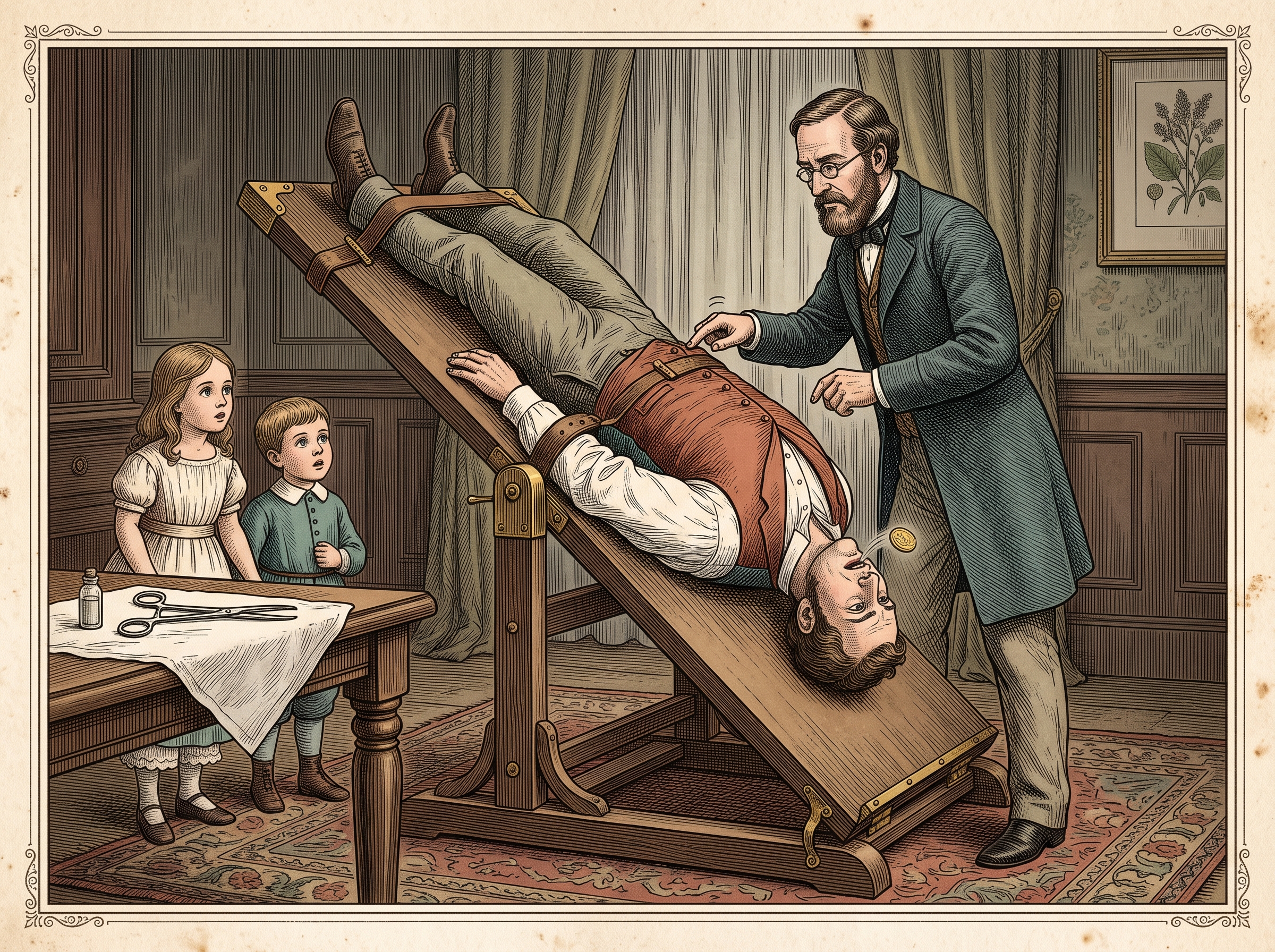
On 13 May 1843, one of Britain's most famous engineers lay strapped to a hinged board in his London home as it tipped him until his head pointed at the floor. Someone tapped him firmly between the shoulder blades. He coughed two or three times — and a small gold coin clinked against his front teeth and dropped out of his mouth. It had been stuck in his airway for six weeks, ever since a magic trick for the children went wrong.
By the Curiosities Desk · · 5 min read · Filed under Engineering · Today’s round
What happened?
In the spring of 1843, Isambard Kingdom Brunel was days from his 37th birthday and near the height of his fame as chief engineer of the Great Western Railway, with a giant new steamship, the Great Britain, nearly finished in Bristol.
He was also, at home, a father who liked to perform for children. On 3 April 1843, according to the Victorian accounts, he was amusing them with a classic conjuring trick: making a coin seem to pass in through his ear and out of his mouth. The coin he had tucked in his mouth was a half-sovereign — a gold piece worth ten shillings and a little smaller than a U.S. nickel. It slipped. Instead of going down his throat toward his stomach, it went down his windpipe.
Brunel had coughing fits and an ache on the right side of his chest, but he breathed well enough that people doubted the coin was in his airway at all. About two weeks later, he consulted two of London’s leading surgeons: Sir Benjamin Brodie, surgeon to Queen Victoria, and Charles Aston Key of Guy’s Hospital. They concluded that the coin was probably sitting at the bottom of the right bronchus — one of the two main branches of the windpipe that lead into the lungs.
Brunel then ran what his contemporaries called an “experiment.” He lay face-down across some chairs and hung his head and neck downward. He could feel the coin slide toward his throat, which set off a violent cough; when he sat back up, it slid back down into his chest. The coin could move. It just needed a better way out.
So Brunel treated his own body as an engineering problem. He had a platform built that pivoted on a hinge in the middle, so a person strapped to it could be smoothly turned upside down. On the first trial, on about 25 April, the coin moved again — but the choking cough it triggered was so alarming that the attempt was stopped for fear he would suffocate.
The surgeons tried a different route. Around 27 April, Brodie performed a tracheotomy, cutting an opening in the front of Brunel’s windpipe so he could reach in with long forceps and pull the coin out. This was three years before ether was first publicly demonstrated as an anesthetic, so Brunel faced it without modern pain relief. The forceps attempt failed. A second try on 2 May irritated his airway so badly that the doctors judged it too dangerous to continue.
Instead, they kept the neck opening propped open with a small tube and waited for Brunel to regain his strength. On Saturday, 13 May, he went back onto the tilting platform. His body was inverted, his back was tapped, and this time the coin let go. He felt it leave the right side of his chest, and within seconds it fell from his mouth. Because he could breathe through the opening in his neck, his throat didn’t clamp shut in the dangerous spasm that had ended the first attempt.
A Victorian account of his life reports that Brunel later said the moment he heard the gold piece strike his upper front teeth was perhaps the most exquisite of his whole life. Brodie presented the case to London’s Royal Medical and Chirurgical Society that summer.
Why was it strange?
We tend to picture great engineers at drawing boards, not upside down on a homemade contraption with a hole in their neck. Yet that is the image the case leaves: a man who had helped tunnel under the Thames and bridged rivers, solving his most personal problem with the same tools — a hinge, gravity, and a bit of trial and error.
It also became strangely public: Brunel’s brother-in-law described the treatment step by step in a letter to The Times. A family party trick had turned into a national medical drama.
And the final fix belonged to both men: Brodie’s tracheotomy made the flip safe, and Brunel’s machine did what the forceps couldn’t.
The same thread — Isambard Kingdom Brunel — continues in The Railway That Ran on Suction — and the Rats Blamed for Eating It.
What did scientists learn?
The case is a small lesson in anatomy and physics. The right main bronchus is wider, shorter, and more nearly vertical than the left, so inhaled objects tend to drop into it — exactly where Brodie predicted the coin would be. A thin, dense gold disc sitting in that tube could slide around without fully blocking it, which is why Brunel could keep breathing for weeks.
Gravity was the obvious tool. Turn the airway upside down, add a jolt to the back, and a loose object has a chance to fall toward the mouth. The problem is the larynx, or voice box, which reflexively snaps shut when something touches it. That spasm is what nearly suffocated Brunel on the first try. The tracheotomy gave him a second air supply below the blockage, so the coin could travel through his throat while he kept breathing.
Another scientist, told from the human side: The Computer Pioneer Who Declared War on London’s Organ Grinders.
How does it affect us today?
In 1897, the German doctor Gustav Killian used a rigid tube and light to see inside a man’s airway and remove a piece of bone — the start of bronchoscopy, the technique now used to pull out inhaled objects without cutting into the neck.
But Brunel’s basic insight survives in modern first aid. Back blows, given while a choking person leans forward so their head is lower than their chest, are still part of standard choking guidance. The idea is the same one Brunel tested with his hinged board: let gravity and a sharp jolt help a stuck object find the way out.
Another person who would not drop the question: The Movie Star Who Patented a Secret Weapon the Navy Rejected.
Fun fact
Brunel bounced back fast. Just over two months after the coin came out, he was in Bristol on 19 July 1843 when Prince Albert attended the launch of his giant iron steamship, the Great Britain.
A note on safety: choking can be life-threatening. If someone can’t breathe, cough, or speak, call emergency services right away. A short first-aid course is the best way to learn back blows and abdominal thrusts before you ever need them.
Sources
- Ramachandran & Aronson, “Benjamin Brodie’s infamous case of Isambard Kingdom Brunel and an inhaled gold coin,” Journal of the Royal Society of Medicine 104(4), 2011
- Isambard Brunel (his son), The Life of Isambard Kingdom Brunel, Civil Engineer (1870), Project Gutenberg
- The Quirky Past — “13th May 1843: I.K. Brunel, the Engineer and the Coin” (quotes the 1843 letter to The Times)
- Beachcombing’s Bizarre History Blog — “Not Suitable for Engineers: Choking Danger” (reproduces a Victorian account of the case)
- Wikipedia — Charles Aston Key (follow citations to Plarr’s Lives of the Fellows, Royal College of Surgeons)
#Isambard Kingdom Brunel #Victorian engineering #medical history