Failed Experiments · Engineering
The Railway That Ran on Suction — and the Rats Blamed for Eating It
In September 1847, passengers on the Devon coast boarded a train with no locomotive. There was no smoke, no hiss, no shower of cinders — just a quiet carriage gliding along the seawall at a mile a minute, pulled by the air itself. Underneath it ran an iron pipe with a leather lid, sealed with animal fat. Within a year the whole system had been ripped out, and for the next 170 years people blamed the rats.
By the Curiosities Desk · · 5 read · Filed under Engineering · Today’s round
What happened?
The South Devon Railway Company won Parliament’s approval for its line in July 1844, planning ordinary steam trains from Exeter toward Plymouth. Its engineer was Isambard Kingdom Brunel, already famous for the Great Western Railway. Within weeks, the company received a proposal from the Samuda brothers, who were promoting a new “atmospheric” system. Brunel and a group of directors went to see a short working version at Dalkey, near Dublin, and came back convinced. By September the board had resolved to use it on the whole line.
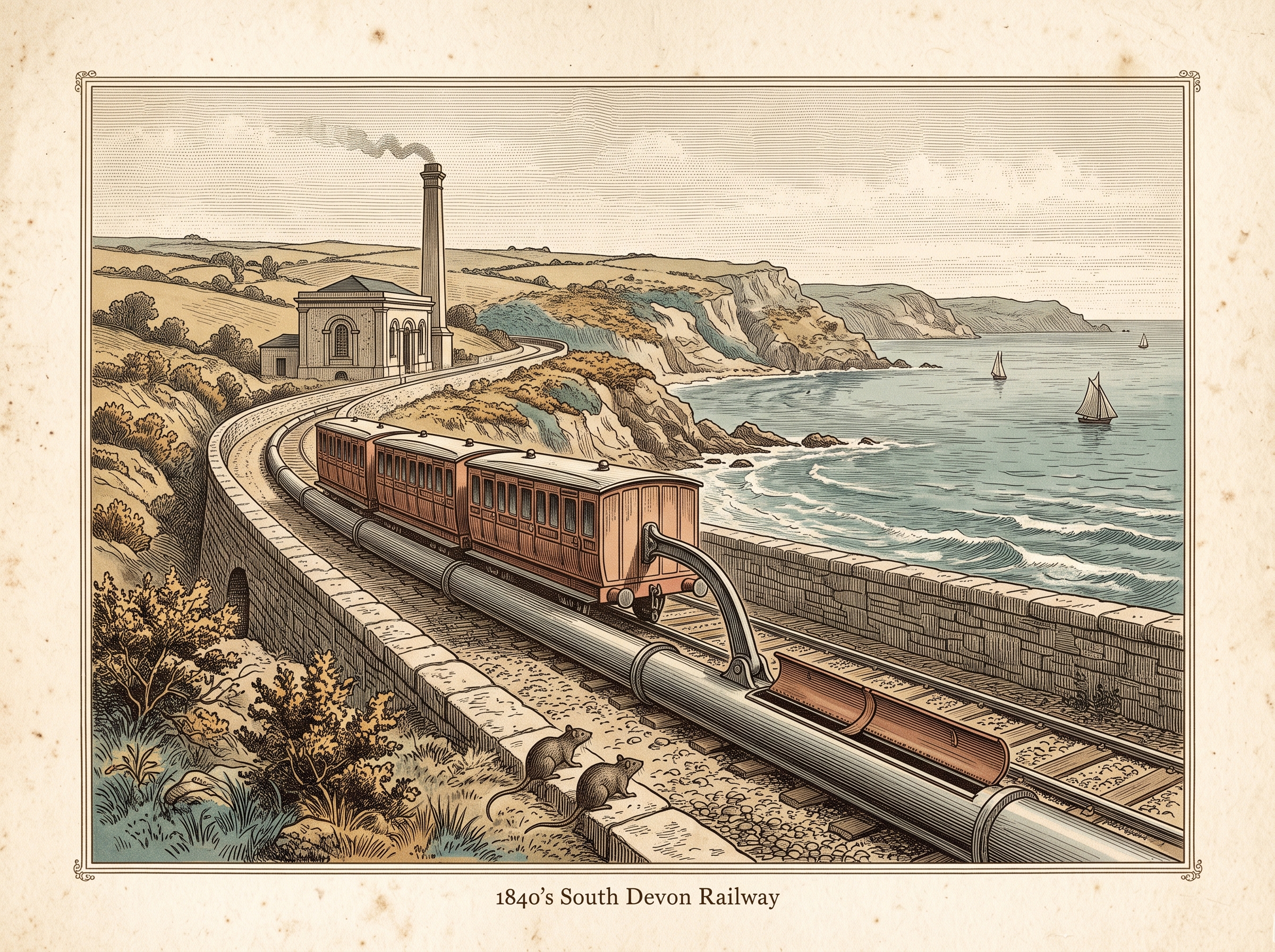
The idea was elegant. Between the rails lay a continuous cast-iron pipe — 15 inches across on the level section — with a slot running along its top. A flap of leather, stiffened with iron plates, covered the slot. Every few miles a stone engine house held a steam engine that pumped air out of the pipe. Inside the pipe sat a piston, connected through the slot to a special carriage at the front of the train. Air pressure behind the piston pushed it toward the emptied section ahead, dragging the train along. As the piston’s arm passed, it lifted the leather flap; rollers pressed it back down behind, and a mix of tallow (rendered animal fat) and beeswax was meant to reseal the gap.
Getting it running took longer than planned. Trains between Exeter and Teignmouth opened in May 1846, but they were hauled by borrowed steam locomotives. Atmospheric passenger trains finally began on 13 September 1847, and by March 1848 every train on the 20-mile stretch to Newton (now Newton Abbot) ran on suction. Travelers liked it. The ride was smooth and quiet, and there was no locomotive smoke to breathe. The best recorded run reportedly averaged 64 miles per hour over four miles.
Then the weather got involved. In the winter of 1847–48, rain soaked the leather flap and frost froze it stiff, so it failed to close behind each train and air leaked back into the pipe. The following spring and summer, the leather dried out and cracked. Brunel had it treated with whale oil. Worse, chemicals in the leather reacted with rust on the iron pipe, weakening the material from within. By May and June 1848, sections of the flap were tearing away from their fixings.
The pumping engines had their own troubles. Brunel had underpowered them, and without a working telegraph to warn when a train was coming, engine houses had to pump according to the timetable — even when a train ran late. Coal costs came in at roughly three times the forecast.
Replacing the entire flap would cost an estimated £32,000. Samuda, who was contractually responsible for maintenance, declined. In a report shown to shareholders on 29 August 1848, Brunel advised giving up, writing that he could not “anticipate the possibility of any inducement to continue the system beyond Newton.” Atmospheric working ended on 9 September 1848 — just under a year after it began. A last-ditch shareholders’ vote in January 1849 confirmed the decision, 5,324 shares to 1,230.
Why was it strange?
It wasn’t a crazy idea. It actually worked — trains ran at speed, on time, for months. What makes the story strange is how the failure has been remembered.
Ask almost anyone who knows the tale and they will tell you the rats ate the leather, lured by the tasty tallow. It’s a perfect punchline, and it is repeated on heritage sites, in books, and by tour guides. But the documents from the actual crisis don’t mention rats. Brunel’s own report blamed weather, tearing leather, and poor engines. Railway historian Colin Divall has said there is “no documentary evidence whatsoever” that rats caused the South Devon failure.
The rats weren’t invented from nothing, though. The Victorian naturalist Frank Buckland included a piece on “rats killed in the atmospheric railway pipes” in his Curiosities of Natural History, and there are reports of rats creeping into the pipes on other atmospheric lines. Somewhere along the way, a real but minor nuisance seems to have grown into the whole explanation.
The same thread — Isambard Kingdom Brunel — continues in The Engineer Who Built a Flip Table to Shake a Gold Coin Out of His Own Windpipe.
What did scientists learn?
The atmospheric railway was a lesson in materials, not in physics. The physics was sound: pull air out of one side of a piston and the atmosphere pushes on the other with about 14.7 pounds per square inch. The problem was the seal. A pipe miles long only works if it is almost airtight, and tiny leaks along every yard add up to one enormous hole. Leather was the best flexible material available in the 1840s, and it simply could not survive sun, frost, salt spray, and constant bending. Vulcanized rubber, which might have done better, was only just being developed.
Engineers also learned that stationary power has limits. A piston can only pull as hard as its area times the pressure difference allows, so steep hills — which the atmospheric system was supposed to conquer — would have demanded bigger pipes and bigger engines everywhere.
Another experiment that taught more by not working: The Windows That Took the Blame for a Plane Crash They Didn’t Cause.
How does it affect us today?
The dream never really died. The steam catapults that launched jets from aircraft carriers for decades used a similar slotted cylinder with a moving seal. Brazil’s Aeromovel system, which carries passengers at Porto Alegre’s airport, pushes small trains using air in a duct beneath the track. And every proposal for a “hyperloop” inherits Brunel’s hardest problem: keeping a very long tube properly sealed.
The Starcross engine house, beside the Exe estuary, still stands and is protected as a Grade I listed building — the only complete pumping house surviving from the three atmospheric lines that ran in the British Isles.
Another ambitious failure: The Talking Doll Edison Built With a Phonograph in Its Chest — and Pulled From Stores Within Weeks.
Fun fact
In 1993, three unused lengths of Brunel’s 22-inch atmospheric pipe turned up buried in the sand at Goodrington Sands near Paignton. They are now on display at the Didcot Railway Centre in Oxfordshire.
Sources
- Historic England — The Starcross Pumping House (List Entry 1097684)
- Grace’s Guide to British Industrial History — Atmospheric Railway
- Wikipedia — Atmospheric railway (quotes Brunel’s 1848 report to the directors via Clayton, The Atmospheric Railways, 1966; cites Hadfield, Atmospheric Railways, 1985)
- Francis T. Buckland, Curiosities of Natural History (1859), Internet Archive
- BBC Radio 4, The Long View — Elon Musk’s Hyperloop and Brunel’s Atmospheric Traction Rail