The Scientist Behind It · Medicine
The Doctor Who Discovered Handwashing — and Was Locked Away for It
In April 1847, a woman admitted to the maternity ward of Vienna General Hospital had roughly a one-in-five chance of dying within days of giving birth. Down the hall, in a second ward staffed by midwives instead of doctors, the odds were four times better. Terrified women begged on their knees not to be sent to the doctors' ward. A young Hungarian physician named Ignaz Semmelweis noticed the gap, traced it to something on his colleagues' hands, and ordered them to wash. The deaths nearly stopped overnight. Eighteen years later, he was dead too — beaten in an asylum, dying of the very kind of infection he had spent his career trying to stop.
By the Curiosities Desk · · 6 min read · Filed under Medicine · Today’s round
Part of The Person Who Would Not Drop It
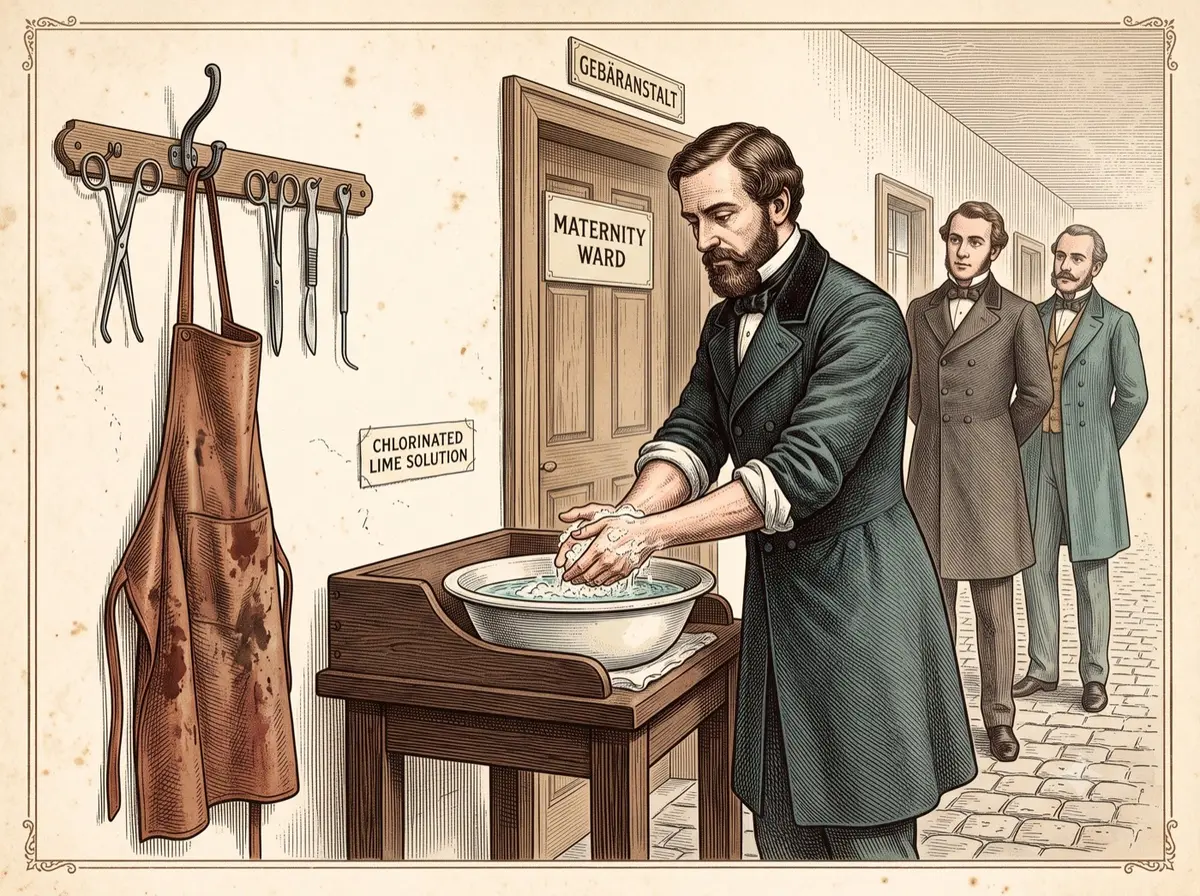
What happened: Handwashing Saves Lives
Ignaz Philipp Semmelweis was born in Buda (now part of Budapest) on July 1, 1818. He studied law at the University of Vienna, switched to medicine, and earned his degree in 1844. After failing to land a post in internal medicine, he took a position in obstetrics — then near the bottom of medicine’s pecking order — and in 1846 became an assistant in the First Obstetrical Clinic at Vienna General Hospital.
The hospital ran two maternity wards. The First Clinic was staffed by physicians and medical students; the Second, by midwives-in-training. Both treated similar patients, yet the First Clinic’s death rate from puerperal fever — a bacterial infection of the reproductive tract following childbirth, then called “childbed fever” — ran several times higher. Across the 1840s the First Clinic averaged close to 10 percent mortality, spiking to 18.3 percent in April 1847, while the Second stayed under 4 percent. Women sometimes gave birth in the street rather than be admitted to the First Clinic, and fared better for it.
Semmelweis ruled out overcrowding (the midwives’ ward was more crowded) and climate (the clinics shared a building). He even had a priest stop ringing a bell on his way to give last rites, in case fear itself was the culprit. Mortality didn’t move.
The breakthrough came after a colleague died. In 1847, Semmelweis’s friend Jakob Kolletschka, a pathologist, was accidentally cut by a student’s scalpel during an autopsy — and died with a pathology strikingly similar to the women succumbing to childbed fever. Semmelweis realized that he and his students spent mornings dissecting cadavers, then walked straight to the maternity ward with barely a rinse in between. He proposed that “cadaverous particles” were being carried from the dead to the living on unwashed hands. The midwives, who never touched a corpse, had none to transmit.
Germ theory didn’t exist yet, so Semmelweis had no real mechanism — only the observation that chlorinated lime cut the smell of decay better than soap and water, and a hunch that whatever killed the smell might kill the danger too. In May 1847 he ordered everyone in the First Clinic to scrub with chlorinated lime before touching patients. Mortality fell to 2.2 percent in June, 1.2 percent in July, 1.9 percent in August — and in two later months, to zero.
Why it was strange: Handwashing Saves Lives
The strangeness isn’t the discovery — it’s what happened after. Semmelweis had numbers showing a simple, cheap habit cutting deaths by roughly 90 percent, and almost no one wanted them. He couldn’t explain why it worked in terms doctors of the 1840s would accept, and by his own account many physicians were personally offended at the suggestion that their hands — a gentleman’s hands — could carry death. Much of Vienna’s medical establishment shrugged off the practice, misrepresented it, or ignored it. Semmelweis was pushed out of his hospital post for reasons more political than medical.
He didn’t handle the rejection gracefully. As respected figures like pathologist Rudolf Virchow dismissed his ideas, Semmelweis grew bitter, firing off open letters accusing prominent obstetricians of being murderers for refusing to wash their hands. What was actually happening to him by 1865 is debated — possibly a psychiatric breakdown, possibly a neurological illness, possibly the toll of two decades of being ignored. What’s documented is the ending: his own wife came to believe he was losing his mind. In July 1865 a friend lured him to a Viennese asylum under a false pretense. Semmelweis realized what was happening, tried to leave, and was severely beaten by guards, then restrained in a straitjacket. He died two weeks later, on August 13, 1865, at 47, of pyemia — blood poisoning — from a gangrenous wound on his hand, possibly caused by the struggle. The man who begged the world to fear infected hands died of one.
Another person who would not drop the question: The Doctor Who Ate, Slept, and Worked on a Giant Scale for 30 Years.
What scientists learned: Handwashing Saves Lives
Semmelweis’s data showed, before anyone understood microbes, that an invisible agent on hands could cause disease — and that removing it saved lives. It took Louis Pasteur’s work in the 1860s on microorganisms, and Joseph Lister’s subsequent antiseptic surgical technique, to give those numbers a mechanism the world would accept. Once germ theory existed, hand disinfection stopped looking eccentric and became a foundation of infection control.
The story doubles as a case study in how institutions resist evidence that threatens status, not just theory. Semmelweis had the statistics right decades before anyone had the explanation — and that gap, plus his own unraveling, was enough to bury the finding until others rediscovered it.
The same thread — Obstetrics — continues in The Woman Who Convinced the King’s Surgeon She Gave Birth to Rabbits.
How it reaches us today: Handwashing Saves Lives
Every “wash your hands” sign in a hospital, every gel dispenser outside a patient’s room, traces back to a bucket of chlorinated lime in a Viennese maternity ward. Hand hygiene remains one of the cheapest, most effective tools in medicine for preventing hospital-acquired infections, and the World Health Organization’s global hand hygiene guidelines cite Semmelweis as the founding case. His name also survives as the “Semmelweis reflex,” shorthand for reflexively rejecting evidence that contradicts entrenched belief — though exactly who coined the phrase, and when, is murky; it’s often traced to a 1979 book by Robert Anton Wilson, without firm confirmation.
Another scientist, told from the human side: The Doctor Who Rode a Rocket Sled at 632 MPH — and Gave Us Murphy’s Law.
Fun fact: Handwashing Saves Lives
Semmelweis never published his own account of the discovery until 1861 — fourteen years after the results came in — relying instead on secondhand reports by students and colleagues that were often garbled or incomplete. By the time his own book, Die Ätiologie, der Begriff und die Prophylaxis des Kindbettfiebers (“The Etiology, Concept and Prophylaxis of Childbed Fever”), reached print, one rival obstetrician had already dismissed it in print as “the Koran of puerperal theology.”
A note: this article discusses a historical death involving institutional confinement and violence. If any of this touches something you’re navigating personally, it’s worth talking to someone you trust or a professional about it.
Sources: Handwashing Saves Lives
- Ignaz Semmelweis — Wikipedia (cross-referenced with cited primary biographical sources, including K. Codell Carter’s biography)
- How dramatic were the effects of handwashing on maternal mortality observed by Ignaz Semmelweis? — PMC
- Historical perspective on hand hygiene in health care — WHO Guidelines on Hand Hygiene in Health Care, NCBI Bookshelf
- In 1850, Ignaz Semmelweis saved lives with three words: wash your hands — PBS NewsHour
- Epidemics: wash your hands! The asylum death and violent end of Professor Ignaz Philipp Semmelweis — The British Journal of Psychiatry, Cambridge Core
Related stories: Handwashing Saves Lives
- The Doctor Who Drank a Beaker of Bacteria to Prove Ulcers Weren’t Caused by Stress — He drank a flask of bacteria to prove ulcers were an infection
- The Moldy Petri Dish That Almost Got Thrown Away — A contaminated petri dish that nearly went in the bin
- From a Sponge on a Stick to the Flush Toilet: A Short History of the Toilet — Two thousand years of sanitation, from shared sponges to the S-bend