The Scientist Behind It · Medicine
The Doctor Who Rode a Rocket Sled at 632 MPH — and Gave Us Murphy's Law
On a December morning in 1954, an Air Force doctor strapped himself into a sled with nine rockets bolted to the back, accelerated to 632 miles per hour in five seconds, and then stopped in 1.4 seconds. When the crew unbuckled him, he managed about half a smile. Nearly every capillary in both eyes had burst.
By the Curiosities Desk · · 5 min read · Filed under Medicine · Today’s round
What happened?
The doctor was John Paul Stapp, born in Bahia, Brazil, in 1910 to Baptist missionary parents. He was taught at home until he was twelve and wanted to be a writer, then switched to medicine after an infant cousin died. He collected a PhD in biophysics and an MD before joining the Army Air Forces in 1944 as a flight surgeon.
In March 1947 he was handed a question the Air Force badly needed answered: how much sudden force can a human body take? Jets were getting faster far faster than anyone understood what that meant for the people inside them. The accepted survivable limit was around 18 g — 18 times Earth’s gravity — and cockpits were designed to that number. Nobody was certain where it had come from.
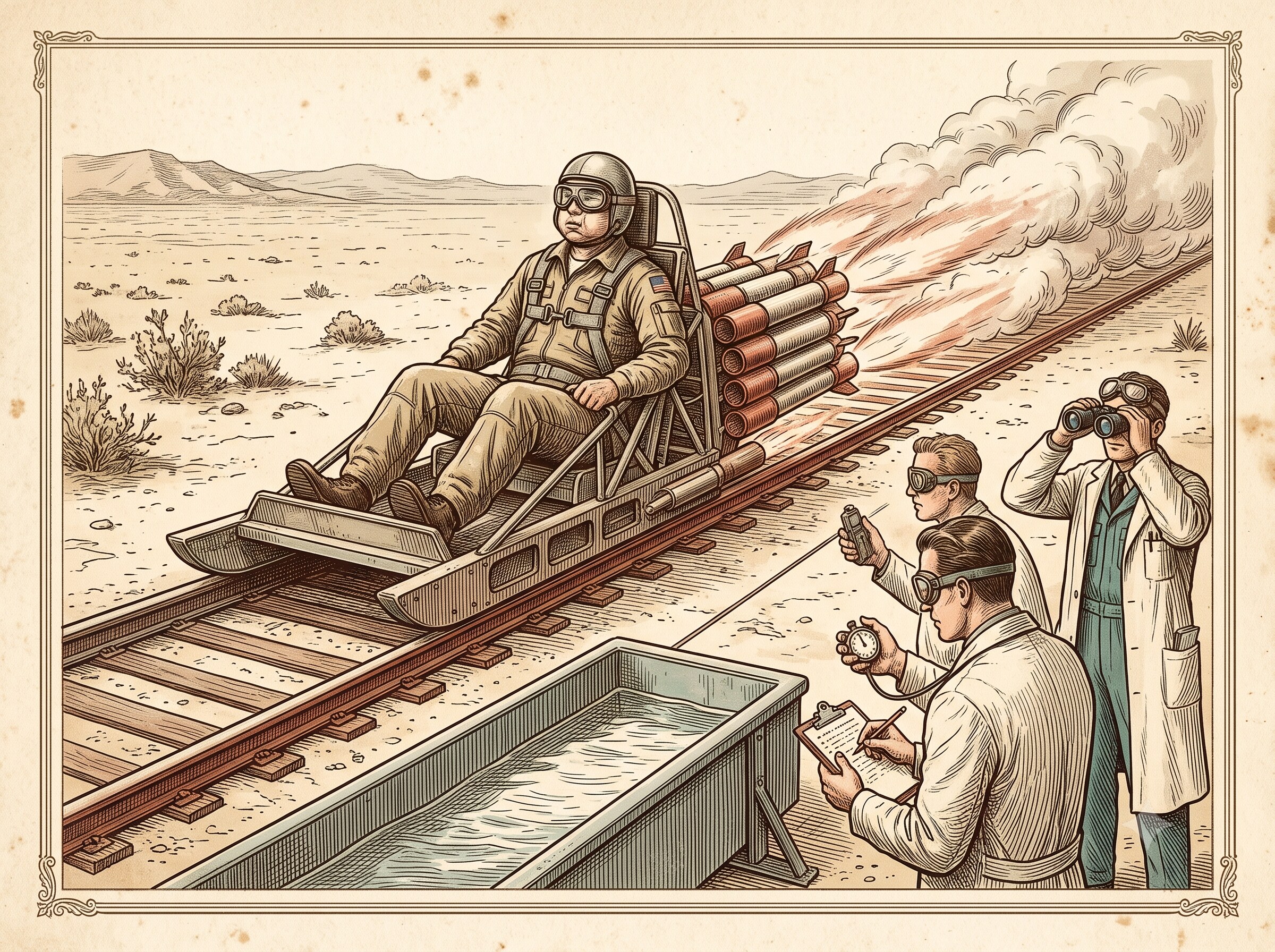
His method was a rocket sled: a seat on rails, pushed by solid-fuel rockets, then stopped by scoops that dropped into a water trough. He ran it 32 times with a dummy before climbing in himself in December 1947 at Muroc Army Air Field, California, on a sled the crew nicknamed the Gee Whiz. By the next summer he had made sixteen runs facing backward and taken up to 35 g — roughly double the supposed ceiling. Along the way he broke ribs, broke his wrist, and blew out blood vessels in his eyes more than once. He kept riding.
In 1953 the work moved to Holloman Air Force Base in New Mexico, where the track was longer. On December 10, 1954, Stapp rode the Sonic Wind No. 1 — nine rockets, about 40,000 pounds of thrust — more than 3,000 feet down the rails. He hit 632 mph, faster than a .45 pistol bullet, then the water brake grabbed the sled and took him to zero in 1.4 seconds. The Smithsonian and the New Mexico Museum of Space History put the peak deceleration at 46.2 g; Air Force accounts round it to “more than 40.” Either way, it was more than any human had voluntarily taken.
He described it afterward with the flatness of a man filling in a form: “I felt a sensation in the eyes … somewhat like the extraction of a molar without anesthetic.” On the way to the hospital he was quietly terrified that a retina had detached. By the next day he could see well enough to be discharged. His eyesight never fully recovered.
He wanted to go faster — to bolt on more rockets and push past 1,000 mph. His superiors said no. They did not think he would survive it.
Why was it strange?
Stapp had a surplus of volunteers. He turned them down and rode himself, on the grounds that he would not put anyone in a seat he had not already sat in. “I have the missionary spirit,” he said. “I took my risks for information that will always be of benefit.”
The odder part is what he did with the fame. Stapp became a magazine-cover celebrity — Time called him “the fastest man on earth” in September 1955 — and he spent that celebrity on something far less glamorous than rocket sleds. At Holloman he had noticed something that bothered him more than the g-forces did: the Air Force was losing nearly as many men to car crashes as to plane crashes. His airmen could survive 40 g strapped to a rocket sled, then die at 40 mph on the highway into Alamogordo, because nothing was holding them in the car.
So the most violently decelerated man in history went on television to talk about seat belts.
It shares a shelf with The Doctor Who Ate, Slept, and Worked on a Giant Scale for 30 Years, in The Scientists Who Ran the Experiment on Themselves.
What did scientists learn?
The core finding is one line, and it reshaped a field: speed doesn’t injure you. Changing speed does — and how badly depends on how fast the change happens and how the force spreads across your body.
A “g” is just a multiple of normal gravity, and the number alone says almost nothing. Stapp’s runs showed that a properly restrained human — load carried by strong structures like the pelvis, chest, and shoulders, and spread over even a fraction of a second longer — survives forces several times what engineers had assumed were fatal. The same 46 g that nearly blinded him would kill a person held only by a lap belt across the abdomen.
His backward-facing runs produced a result that still holds: rearward-facing seats spread crash loads across the whole back and are measurably safer, which is why military transports and rear-facing child seats are built the way they are. And the 1954 run answered its original question — a pilot ejecting at 35,000 feet at supersonic speed could survive the windblast.
The same thread — Self Experimentation — continues in The Needle Isaac Newton Slid Behind His Own Eyeball to Find Out Where Color Comes From.
How does it affect us today?
Stapp’s Holloman work seeded the crash-testing world: instrumented dummies, salvaged cars fired into concrete barriers, volunteers testing belts at lower forces. In 1955 he helped start what became the Stapp Car Crash Conference, which still runs annually and publishes the peer-reviewed Stapp Car Crash Journal.
On September 9, 1966, Stapp was in the room when President Lyndon Johnson signed the federal highway safety legislation that led to seat belts being required in new American cars from 1968. He later worked for the National Highway Traffic Safety Administration, and in 1991 received the National Medal of Technology.
To be precise: Stapp did not invent the seat belt, and the modern three-point belt was designed by Volvo engineer Nils Bohlin in 1959. Stapp supplied the evidence — hard numbers proving a restrained body survives crashes an unrestrained one does not — and the very loud voice arguing that ordinary drivers deserved the same protection as fighter pilots.
Also in The Scientists Who Ran the Experiment on Themselves: The Doctor Who Drank a Beaker of Bacteria to Prove Ulcers Weren’t Caused by Stress.
Fun fact
Murphy’s Law was born on Stapp’s project. In 1949, on the Muroc deceleration tests, an engineer named Edward Murphy found a set of strain gauges wired backward, producing a reading of zero. Murphy said something sour about it, his colleagues sharpened the remark into a rule, and Stapp made it famous — asked at a press conference why nobody on his team had been badly hurt, he answered that they always accounted for “Murphy’s Law.”
Who actually said what is disputed: George Nichols, Murphy’s son Robert, and later researchers all tell different versions, and no printed use of the phrase has surfaced before 1951. In 2003 the Ig Nobel Prize in engineering went jointly to Stapp, Murphy, and Nichols — “for (probably) giving birth to the name.”
Sources
- The Man Behind High-Speed Safety Standards — Smithsonian National Air and Space Museum (holds the Sonic Wind No. 1 sled)
- 60 years later: Earning the title ‘the fastest man on earth’ — U.S. Air Force, 49th Wing Public Affairs
- John P. Stapp, International Space Hall of Fame — New Mexico Museum of Space History
- About John P. Stapp — Stapp Car Crash Association
- Past Ig Nobel Winners (2003, Engineering) — Improbable Research