Weird Medical History · Medicine
The Doctor Who Drank a Beaker of Bacteria to Prove Ulcers Weren't Caused by Stress
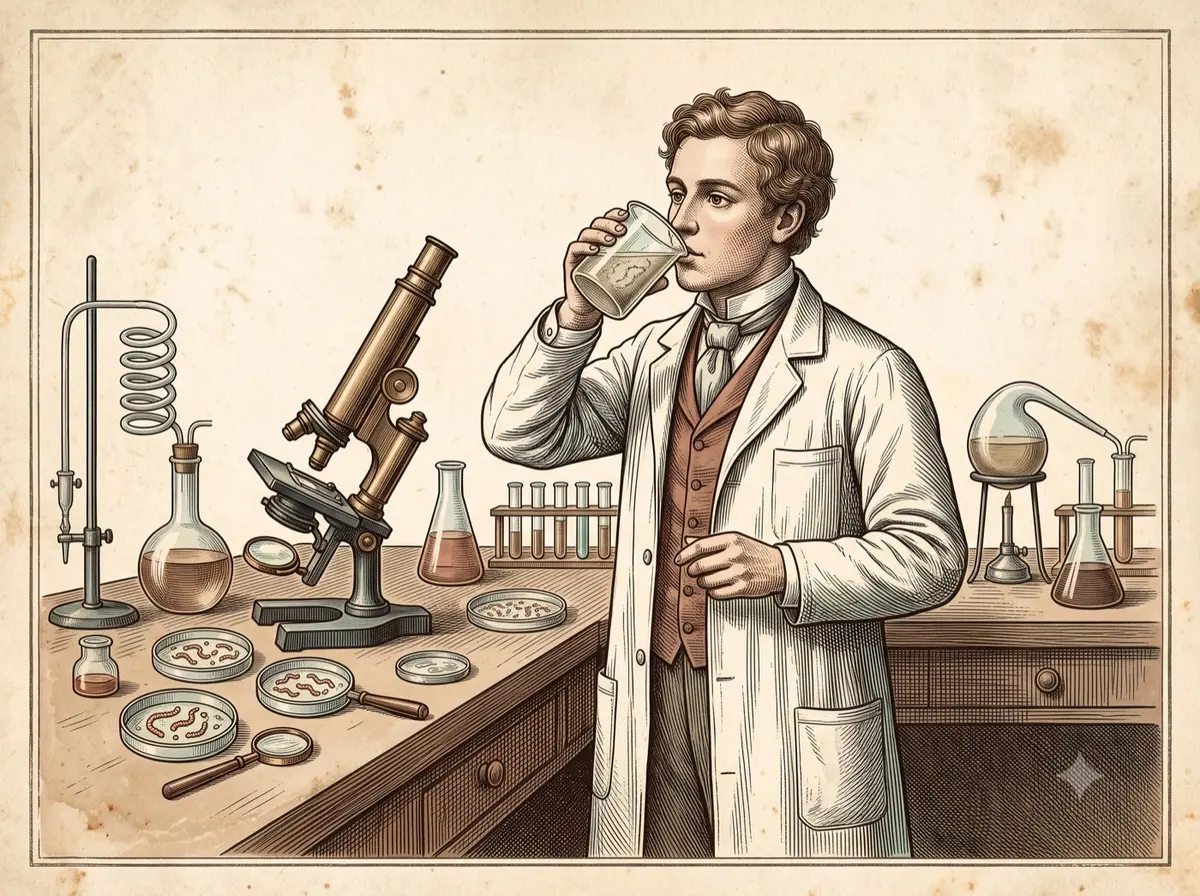
One morning in 1984, a 32-year-old doctor at a hospital in Perth, Australia, stood in a lab, swirled a cloudy broth teeming with bacteria, and drank it down like a shot. He had skipped breakfast for the occasion. Within days he was nauseous, vomiting, and — according to his wife — had breath bad enough to clear a room. He was thrilled. He had just deliberately infected his own stomach to win an argument that the entire medical establishment insisted he was losing.
By the Curiosities Desk · · 6 min read · Filed under Medicine · Today’s round
What happened: The Doctor Who Drank a Beaker of Bacteria to Prove Ulcers Weren't Caused
The doctor was Barry Marshall, born in the gold-mining town of Kalgoorlie in 1951 and trained at the University of Western Australia. In 1981, during fellowship training at Royal Perth Hospital, he met Robin Warren, a pathologist who had noticed something odd under his microscope: curved, spiral-shaped bacteria living in the stomachs of patients with gastritis. This was supposed to be impossible. The stomach is a vat of hydrochloric acid, and the textbook consensus held that nothing could survive there.
Marshall and Warren teamed up and, in 1982, managed to grow the bacterium in the lab — but only by accident. Their first 34 attempts failed because lab technicians, following the standard two-day routine for throat cultures, threw the plates out before anything grew. Over the 1982 Easter long weekend, a backlog meant one plate was simply left sitting for five days. When staff returned, it was covered in colonies. The bug, later named Helicobacter pylori, just grew more slowly than anyone expected.
The pair proposed a radical idea: that this bacterium, not stress or spicy food or excess acid, was the real cause of most stomach and duodenal ulcers. The reaction was withering. In 1983 the Gastroenterological Society of Australia rejected their abstract, ranking it in the bottom 10 percent of submissions that year. A multibillion-dollar industry of antacids was built on the stress theory, and few specialists were eager to overturn it on the word of two unknowns from Western Australia.
Marshall needed proof that the bacterium could actually cause disease in a healthy person. He tried infecting piglets; that failed. So he turned to the one test subject who could give informed consent and whom no ethics board could stop: himself. After a baseline endoscopy confirmed his stomach was healthy, he drank a culture of H. pylori taken from one of his patients. He expected that if anything happened at all, it might take years. Instead, within three days he felt nauseous and developed foul breath. By day five he was vomiting. A follow-up endoscopy on day eight showed his stomach lining badly inflamed, and a biopsy grew the same bacteria he had swallowed. He had given himself acute gastritis in barely a week. He started antibiotics, recovered, and published the experiment in the Medical Journal of Australia in 1985.
Why it was strange: The Doctor Who Drank a Beaker of Bacteria to Prove Ulcers Weren't Caused
The strangeness runs deeper than a doctor drinking germs on purpose. For most of the 20th century, “ulcers are caused by stress” was not a fringe belief — it was orthodoxy, taught in every medical school and reinforced by the era’s fascination with psychosomatic illness. Patients were told to relax, drink milk, and manage their nerves. The idea that a humble bacterium could be the culprit collided with a wall of confident expertise.
What makes the story more than a curiosity is how the evidence was ignored even as it accumulated. Spiral bacteria in the stomach had actually been spotted by various researchers as far back as the late 1800s, but the observations were dismissed as contamination or forgotten entirely. The acid-and-stress model was so dominant that the data kept getting explained away. It took an act of self-experimentation — flamboyant, slightly reckless, impossible to wave off — to force the field to look again.
It shares a shelf with The Surgeon Who Threaded a Tube Into His Own Heart, in The Scientists Who Ran the Experiment on Themselves.
What scientists learned: The Doctor Who Drank a Beaker of Bacteria to Prove Ulcers Weren't Caused
Marshall’s experiment satisfied a classic standard in microbiology known as Koch’s postulates, the criteria for proving that a specific microbe causes a specific disease: he took the organism from a sick person, grew it in pure culture, introduced it into a healthy host, and reproduced the illness. His case fulfilled those postulates for gastritis, the inflammation that often precedes ulcers.
The larger lesson was that a major class of “lifestyle” diseases was, in fact, infectious. Once H. pylori was accepted as the driver of most peptic ulcers, the treatment changed completely. Instead of a lifetime of acid suppression to manage symptoms, many patients could be cured outright with a short course of antibiotics combined with acid-reducing drugs. Researchers later linked chronic H. pylori infection to stomach cancer as well, making it one of the few bacterial infections recognized as a cause of cancer.
In 2005, the Karolinska Institute awarded Barry Marshall and Robin Warren the Nobel Prize in Physiology or Medicine “for their discovery of the bacterium Helicobacter pylori and its role in gastritis and peptic ulcer disease.”
The same thread — Self Experimentation — continues in The Doctor Who Rode a Rocket Sled at 632 MPH — and Gave Us Murphy’s Law.
How it reaches us today: The Doctor Who Drank a Beaker of Bacteria to Prove Ulcers Weren't Caused
If you or someone you know has had a stomach ulcer treated with antibiotics rather than a permanent prescription for antacids, that is Marshall and Warren’s legacy. A condition that once meant chronic pain, recurring bleeding, and sometimes dangerous surgery became, for most people, curable. The discovery also reshaped how medicine thinks about the link between microbes and chronic disease, helping open the door to today’s intense research on the gut microbiome.
It is also a lasting cautionary tale about expert consensus. The ulcer story is now taught in medical schools not only for its biology but as a reminder that a well-established theory can be wrong, and that evidence sometimes has to shout to be heard.
Also in The Scientists Who Ran the Experiment on Themselves: The Student Who Drank Vomit to Prove Yellow Fever Wasn’t Contagious.
Fun fact: The Doctor Who Drank a Beaker of Bacteria to Prove Ulcers Weren't Caused
Marshall’s wife only realized how far the experiment had gone when she complained about his terrible breath. The halitosis was a symptom: the bacteria had so disrupted his stomach chemistry that his body had stopped making normal stomach acid, letting the microbes’ waste products build up. A spouse’s offhand complaint was, in a sense, one of the first clinical readouts of the experiment.
Sources: The Doctor Who Drank a Beaker of Bacteria to Prove Ulcers Weren't Caused
- Nobel Prize in Physiology or Medicine 2005 — Summary: https://www.nobelprize.org/prizes/medicine/2005/summary/
- Barry J. Marshall — Biographical, The Nobel Foundation: https://www.nobelprize.org/prizes/medicine/2005/marshall/biographical/
- Marshall BJ, Armstrong JA, McGechie DB, Glancy RJ. “Attempt to fulfil Koch’s postulates for pyloric Campylobacter.” Medical Journal of Australia, 1985: https://doi.org/10.5694/j.1326-5377.1985.tb113443.x
- “Barry Marshall” — Wikipedia (cross-referenced with cited sources): https://en.wikipedia.org/wiki/Barry_Marshall
- NIDDK (National Institutes of Health), Peptic Ulcers and H. pylori: https://www.niddk.nih.gov/health-information/digestive-diseases/peptic-ulcers-stomach-ulcers
A note on health: This is a historical story, not medical advice. Persistent stomach pain, nausea, or signs of bleeding are worth taking seriously — if any of this sounds familiar, it’s worth a conversation with a doctor, since the underlying causes are now very treatable.
Related stories: The Doctor Who Drank a Beaker of Bacteria to Prove Ulcers Weren't Caused
- Part of The Scientists Who Ran the Experiment on Themselves
- The Surgeon Who Threaded a Tube Into His Own Heart — He threaded a catheter into his own heart and walked to the X-ray room
- The Student Who Drank Vomit to Prove Yellow Fever Wasn’t Contagious — A student drank black vomit to prove yellow fever was not contagious
- The Doctor Who Discovered Handwashing — and Was Locked Away for It — He proved handwashing saved mothers and was destroyed for it