Weird Medical History · Medicine
The Surgeon Who Threaded a Tube Into His Own Heart
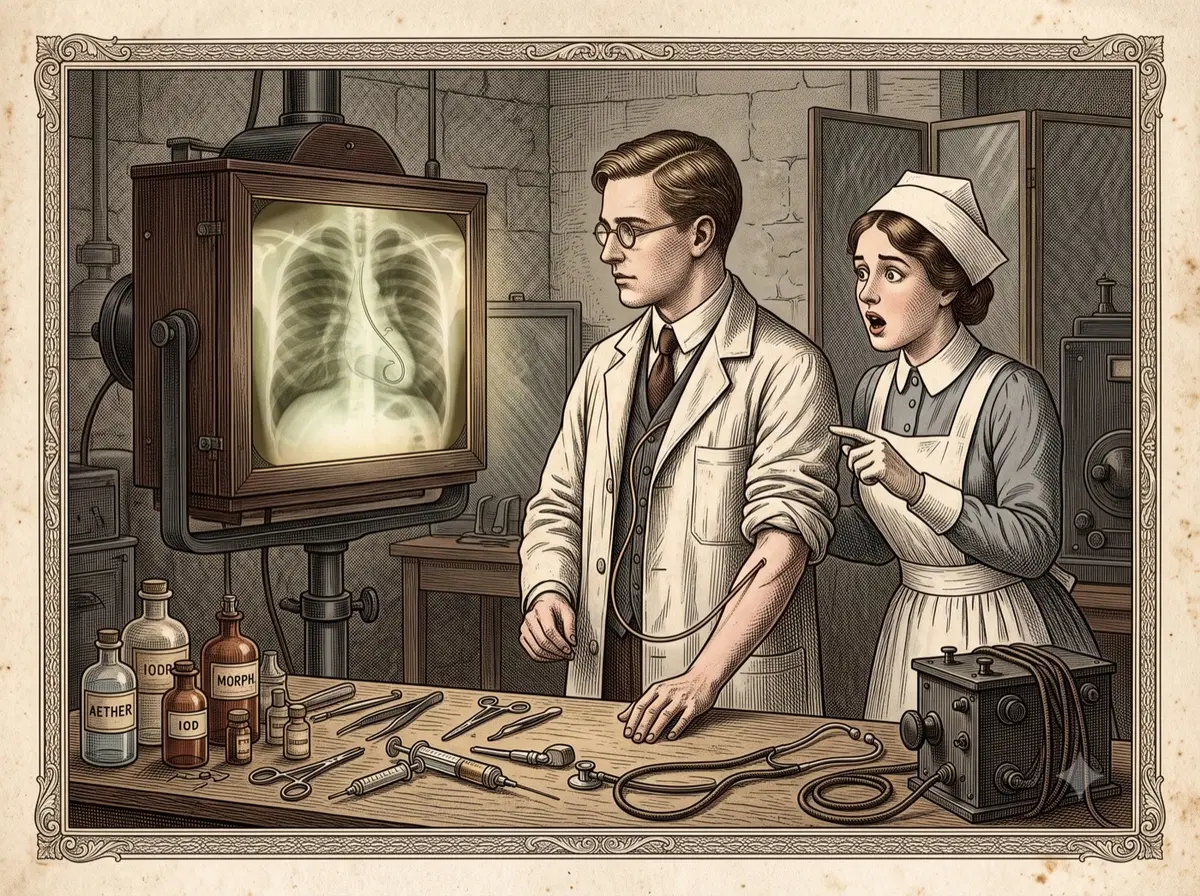
In the summer of 1929, a 25-year-old surgical intern in a small German hospital pushed a thin rubber tube up the vein of his own arm, fed it slowly toward his chest, and kept feeding until the tip reached the inside of his beating heart. Then he stood up, walked down a flight of stairs to the X-ray department, and asked someone to take a picture to prove it. His boss had explicitly forbidden the experiment. He had done it anyway, alone, on himself.
By the Curiosities Desk · · 6 min read · Filed under Medicine · Today’s round
What happened: The Surgeon Who Threaded a Tube Into His Own Heart
The intern was Werner Forssmann, born in Berlin in 1904 and freshly qualified as a doctor. He was working at the Auguste Viktoria Home, a hospital in Eberswalde, a town northeast of Berlin. Forssmann had become fascinated by an old illustration of a procedure done on a horse, in which a tube had been passed into the animal’s heart to measure pressure. He wondered whether the same thing could be done safely in a human — and whether a catheter reaching the heart might one day let doctors deliver drugs directly to a failing organ in an emergency.
The medical wisdom of the day was emphatic: the heart was off-limits. Touching it, or putting anything inside it, was thought likely to send it into a fatal spasm or rhythm collapse. Forssmann’s supervisor, Richard Schneider, refused him permission to try it on a patient, and certainly on himself.
So Forssmann found a quieter way. According to the standard account, he won over a surgical nurse named Gerda Ditzen, who had access to the sterile instruments and the catheters. She was willing to help — and even offered herself as the test subject. Forssmann had her lie down and, by his telling, made a show of preparing her arm while he actually numbed and cut into his own. By the time she realized the catheter was going into his vein and not hers, the procedure was already under way.
Working from the crook of his left elbow, Forssmann threaded a flexible urinary catheter — the kind normally used in the bladder — up the vein toward his torso. He advanced it roughly 60 centimeters, about two feet, until he judged it had reached the right side of his heart. Then the two of them went to the radiology department. A fluoroscope and an X-ray confirmed it: the tip of the catheter sat in his right atrium, one of the heart’s upper chambers. He had documented the first cardiac catheterization in a living human being, and the patient was himself.
He published the result that same year, in 1929, in the German journal Klinische Wochenschrift. Rather than making him a star, it nearly ended his career. Senior physicians considered the self-experiment reckless showmanship. Forssmann drifted out of cardiology and spent most of his working life as a urologist in the Black Forest, far from the field he had helped open.
Why it was strange: The Surgeon Who Threaded a Tube Into His Own Heart
The strangeness isn’t only that a doctor used his own body as the lab animal — self-experimentation has a long, complicated tradition in medicine. It’s that he did it to disprove a near-universal fear, and that he did it essentially in secret, against orders, with borrowed equipment and a single accomplice.
There’s also the cool, almost clinical patience of it. This was not a reflex. Forssmann had to insert a tube into his vein, feel it travel through his shoulder and into his chest, and resist every instinct telling him to stop, all while calm enough to then walk to another room and queue up for an X-ray. He reportedly performed versions of the self-catheterization several times to refine the technique. The story is so cinematic that legend has crept in around the edges — the exact details of how he handled the nurse, and how many times he repeated it, vary between tellings — which is exactly why the X-ray mattered. The photograph turned a wild claim into a record.
It shares a shelf with The Student Who Drank Vomit to Prove Yellow Fever Wasn’t Contagious, in The Scientists Who Ran the Experiment on Themselves.
What scientists learned: The Surgeon Who Threaded a Tube Into His Own Heart
The immediate lesson was simple and enormous: you could put a catheter into a living human heart without killing the patient. The organ did not seize or stop. That single fact removed the wall of fear that had kept the inside of the heart a black box.
The deeper payoff came later, and from other people. In the 1940s, two researchers in New York — the French-born physiologist André Cournand and the American physician Dickinson W. Richards, working at Bellevue Hospital and Columbia University — built on Forssmann’s idea and turned it into a precise diagnostic tool. By guiding catheters into the heart, they could measure blood pressures and oxygen levels chamber by chamber, mapping how a sick heart actually behaved. Cardiac catheterization became a cornerstone of modern cardiology.
In 1956, the Nobel Prize in Physiology or Medicine was awarded jointly to Forssmann, Cournand, and Richards “for their discoveries concerning heart catheterization and pathological changes in the circulatory system.” By then Forssmann was a country urologist who had given up the field; he reportedly said he felt like a village parson who had just learned he’d been made a bishop.
The same thread — Nobel Prize — continues in The Doctor Who Drank a Beaker of Bacteria to Prove Ulcers Weren’t Caused by Stress.
How it reaches us today: The Surgeon Who Threaded a Tube Into His Own Heart
If you or someone you know has ever had a coronary angiogram, a stent placed to open a blocked artery, a pacemaker threaded into position, or a heart-valve repair done through a catheter rather than open surgery, you have benefited from the door Forssmann pried open. All of these procedures rely on the same basic insight he tested on himself: that a tube can be guided through the blood vessels into the heart, and that the heart will tolerate it.
Cardiac catheterization is now one of the most common procedures in medicine, performed millions of times a year worldwide. Much of interventional cardiology — the branch that treats heart disease through small punctures rather than open-chest surgery — descends directly from that afternoon in Eberswalde.
Also in The Scientists Who Ran the Experiment on Themselves: The Doctor Who Rode a Rocket Sled at 632 MPH — and Gave Us Murphy’s Law.
Fun fact: The Surgeon Who Threaded a Tube Into His Own Heart
Forssmann did not stop at threading the catheter into his heart. In follow-up work he experimented with injecting contrast dye through a catheter to make the heart and vessels visible on film — an early step toward angiocardiography, the imaging that lets doctors see blocked arteries today. The man who was punished for one self-experiment quietly kept running them.
Sources: The Surgeon Who Threaded a Tube Into His Own Heart
- The Nobel Prize in Physiology or Medicine 1956 — Award summary, The Nobel Foundation: https://www.nobelprize.org/prizes/medicine/1956/summary/
- Werner Forssmann — Biographical, The Nobel Foundation: https://www.nobelprize.org/prizes/medicine/1956/forssmann/biographical/
- Forssmann W. “Die Sondierung des rechten Herzens” (Probing of the right heart). Klinische Wochenschrift, 1929. (Original publication of the self-catheterization.)
- “Werner Forssmann” — Wikipedia (cross-referenced against its cited sources): https://en.wikipedia.org/wiki/Werner_Forssmann
- Berry D. “Werner Forssmann and self-experimentation,” Journal of the Royal Society of Medicine / history-of-cardiology literature on the 1929 procedure.
A note on health: This is a historical story, not a how-to. Self-experimentation of this kind was dangerous then and would be considered indefensible now — modern cardiac procedures are done by trained teams under careful safeguards. If you have concerns about your heart, the right next step is a conversation with a doctor.
Related stories: The Surgeon Who Threaded a Tube Into His Own Heart
- Part of The Scientists Who Ran the Experiment on Themselves
- The Doctor Who Drank a Beaker of Bacteria to Prove Ulcers Weren’t Caused by Stress — He drank a flask of bacteria to prove ulcers were an infection
- The Student Who Drank Vomit to Prove Yellow Fever Wasn’t Contagious — A student drank black vomit to prove yellow fever was not contagious
- The Wrong Resistor That Grabbed a Heartbeat Out of Thin Air — A wrong resistor turned a recording device into the pacemaker