The Student Who Drank Vomit to Prove Yellow Fever Wasn't Contagious
In a Philadelphia laboratory around 1802, Stubbins Ffirth made small cuts in his own arms, then rubbed a stranger's black vomit into the wounds. When that failed to make him sick, he dripped the vomit into his eyes. Then he fried some of it and inhaled the steam. Then — and this is the part that has kept his name alive for two centuries — he poured a fresh glassful and drank it down. He was trying to prove a point.
By the Curiosities Desk · · 5 min read · Filed under Medicine · Today’s round
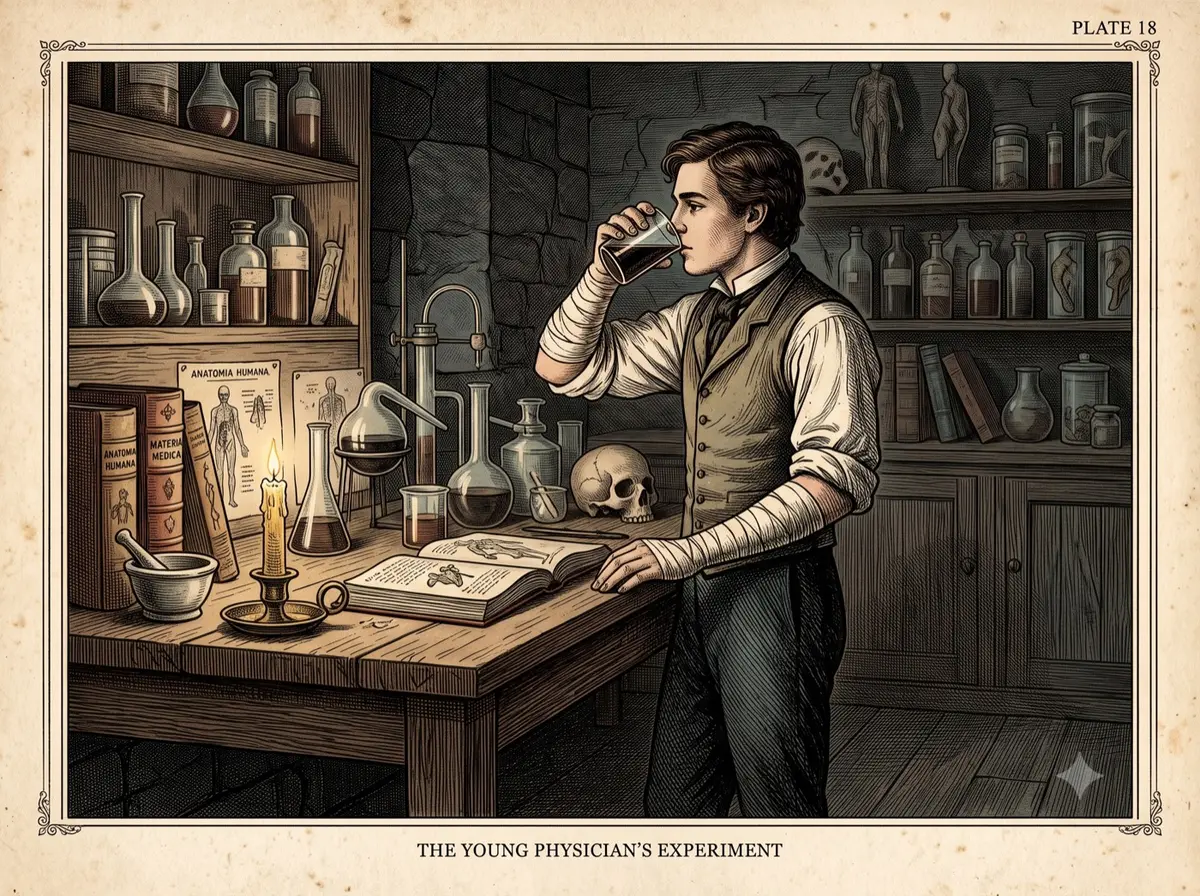
What happened: The Student Who Drank Vomit to Prove Yellow Fever Wasn't Contagious
The student was Stubbins Ffirth, born in 1782 in Salem County, New Jersey. He enrolled at the University of Pennsylvania to study medicine in 1801, and by his third year he had fixed on one of the most terrifying questions of his era: what caused yellow fever?
He had good reason to care. In 1793, the worst yellow fever epidemic in American history had torn through Philadelphia, then the nation’s capital. It killed roughly 5,000 people — close to one in ten residents — and emptied the city as those who could afford to fled. The disease announced itself with fever, jaundice that turned the skin yellow, and, in its grim final stages, the vomiting of partly digested blood that doctors called “black vomit.”
Ffirth noticed something real: cases collapsed every winter and surged every summer. From that pattern he drew a sweeping conclusion. Yellow fever, he decided, was not contagious at all. It came instead from the heat, filth, and stress of the summer months — an imbalance in the body, not something passed person to person. And he was so confident he set out to prove it on the only test subject he could fully control: himself.
He started with the incisions and the black vomit. Nothing. He poured the vomit into his eyes. Nothing. He cooked it and breathed the fumes, then escalated to swallowing it undiluted. Still nothing. To rule out the idea that vomit was somehow special, he smeared himself with infected blood, saliva, and urine too. Through all of it, he stayed healthy — and took his survival as victory. In 1804 he published his results in his graduating thesis with a title that left no doubt about his thesis: A Treatise on Malignant Fever; with an Attempt to Prove its Non-contagious Nature.
Why it was strange: The Student Who Drank Vomit to Prove Yellow Fever Wasn't Contagious
The strangeness runs deeper than the obvious gross-out. Ffirth ran one of the most stomach-turning self-experiments in medical history — and his headline conclusion wasn’t entirely wrong. Yellow fever genuinely does not spread the way a cold does. You cannot catch it by touching a sick person, sharing their cup, or, as Ffirth painfully demonstrated, drinking their vomit.
But being right about the conclusion while being wrong about the reason is its own kind of failure. Ffirth thought his survival proved the disease arose from heat and bad air. In fact he had stumbled into a false negative, the experimenter’s trap where a test “works” for reasons that have nothing to do with the hypothesis. His samples, it later emerged, came largely from late-stage patients whose bodies were no longer carrying live, transmissible infection. And even fresh material wouldn’t have infected him through a cut or a swallow, because the real route in was something he never imagined.
It shares a shelf with The Surgeon Who Threaded a Tube Into His Own Heart, in The Scientists Who Ran the Experiment on Themselves.
What scientists learned: The Student Who Drank Vomit to Prove Yellow Fever Wasn't Contagious
The answer arrived long after Ffirth’s death in 1820. In 1881, the Cuban physician Carlos Finlay proposed a radical idea: yellow fever wasn’t spread by contact or foul air, but carried from person to person by a mosquito. A year later he pointed to a specific culprit, the mosquito we now call Aedes aegypti. When Finlay presented the theory at an international conference, it was met with ridicule.
Vindication came in 1900, when the U.S. Army’s Walter Reed Commission tested the mosquito theory in Cuba and confirmed it. Yellow fever is caused by a virus, and that virus needs the mosquito as a go-between — a “vector.” This is why Ffirth could bathe in infected fluids and stay well: without a mosquito bite to inject the virus into his bloodstream, the disease had no way in. His grueling experiments were doomed before they began. The biggest lesson, though, was the principle behind the whole episode. A vivid result proves nothing on its own; you have to rule out every other reason it might have come out that way.
The same thread — Self Experimentation — continues in The Doctor Who Rode a Rocket Sled at 632 MPH — and Gave Us Murphy’s Law.
How it reaches us today: The Student Who Drank Vomit to Prove Yellow Fever Wasn't Contagious
The mosquito discovery rewired public health. Once officials understood the vector, they could fight the disease by draining standing water and killing mosquito larvae rather than quarantining the sick. That insight let William Gorgas clear yellow fever and malaria out of the Panama Canal zone, after disease had been killing workers by the thousands and had helped sink an earlier French attempt to build the canal. The same vector-control playbook still shapes how the world confronts dengue, Zika, and malaria. A yellow fever vaccine, developed in the 1930s, now protects travelers and residents across affected regions. And every time a study insists on a control group, it’s guarding against exactly the trap Ffirth fell into.
Also in The Scientists Who Ran the Experiment on Themselves: The Doctor Who Drank a Beaker of Bacteria to Prove Ulcers Weren’t Caused by Stress.
Fun fact: The Student Who Drank Vomit to Prove Yellow Fever Wasn't Contagious
Ffirth wasn’t even the last word in unpleasant yellow fever self-experiments. A full century later, members of the Walter Reed Commission deliberately let infected mosquitoes bite them to test Finlay’s theory — and one of them, Jesse Lazear, contracted yellow fever and died. Proving the thing Ffirth got wrong cost a researcher his life.
Sources: The Student Who Drank Vomit to Prove Yellow Fever Wasn't Contagious
- Stubbins Ffirth, A Treatise on Malignant Fever; with an Attempt to Prove its Non-contagious Nature (1804) — primary source. Archive copy
- Smaglik, P. “It could be worse…” Nature 425, 745 (2003). doi:10.1038/nj6959-745a
- Chaves-Carballo, E. “Carlos Finlay and Yellow Fever: Triumph Over Adversity.” Military Medicine 170(10), 881–885 (2005). PubMed
- “Yellow Fever.” U.S. Centers for Disease Control and Prevention. cdc.gov/yellow-fever
- “Stubbins Ffirth.” Wikipedia. en.wikipedia.org/wiki/Stubbins_Ffirth
Related stories: The Student Who Drank Vomit to Prove Yellow Fever Wasn't Contagious
- Part of The Scientists Who Ran the Experiment on Themselves
- The Doctor Who Drank a Beaker of Bacteria to Prove Ulcers Weren’t Caused by Stress — He drank a flask of bacteria to prove ulcers were an infection
- The Surgeon Who Threaded a Tube Into His Own Heart — He threaded a catheter into his own heart and walked to the X-ray room
- The Beef and Cabbage Lowered Into a Man’s Stomach on a Silk String — A hole in a man’s stomach taught the world how digestion works