Weird Medical History · Medicine
The Beef and Cabbage Lowered Into a Man's Stomach on a Silk String
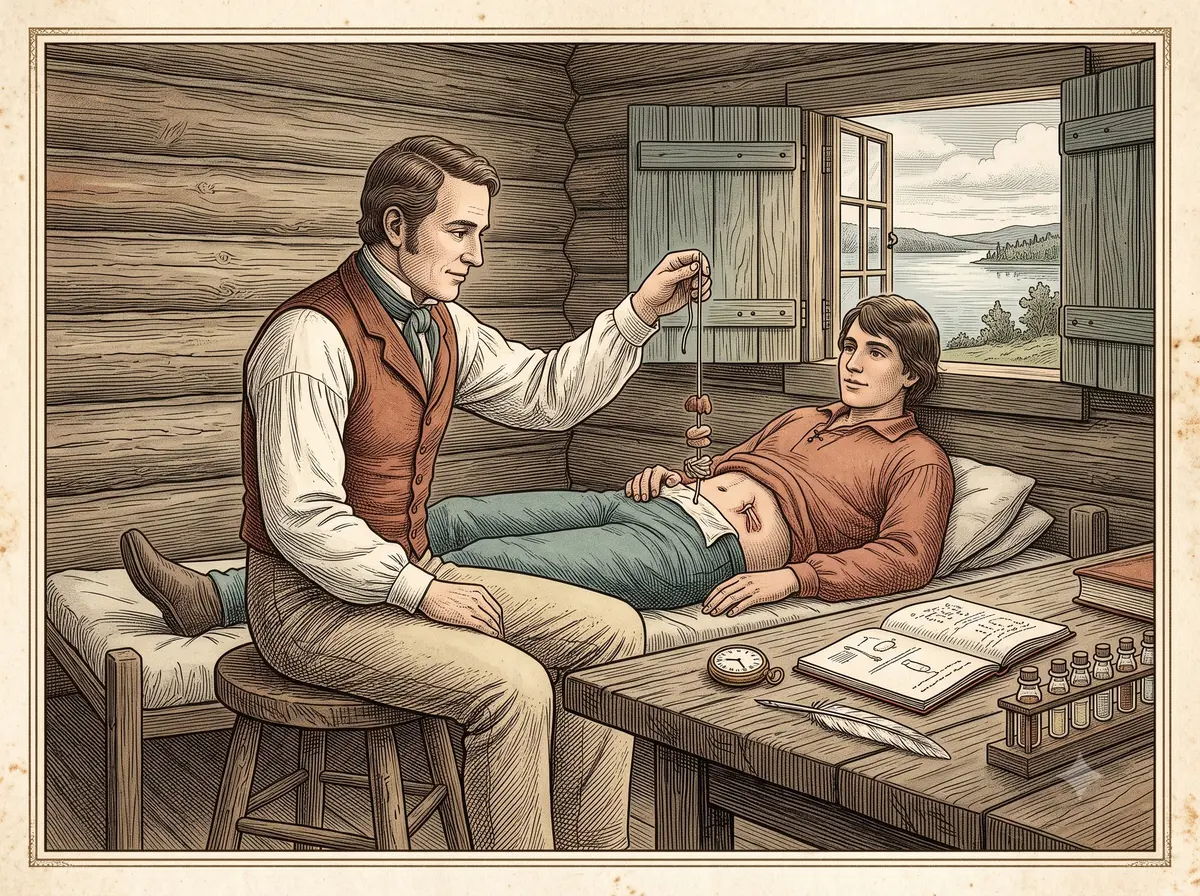
At noon on August 1, 1825, an army doctor on a small island in Lake Huron knotted six pieces of food onto a length of silk string — seasoned beef, salted pork, salted raw beef, boiled beef, stale bread, and a bunch of raw sliced cabbage — and lowered the whole grocery list into a living man's stomach through a hole in his side. Every hour or so, he pulled the string back out to see how lunch was doing.
By the Curiosities Desk · · 5 min read · Filed under Medicine · Today’s round
Part of Medicine, Before It Was Sure
What happened: William Beaumont
The hole came first, and nobody planned any of it.
On the morning of June 6, 1822, a young French Canadian voyageur named Alexis St. Martin was standing in the American Fur Company store on Mackinac Island, in what is now Michigan, when a gun went off by accident about three feet away. The blast tore through his ribs, his diaphragm, and the lower lobe of his left lung. His shirt caught fire.
The only physician on the island was William Beaumont, the surgeon at Fort Mackinac. What he found when he arrived, he wrote later, was “a portion of the lung as large as a turkey’s egg, protruding through the external wound, lacerated and burnt,” and beneath it a piece of stomach with “an orifice big enough to admit the forefinger,” leaking St. Martin’s breakfast into his clothes. Beaumont did not expect him to last thirty-six hours.
St. Martin lasted fifty-eight more years.
He recovered, slowly and horribly — fever, infection, bits of rib working their way out of the wound — with one permanent oddity. The hole in his stomach never closed. Instead, the stomach wall fused to the wall of his abdomen, leaving a fistula: an abnormal open tunnel between two body parts that shouldn’t be connected, in this case running from the outside world into a working organ. At first, anything St. Martin ate leaked straight back out; eventually his body grew a small interior flap of tissue that plugged the opening from the inside, and the flap could be pushed aside with a finger.
Which meant Beaumont could look directly into a living human stomach and watch it work.
He started experimenting in earnest in 1825, by which point St. Martin — unable to paddle canoes for a living anymore — was living in Beaumont’s household as a servant under a signed contract. Over roughly ten years, in fits and starts, across Fort Mackinac, Fort Niagara, Fort Crawford in Wisconsin, Washington D.C., and Plattsburgh, New York, Beaumont ran the experiments he published in 1833 as Experiments and Observations on the Gastric Juice, and the Physiology of Digestion. The book describes 238 of them and ends with 51 numbered conclusions.
The methods were as blunt as they sound. Food went in on strings and came back out on schedule to be weighed and inspected. Gastric juice was siphoned into vials. Beaumont timed how long different meals took to break down and built the first real table of digestibility. He also noticed something nobody had documented: when St. Martin was angry or feverish, his digestion slowed and his stomach lining changed color.
St. Martin kept leaving. He went home to Canada without permission, married, was tracked down, was persuaded back, and left again. In June 1834 he wrote to Beaumont refusing to return. He never did.
Why it was strange: William Beaumont
Before Beaumont, nobody could say with confidence what digestion actually was. The leading theories were guesses stacked on older guesses: that the stomach cooked food with internal heat, or fermented it, or ground it up mechanically, or that digestion ran on some unmeasurable “vital force” chemistry could never touch.
The problem was access. You can dissect a stomach, but a dead stomach isn’t digesting anything. Previous investigators had been reduced to swallowing perforated tubes and sponges, or arguing from first principles.
Then a gunshot accident on a fur-trading island handed one frontier surgeon — a man with about a year of formal medical schooling — a window into the one organ everyone was arguing about. The strangest part isn’t that Beaumont used it. It’s that the most important experimental apparatus in nineteenth-century physiology was a person, with opinions about the arrangement.
The same thread — Medical Ethics — continues in The Doctor Who Toured America in a ‘Lobotomobile’.
What scientists learned: William Beaumont
The headline finding: digestion is chemistry, not cooking.
Beaumont drew gastric juice out of St. Martin’s stomach, sealed it in a vial, kept it warm, dropped food in — and watched the food dissolve outside the body. That single result was devastating to the vitalist position. Whatever the stomach was doing, a bottle could do it too, given the right fluid and the right temperature.
He confirmed that the active ingredient was hydrochloric acid — a finding the British chemist William Prout had reported in animals a year before Beaumont began, and one many physicians found hard to believe. An acid that aggressive, sloshing around inside us, not burning a hole through anything? Beaumont went further and showed the juice was secreted by the stomach lining itself, and appeared in quantity only when there was food to work on.
He also mapped things that sound obvious now and weren’t then: that the stomach churns its contents, that vegetables generally break down more slowly than meat, that milk curdles early in the process. And, ahead of its time by a century, that stress and anger measurably interfere with the whole operation.
A close cousin: The Dogs That Drooled Too Soon — and the Bell Pavlov Didn’t Ring.
How it reaches us today: William Beaumont
Every time a doctor tells you that acid reflux is about acid, or prescribes a drug that suppresses gastric acid secretion, or explains that your stomach ache got worse because you were anxious — that lineage runs back through a hole in Alexis St. Martin’s side. Beaumont is counted among the first American doctors whose research had real international impact, and gastroenterology dates its beginnings to that 1833 book.
The other legacy is ethical, and less comfortable. Beaumont never surgically closed the fistula, and historians have argued ever since about why. St. Martin was illiterate, penniless, and signed contracts that made his physician also his employer, landlord, and sole source of income — an arrangement that left him very little room to say no. Research-ethics courses now teach the case as a founding example of what informed consent has to protect against. Both things are true at once: the science was real, and the arrangement that produced it would not be permitted today.
St. Martin outlived Beaumont by twenty-seven years. When he died in 1880 at Saint-Thomas, Quebec, his family — who had spent decades fending off doctors angling for the stomach — deliberately let the body decompose before burial and put it eight feet down, so no one could dig him up for one last experiment. In 1962 the Canadian Physiological Society placed a plaque near his grave, saying in part that through his affliction he served all humanity.
Another odd chapter in medicine: The Blindfolded Boy Who Fainted at the Wrong Apricot Tree.
Fun fact: William Beaumont
To test whether body heat mattered to digestion, Beaumont had St. Martin carry sealed vials of his own stomach juice tucked into his armpits — a human incubator, walking around Fort Mackinac chopping firewood with samples of himself under each arm.
Sources: William Beaumont
- Beaumont, William. Experiments and Observations on the Gastric Juice, and the Physiology of Digestion (1833) — the primary source, digitized by the U.S. National Library of Medicine.
- William Beaumont’s momentous and unethical experiments — Bernard Becker Medical Library, Washington University School of Medicine, which holds Beaumont’s papers and the signed contracts.
- Roberts, Charles Stewart. William Beaumont, the Man and the Opportunity — in Clinical Methods, 3rd ed. (NCBI Bookshelf).
- Price, Catherine. Probing the Mysteries of Human Digestion — Distillations, Science History Institute.
- Dr. William Beaumont, Father of Gastric Physiology — Mackinac State Historic Parks.
A note on the record: sources disagree on St. Martin’s age in 1822. Beaumont recorded him as 19; a baptismal record suggests he was born in 1802, making him 20; a 1962 commemorative plaque gives 1794, which would make him 28. Contemporary accounts also differ on whether the gun was a musket or a shotgun.
Related stories: William Beaumont
- The Doctor Who Drank a Beaker of Bacteria to Prove Ulcers Weren’t Caused by Stress — He drank a flask of bacteria to prove ulcers were an infection
- The Doctor Who Ate, Slept, and Worked on a Giant Scale for 30 Years — A doctor who spent 30 years living on a giant weighing chair
- The Student Who Drank Vomit to Prove Yellow Fever Wasn’t Contagious — A student drank black vomit to prove yellow fever was not contagious