Weird Medical History · Medicine
The Wound Cure You Rubbed on the Sword Instead of the Patient
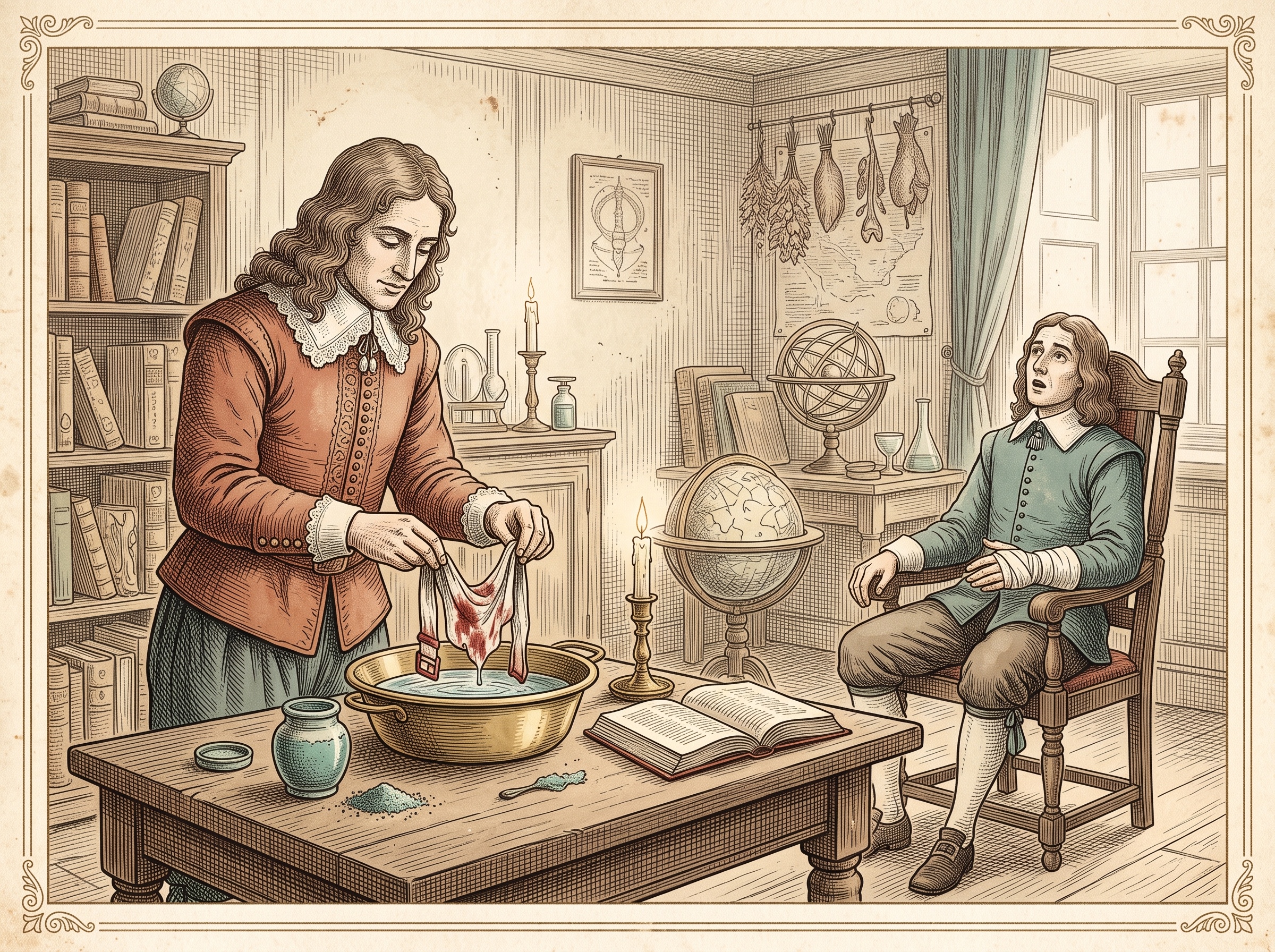
In 1658, Sir Kenelm Digby told a learned audience about the time he cured a friend's slashed hand without touching it. He took the man's bloodstained garter, dropped it into a basin of water and dissolved powder, and the patient across the room sighed with sudden, cooling relief. Later, Digby says, he pulled the garter out and dried it by the fire — and a servant came running to report that his master's hand was burning up again.
By the Curiosities Desk · · 5 min read · Filed under Medicine · Today’s round
What happened?
The man with the hand was James Howell, a writer who would later become historiographer royal to Charles II. According to Digby’s account, in 1624 Howell came upon two friends fighting a duel and tried to break it up the hard way: he grabbed one sword by the hilt and the other by the blade. Both fighters yanked their weapons back. Howell’s hands were cut badly, and Digby says the king’s own surgeons worried about gangrene.
Digby’s treatment was his “powder of sympathy,” made mostly from vitriol — in practice usually green vitriol, or iron sulfate. He dissolved it in water and soaked the bloody garter that had been used to bind the wound, not the wound itself. Howell was told to keep the injury clean and leave it alone. Within days, Digby wrote, the wounds “were cicatriced” — scarred over — “and entirely healed.”
Digby delivered this story as a lecture in Montpellier, France, and it was published in English in 1658 as A Late Discourse… Touching the Cure of Wounds by the Powder of Sympathy. It was a hit, going through many editions and translations. Digby claimed he had learned the secret from a Carmelite friar who had traveled in Asia and conveniently retired to Persia, which made Digby the only man in Europe who knew it.
Historians are skeptical about the Howell story. Elizabeth Hedrick, writing in the British Journal for the History of Science, argues the anecdote was probably contrived, partly to stake Digby’s claim to priority for the powder. So treat the burning-hand episode as Digby’s telling, not as a documented medical case.
Digby’s powder was the tidy, modern version of an older and much stranger idea: the weapon salve. Recipes for it called for ingredients such as moss scraped from the skull of a dead man, powdered mummy, earthworms, and fat. The salve was smeared on the weapon that caused the wound — the sword, the knife, the splinter — while the wound itself was simply washed and bandaged.
This set off one of the great pamphlet fights of the 17th century. Around 1630, an English clergyman named William Foster published an attack titled Hoplocrisma-Spongus: or, A Sponge to Wipe Away the Weapon-Salve, arguing the cure worked through the devil. The physician Robert Fludd, a passionate defender, answered with Doctor Fludds Answer unto M. Foster, or, The Squeesing of Parson Fosters Sponge. Each side had a better title than an experiment.
The idea even reached the young Royal Society. Its records show that soon after Sir Gilbert Talbot became a Fellow in 1661, he presented ten cases of successful “Sympathetick pouder” cures — including, he said, his own wounds from the 1645 Siege of Tiverton. At one meeting, Talbot reportedly proposed “to torment a man presently with the sympatheticall pouder.”
Why was it strange?
Because almost everyone agreed it worked. The argument wasn’t really whether weapon salve healed people, but why. Foster said demons. Fludd said a kind of natural magnetism. Digby said it was physics: bodies constantly shed tiny particles, so the blood on a garter stayed linked to its source, and treating one treated the other.
That last part is the surprising twist. Digby wasn’t reaching for spirits. He was explicitly trying to explain healing at a distance without “the intervention of Demons, and Spirits,” using the new language of atoms and particles. He was wrong, but he was wrong in a way that was trying to be scientific.
Another treatment that history kept the receipt for: The Man Who Took an Iron Rod Through His Brain and Lived.
What did scientists learn?
The best explanation for the “successes” has nothing to do with the sword. Seventeenth-century wound care often meant packing injuries with ointments, plasters, and other concoctions that could irritate tissue and introduce infection. Weapon-salve patients skipped all that. Their wounds were cleaned, covered, and left undisturbed, while the strange stuff went on the weapon across the room.
Historians, and the Royal Society’s own archivists, point out that this alone could explain many reported cures: the body was simply allowed to heal on its own, with less interference. In the 19th century the physician Oliver Wendell Holmes made the same argument — anointing the weapon gave the wound a chance to heal naturally.
There’s a second lesson hiding here. A treatment can seem to work for reasons that have nothing to do with its theory. Patients feel better, wounds close, and the story about why gets the credit. Separating the real cause from the believed cause takes comparison groups and careful records, which the weapon-salve debaters mostly argued about instead of doing.
Another odd chapter in medicine: The Summer 400 People Couldn’t Stop Dancing.
How does it affect us today?
Modern wound care quietly agrees with the weapon-salve patients on one point: clean the wound, protect it, and don’t load it with irritants. Doctors today warn against putting things like butter, toothpaste, or harsh chemicals on injuries for much the same reason.
The bigger legacy is methodological. Stories like Digby’s are why medicine now insists on controlled trials, in which one group gets the treatment and a comparable group doesn’t, so that “it healed” can be tested against “it would have healed anyway.” By the 1690s, skepticism was rising: Antoni van Leeuwenhoek wrote to the Royal Society about a man who claimed to cure people at a distance, concluding that his claims found “no belief in me.”
A close cousin: The Surgeon So Fast He Supposedly Killed Three People With One Amputation.
Fun fact
An anonymous 1687 pamphlet proposed using the powder of sympathy to solve the longitude problem: keep a wounded dog on a ship and its bloody bandage in London, dip the bandage at an agreed hour, and the dog’s reaction would tell sailors the time back home. Nobody knows if it was ever tried — and many historians suspect the pamphlet was satire.
A note on wound care: for any deep or bleeding cut, clean it, cover it, and see a medical professional — no swords required.
Sources
- Royal Society, “Powders of sympathy” (Isabel Lauterjung, 2022), drawing on the Society’s archival records of Gilbert Talbot and others.
- Kenelm Digby, Of the Sympathetick Powder: A Discourse (1669 edition), scanned original via Internet Archive.
- Elizabeth Hedrick, “Romancing the Salve: Sir Kenelm Digby and the Powder of Sympathy,” British Journal for the History of Science (2008).
- Science History Institute, “A Remote Idea” — rare book exhibition on the weapon salve debate.
- The Public Domain Review, “Longitude by Way of Wounded Hounds.”