Weird Medical History · Medicine
The Man Who Took an Iron Rod Through His Brain and Lived
Thirty minutes after a three-and-a-half-foot iron rod was blown clean through his skull, Phineas Gage was sitting upright in a chair outside a Vermont hotel, conscious and talking. When the first doctor pulled up in his carriage, Gage greeted him with one of the great understatements in the history of medicine: "Doctor, here is business enough for you."
By the Curiosities Desk · · 6 min read · Filed under Medicine · Today’s round
Part of Medicine, Before It Was Sure
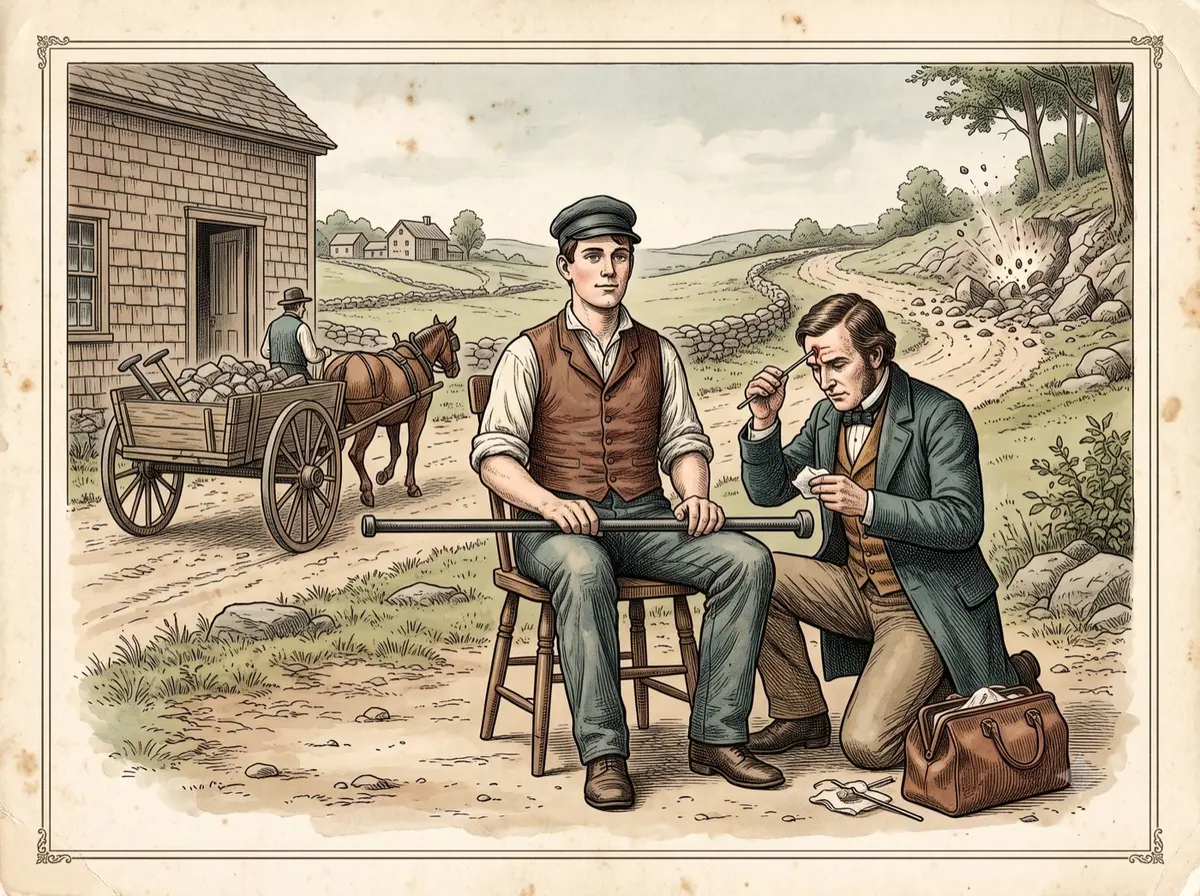
What happened: Phineas Gage
It was September 13, 1848. Phineas Gage, a 25-year-old railroad construction foreman, was directing a crew blasting rock to clear a roadbed for the Rutland & Burlington Railroad just south of Cavendish, Vermont. He was, by his physician’s account, “a perfectly healthy, strong and active young man,” about five foot six and 150 pounds, with “an iron will as well as an iron frame.” His employers thought him the most capable foreman they had.
Setting a blast was routine work. You bored a hole into the rock, poured in blasting powder and a fuse, then used a tamping iron to pack inert sand or clay on top so the explosion would drive downward into the stone. Gage had even commissioned a custom tamping iron for the job: an iron rod one and a quarter inches in diameter, three feet seven inches long, and weighing thirteen and a quarter pounds.
Something went wrong. Distracted by his men working behind him, Gage looked over his shoulder and, it seems, the sand was never added. When he brought the iron down, it sparked against the rock and the bare powder exploded. The rod shot out of the hole like a javelin. It entered under his left cheekbone, passed behind his left eye, tore through the front of his brain, and exited through the top of his skull. It landed point-first about 80 feet away, smeared with blood and brain.
Gage was thrown onto his back and convulsed briefly. Then he spoke. Within minutes he was walking with a little help, and he sat upright in an oxcart for the three-quarter-mile ride back into town. The local physician, Edward Williams, found him calmly sitting in a chair, the pulse of his exposed brain visible through the wound. Dr. John Martyn Harlow took over the case that evening, cleaned away bone fragments and “an ounce or more” of protruding brain, and closed what he could. Astonishingly, Gage survived the infection that followed and lived another twelve years.
Why it was strange: Phineas Gage
By every expectation of 1848, Phineas Gage should have died — instantly, or within days from massive infection. That he didn’t was strange enough. But the deeper strangeness came later.
Gage’s memory, speech, coordination, and general intelligence appeared largely intact. He knew who he was, recognized people, and could reason. And yet the same employers who had prized him refused to give him his old job back. According to Harlow, the man who came back was not quite the man who had left. The “balance,” as Harlow put it, “between his intellectual faculties and animal propensities” seemed to have been destroyed. Gage was now “fitful, irreverent, indulging at times in the grossest profanity (which was not previously his custom),” impatient, obstinate, and unable to stick to any plan. Friends offered the haunting verdict that he was “no longer Gage.”
Here was the puzzle that made him famous: a brain injury that left the machinery of thought running but seemed to scramble the person. How could damage to one region change who someone was while leaving intelligence behind?
Another treatment that history kept the receipt for: The Wound Cure You Rubbed on the Sword Instead of the Patient.
What scientists learned: Phineas Gage
In the mid-1800s, scientists were locked in a debate over whether mental functions were localized to specific parts of the brain or spread evenly across the whole organ. Gage became a key exhibit. His injury destroyed much of the brain’s left frontal lobe, and the apparent change in his temperament suggested that this region had something to do with personality, self-control, and planning — the qualities we now group under “executive function.”
That said, the real Gage is buried under a century of exaggeration. Many accounts — including some in scientific textbooks — turned him into a drunken, violent drifter, claims that contradict the documented record. Modern scholars, led by the historian Malcolm Macmillan, have shown how thin the actual evidence is. We have only a few firsthand descriptions, mostly from Harlow, and they describe a man who was difficult for a while, not a monster.
Even the anatomy is contested. A widely cited 1994 study by Hanna Damasio and colleagues concluded the rod damaged both frontal lobes, but that finding came from a cadaver skull digitally reshaped to match Gage’s, not from Gage’s actual skull, and it rested on assumptions about the rod’s path. Later reconstructions using his real skull have reached different conclusions. The honest summary is that Gage shows the frontal lobes matter for personality and judgment — but he is a vivid illustration, not a precise map.
Another odd chapter in medicine: The Blindfolded Boy Who Fainted at the Wrong Apricot Tree.
How it reaches us today: Phineas Gage
Phineas Gage is sometimes called neuroscience’s most famous patient, and the case helped launch the modern study of how the frontal lobes govern behavior — work that underpins our understanding of conditions from frontal-lobe dementia to the consequences of traumatic brain injury. Every time a neurologist links a change in someone’s judgment or impulse control to damage in a specific brain region, they are walking a path Gage’s accident helped clear.
There is a gentler lesson too. The later record suggests Gage’s worst changes were temporary. After years that included a stint exhibiting himself — iron rod in hand — at Barnum’s American Museum in New York, he moved to Chile and worked for years as a long-distance stagecoach driver, a demanding job requiring skill, routine, and dealing with passengers. Researchers have proposed a “social recovery” hypothesis: that the structure of steady work may have helped him relearn lost social skills. The brain, even a badly injured one, can adapt. That idea — neuroplasticity — is central to rehabilitation medicine today.
A close cousin: The Family That Rang Bells and Blindfolded Mothers to Hide a Pair of Tongs.
Fun fact: Phineas Gage
Gage was so attached to his tamping iron that he carried it with him for the rest of his life and was buried near it. When he died in San Francisco in 1860 after a series of epileptic seizures, his family later allowed his skull — and the iron — to be exhumed for science. Both are on display today at the Warren Anatomical Museum at Harvard Medical School, reunited more than 170 years after they were so violently introduced.
Sources: Phineas Gage
- Harlow, J. M. (1868). “Recovery from the Passage of an Iron Bar through the Head.” Publications of the Massachusetts Medical Society — the primary firsthand medical account.
- Twomey, S. “Phineas Gage: Neuroscience’s Most Famous Patient.” Smithsonian Magazine (2010). https://www.smithsonianmag.com/history/phineas-gage-neurosciences-most-famous-patient-11390067/
- “Phineas Gage.” Warren Anatomical Museum, Center for the History of Medicine, Harvard Countway Library. https://collections.countway.harvard.edu/onview/exhibits/show/warren-anatomical-museum/phineas-gage
- Macmillan, M. An Odd Kind of Fame: Stories of Phineas Gage (MIT Press, 2000) — the definitive scholarly study separating fact from legend.
- “Phineas Gage.” Wikipedia. https://en.wikipedia.org/wiki/Phineas_Gage
A note: this story touches on serious injury and death. If you or someone you know is recovering from a brain injury, organizations like the Brain Injury Association of America offer information and support.
Related stories: Phineas Gage
- The Doctor Who Toured America in a ‘Lobotomobile’ — A doctor who toured America performing lobotomies out of a van
- The Myth That You Only Use 10% of Your Brain — You use all of your brain; the myth just will not die
- The Chicken That Lived 18 Months After Losing His Head — A rooster that lived 18 months after losing his head