Weird Medical History · Medicine
The Blindfolded Boy Who Fainted at the Wrong Apricot Tree
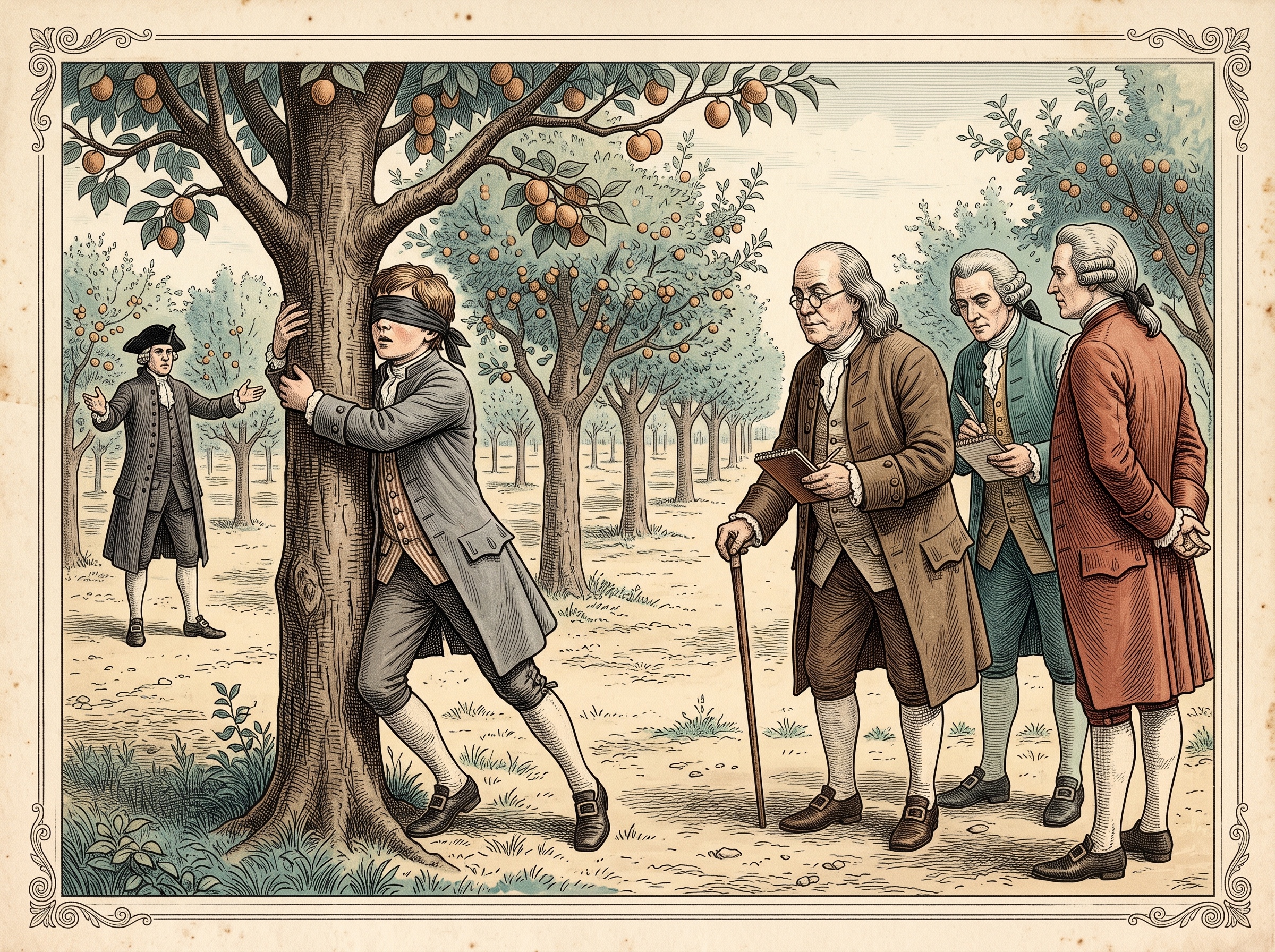
On June 19, 1784, in Benjamin Franklin's orchard at Passy, just outside Paris, a blindfolded 12-year-old boy was led from one fruit tree to the next and asked to hold each one. Somewhere in that row stood an apricot tree that a physician had just "magnetized" with sweeping hand gestures. At the first tree, the boy said he felt something. At the second and third, the feeling grew stronger. At the fourth, he went rigid and passed out. He was nowhere near the magnetized tree. None of the trees he touched had been treated at all.
By the Curiosities Desk · · 5 min read · Filed under Medicine · Today’s round
What happened?
The tree was a test, and the thing being tested was the most fashionable medicine in France.
Its inventor was Franz Anton Mesmer, a German-born physician who arrived in Paris from Vienna in 1778. Mesmer taught that an invisible “magnetic fluid” flowed through the universe and every living body, and that illness came from blockages in its flow. He called this force animal magnetism (“animal” here meaning “of living things,” from the Latin anima, not “of beasts”). Fix the flow, and you fix the patient.
His treatments were spectacular. Patients sat in circles around the baquet, a large wooden tub filled with water, iron filings, and broken glass, with bent iron rods poking out of the lid. They pressed the rods to their aching joints or stomachs, held hands, and were tied together with cord to form a kind of human circuit. Mirrors lined the room. Music drifted in, often from a glass armonica, an eerie-sounding instrument of spinning glass bowls. Mesmer, or one of his assistants, moved among the patients making “passes” with his hands or an iron wand. Many patients shook, sobbed, laughed, or fainted in what mesmerists called a crisis, which they took as proof the fluid was moving. Then, often, the patients said they felt better.
Paris loved it. The city’s established doctors were far less charmed, and in 1784 King Louis XVI appointed a royal commission to investigate. Its roster reads like a hall of fame. Benjamin Franklin, then the American envoy to France and the world’s most famous expert on another invisible force, electricity, was named its head. Joining him were Antoine Lavoisier, the chemist who helped overturn the old theory of combustion; the astronomer Jean-Sylvain Bailly; and the physician Joseph-Ignace Guillotin.
Mesmer refused to cooperate, so the commissioners worked with his former associate, the physician Charles Deslon. They had themselves magnetized and felt nothing, but healthy skeptics proved little. So they designed tests on people known to respond.
Franklin was 78 and in poor health, so several experiments were held at his house in Passy. The tree test came from a story the mesmerists themselves told: Mesmer had once magnetized a tree in a Paris garden, and several people who touched it had reportedly collapsed. Deslon agreed to magnetize one tree in Franklin’s orchard and bring a boy he said was especially sensitive. The boy was kept inside and watched while the tree was treated, then brought out blindfolded. According to the commission’s report, his sensations grew at each tree until he lost consciousness at the fourth, which had never been magnetized.
It was not a one-off. A blindfolded woman was told Deslon was magnetizing her when he wasn’t in the room; within about three minutes she was trembling in a full crisis. Another woman, told that Deslon was magnetizing her through a closed door, went into convulsions within a minute. He wasn’t there either. In a separate test, a woman was handed cups of plain water she believed were magnetized; she had a crisis at the fourth cup. And when a magnetizer secretly worked on a patient from behind a paper screen for half an hour, she chatted away and felt nothing.
Why was it strange?
The patients were not faking. Their shaking and fainting were real. What the commissioners showed was that these reactions appeared when people believed they were being magnetized, and vanished when they didn’t know, no matter what the magnetizer was actually doing.
That was a new way of asking a medical question. Doctors had long noticed patients improving on useless remedies, but the commission built experiments to pull the treatment apart from the patient’s expectations by controlling one thing: what the subject knew. Hiding the treatment with a blindfold, a door, or a screen turned a dazzling performance into a yes-or-no question.
The commission’s report, dated August 11, 1784, delivered the answer: there was no evidence the magnetic fluid existed. The effects, it concluded, came from imagination, their word for what we would call suggestion and expectation. At least 20,000 copies were printed and spread across France and beyond.
Another odd chapter in medicine: The Beef and Cabbage Lowered Into a Man’s Stomach on a Silk String.
What did scientists learn?
The commissioners made three key moves. First, they separated the two possible causes, testing “magnetism without imagination” (treated but unaware) and “imagination without magnetism” (unaware they weren’t treated). Second, they used sham procedures, fake treatments designed to look real, as a comparison. Third, they blinded their subjects, so the person being tested didn’t know which condition they were in.
Historians now count these as some of the earliest recorded single-blind experiments in medicine. Surviving papers in Lavoisier’s handwriting include a detailed “plan of experiments” for the Passy sessions, and historian Iain Donaldson has argued Lavoisier was probably the main designer, though the report credits the commission as a group and the question can’t be settled for certain.
The commission also didn’t dismiss what it saw. It treated the crises as a real phenomenon worth explaining, and its report discusses how attention, imitation, and crowd settings can produce physical symptoms. In other words, it found that the mind can powerfully affect the body, which is not the same as finding that nothing happened.
Another treatment that history kept the receipt for: The Fake Metal Rods That Accidentally Invented the Placebo-Controlled Trial.
How does it affect us today?
Every modern drug trial that compares a medicine with a placebo, and keeps patients from knowing which they received, descends from this idea. In 1800, the English physician John Haygarth used wooden fakes to test “Perkins tractors,” a popular metal-rod cure, and explicitly cited the Paris commission as his model. Later researchers added double-blinding, in which the doctors running a trial also don’t know who gets the real treatment, to guard against their own expectations.
Mesmerism itself didn’t vanish. It evolved, and by the 1840s the Scottish surgeon James Braid had reframed its trance states as “hypnotism,” which researchers still study today. And every time someone says a performance “mesmerized” them, they’re using Mesmer’s name.
A close cousin: The Family That Rang Bells and Blindfolded Mothers to Hide a Pair of Tongs.
Fun fact
The glass armonica that set the mood at many of Mesmer’s sessions was invented in 1761 by Benjamin Franklin, the same man who, 23 years later, led the investigation that debunked them.
Sources
- Report of Dr. Benjamin Franklin and Other Commissioners, Charged by the King of France with the Examination of the Animal Magnetism, as Now Practised at Paris (English translation, 1785) — Wood Library-Museum of Anesthesiology
- The Royal Commission on Animal Magnetism 1784, translated by I.M.L. Donaldson — Royal College of Physicians of Edinburgh (PDF)
- Donaldson IML (2016). Antoine de Lavoisier’s role in designing a single-blind trial to assess whether ‘Animal Magnetism’ exists — The James Lind Library
- Mesmerising Science: The Franklin Commission and the Modern Clinical Trial — The Public Domain Review
#Benjamin Franklin #placebo #18th century #history of medicine