Weird Medical History · Medicine
The Woman Who Convinced the King's Surgeon She Gave Birth to Rabbits
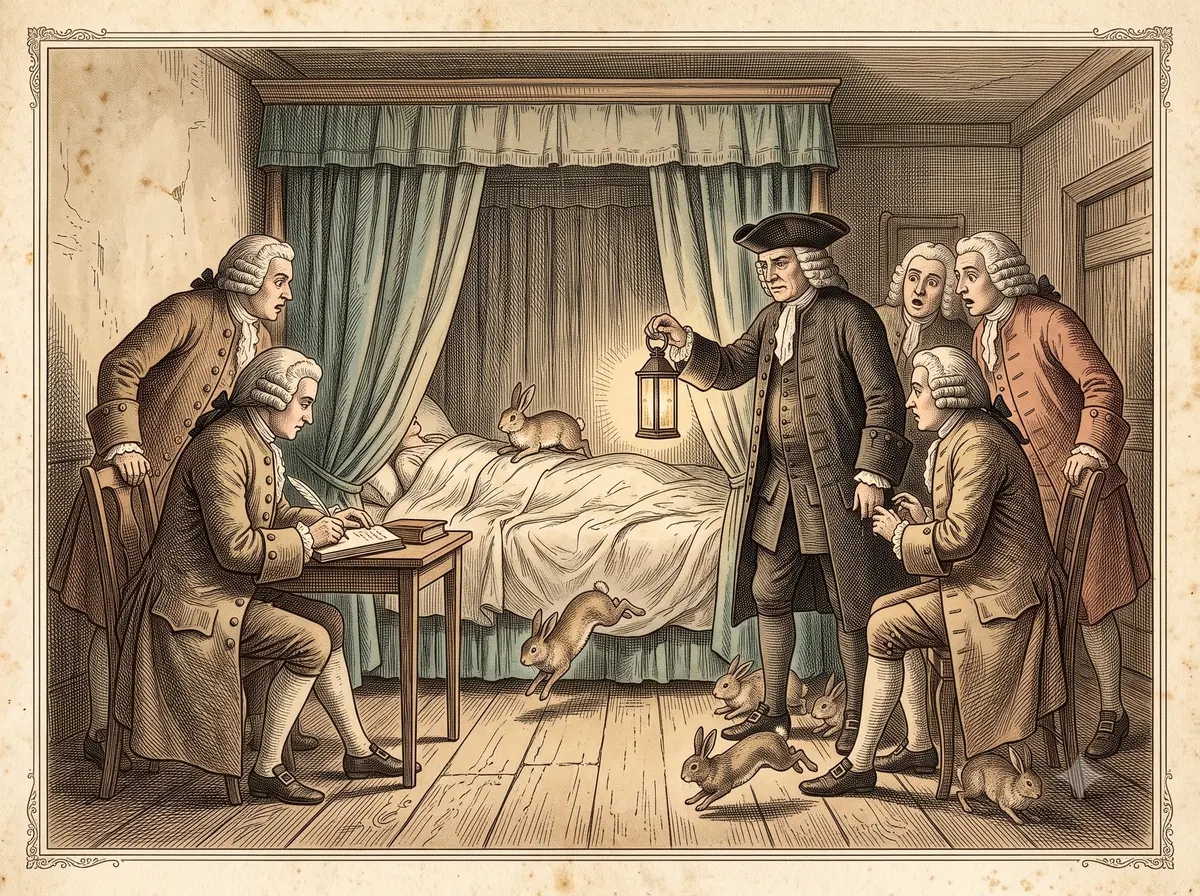
In November 1726, the personal surgeon-anatomist to King George I rushed from London to a house in Guildford, where he was greeted with urgent news: the patient was in labour with her fifteenth rabbit. He examined her, watched her deliver several more, and concluded the births were real. Then he collected some of the rabbits and took them back to London to show the King.
By the Curiosities Desk · · 5 min read · Filed under Medicine · Today’s round
Part of Medicine, Before It Was Sure
What happened: The Woman Who Convinced the King's Surgeon She Gave Birth to Rabbits
Mary Toft was a 25-year-old illiterate servant in Godalming, Surrey, married to a journeyman clothier named Joshua. In August 1726 she suffered a miscarriage — but a month later she appeared, somehow, to still be pregnant. On September 27 she went into labour attended by a neighbour and her mother-in-law, Ann Toft, and produced something described as resembling a cat without a liver.
The family called in John Howard, a man-midwife from nearby Guildford. Over the following month, Howard recorded delivering a parade of animal parts from Mary: a rabbit’s head, the legs of a cat, and — on one especially productive day — nine dead baby rabbits. Convinced he was witnessing something extraordinary, Howard wrote letters to some of England’s most eminent doctors and to the King’s secretary.
The court was intrigued. George I dispatched Nathaniel St André, the Swiss surgeon-anatomist to the Royal Household, along with Samuel Molyneux, secretary to the Prince of Wales. They arrived on November 15 just in time for rabbit number fifteen, watched Mary deliver more in their presence, and ran tests on the specimens. The tests actually showed the rabbits probably hadn’t developed in a womb — St André believed anyway, declared the births supernatural, and carried rabbit parts back to London for the King.
A more skeptical German surgeon, Cyriacus Ahlers, was sent next. Ahlers examined one of the delivered rabbits and found dung pellets in its rectum containing corn, hay, and straw — food no unborn rabbit could have eaten. He reported to the King on November 21 that he smelled a hoax. Meanwhile Sir Richard Manningham, London’s most fashionable man-midwife, examined Mary and privately concluded that one “birth” appeared to be a hog’s bladder.
On November 29 Mary was moved to Lacy’s Bagnio, a bath house in London’s Leicester Fields, so a crowd of doctors could watch her around the clock. Under constant observation, the rabbits abruptly stopped coming. Then a porter was caught sneaking a rabbit into her room — he confessed that Mary’s sister-in-law had asked him to procure the smallest one he could find. After days of pressure, and after Manningham threatened exploratory surgery to see whether she was built differently from other women, Mary confessed on December 7: dead rabbits had been inserted, then “delivered” before witnesses. She was charged as a “Notorious and Vile Cheat” and sent to prison, where curious crowds reportedly gathered for a look at her. In April 1727 she was quietly released — prosecuting the case any further would only have embarrassed the establishment more.
Why it was strange: The Woman Who Convinced the King's Surgeon She Gave Birth to Rabbits
It’s not just that a hoax fooled people — it’s who it fooled, and how easily. The King’s own surgeon watched deliveries at close range, ran anatomical tests that contradicted the story, and endorsed it anyway. St André was so confident that on December 3 he published a forty-page pamphlet, A Short Narrative of an Extraordinary Delivery of Rabbets, presenting the case as genuine. Mary confessed four days later.
The timing turned a medical scandal into a national comedy. Pamphlets and satirical poems poured off the presses. William Hogarth engraved Cunicularii, or The Wise Men of Godliman in Consultation, skewering the doctors as credulous fools. Jonathan Swift’s circle piled on too. The public’s takeaway was blunt: the new men of medical science, who were busy displacing traditional female midwives as the experts on childbirth, had been outwitted by a woman who couldn’t read.
The same thread — Obstetrics — continues in The Family That Rang Bells and Blindfolded Mothers to Hide a Pair of Tongs.
What scientists learned: The Woman Who Convinced the King's Surgeon She Gave Birth to Rabbits
The Toft affair became a stress test for a popular medical theory called maternal impression — the idea that a pregnant woman’s experiences and cravings could physically shape her baby. St André found Mary’s backstory persuasive precisely because it fit the theory: she said she’d been startled by a rabbit while weeding a field, dreamed of rabbits, and craved rabbit meat for months. Under maternal impression, rabbit babies were strange but theoretically possible.
The hoax helped bury that idea. In 1727, physician James Blondel published a direct attack on the theory, arguing the imagination of a pregnant woman had no such power over the fetus, and kicked off a debate that ran for decades. The episode also sharpened a lesson medicine keeps relearning: a test result that contradicts your belief is data, not an inconvenience. Ahlers, who followed the evidence in the rabbit droppings rather than the story, got it right.
Elsewhere in medicine: The Doctor Who Discovered Handwashing — and Was Locked Away for It.
How it reaches us today: The Woman Who Convinced the King's Surgeon She Gave Birth to Rabbits
The Toft case is a landmark in the history of medical skepticism, still taught as a case study in how motivated reasoning can override evidence — even in trained experts, even with the specimens in hand. It also marked a turning point in the credibility politics of childbirth medicine, just as male physicians were taking over obstetrics from midwives. And the paper trail survives: St André’s pamphlet, Manningham’s day-by-day diary, and Mary’s confessions (recorded by the anatomist James Douglas) are preserved in archives at Glasgow and the Wellcome Collection, letting historians reconstruct one of history’s best-documented hoaxes almost hour by hour.
As for the players: St André lost his royal favour and his patients, and died in poverty in an almshouse. Ahlers and Douglas, the skeptics, kept their reputations. Mary returned to Surrey, where the parish register later recorded the birth of her daughter Elizabeth — her “first child after her pretended Rabett-breeding.”
Another treatment that history kept the receipt for: The Blindfolded Boy Who Fainted at the Wrong Apricot Tree.
Fun fact: The Woman Who Convinced the King's Surgeon She Gave Birth to Rabbits
Among the satirical pamphlets rushed out after the confession was The Anatomist Dissected, credited to “Lemuel Gulliver, Surgeon and Anatomist to the Kings of Lilliput and Blefescu” — a joke aimed straight at the doctors, published just months after Gulliver’s Travels first appeared.
A quiet note: this story begins with a real miscarriage, and Mary Toft endured genuine pain and infection during the hoax. If pregnancy loss has touched your life, support is available — organizations like Share Pregnancy & Infant Loss Support offer free help.
Sources: The Woman Who Convinced the King's Surgeon She Gave Birth to Rabbits
- Nathaniel St André, A Short Narrative of an Extraordinary Delivery of Rabbets (1727) — Internet Archive
- Sir Richard Manningham, An Exact Diary of What Was Observ’d During a Close Attendance upon Mary Toft (1726) — Wellcome Collection
- Niki Russell, “Mary Toft and Her Extraordinary Delivery of Rabbits” — The Public Domain Review
- Mary Tofts (1703–1763) — Godalming Museum
- Mary Toft — Wikipedia
Related stories: The Woman Who Convinced the King's Surgeon She Gave Birth to Rabbits
- The Summer 400 People Couldn’t Stop Dancing — Hundreds of people danced in the streets until they collapsed
- The Fake Metal Rods That Accidentally Invented the Placebo-Controlled Trial — Fake metal rods that accidentally invented the placebo-controlled trial
- The Recipe for Making Mice Out of a Sweaty Shirt and a Jar of Wheat — A recipe that promised to make mice from a sweaty shirt