Weird Medical History · Medicine
The Summer 400 People Couldn't Stop Dancing
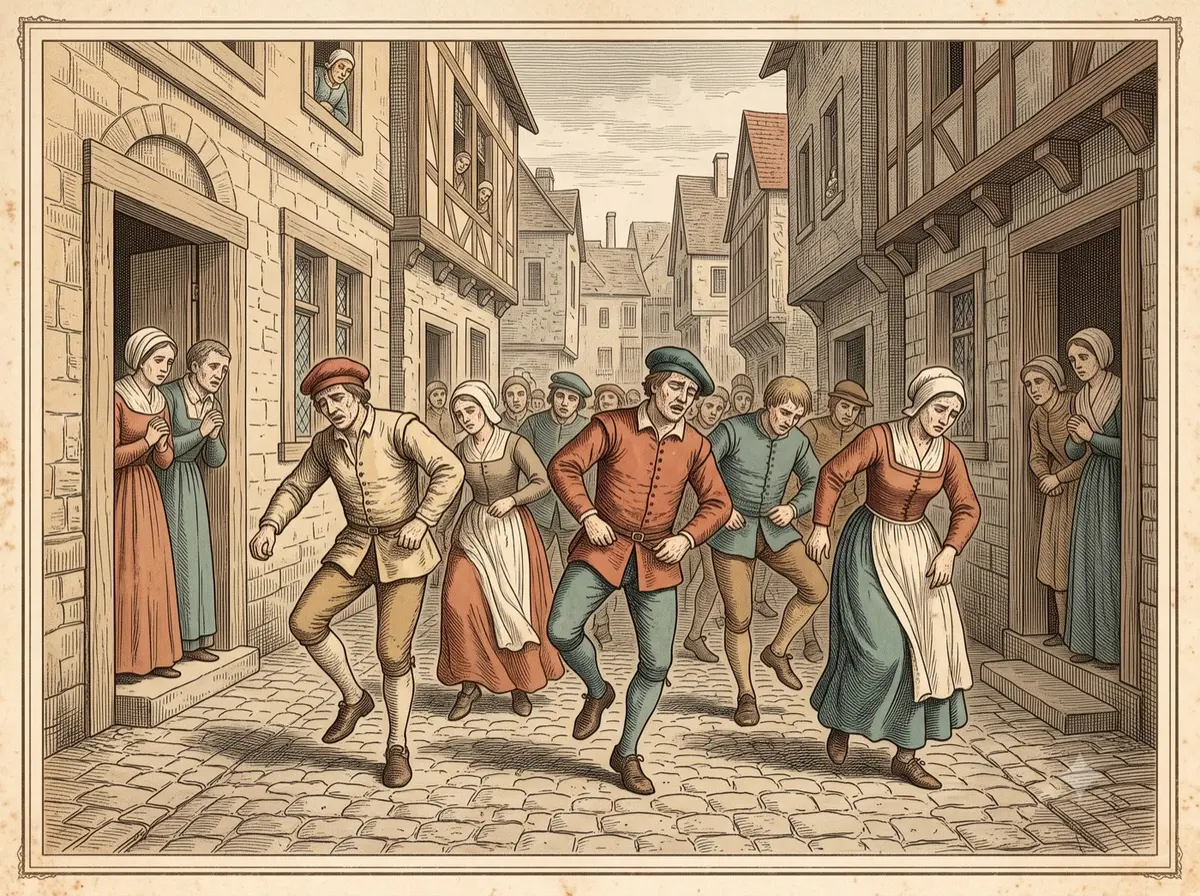
In July 1518, a woman stepped into a narrow street in Strasbourg and began to dance. There was no music, no festival, no reason. She danced through the afternoon, through the evening, and into the next day — silent, sweating, seemingly unable to stop. Within a week, dozens of her neighbors were dancing beside her, and none of them looked like they were having any fun.
By the Curiosities Desk · · 6 min read · Filed under Medicine · Today’s round
Part of Medicine, Before It Was Sure
What happened: The Dancing Plague of 1518
The woman is remembered in the chronicles as Frau Troffea. When she finally collapsed from exhaustion, she rested only briefly before rising to dance again. Her husband pleaded with her; it made no difference. Within days, roughly thirty more residents of Strasbourg — then a prosperous city in the Holy Roman Empire, in the region of Alsace — had joined her, seized by the same relentless compulsion.
The city’s authorities faced a genuine crisis. By the estimates that survive in municipal records and physicians’ notes, as many as 400 people were caught up in the dancing over the course of about a month. These were not revelers. Witnesses described dancers with vacant expressions, bloodied feet, and bodies that kept moving even as they begged for it to end.
Then came the decision that turned a strange episode into a notorious one. The city’s physicians examined the sufferers and concluded, in the medical language of the day, that the cause was “hot blood” — an overheating of the body that could only be worked out through more movement. So the authorities did something that sounds like a fever dream: they encouraged the dancing. According to accounts of the response, they cleared guildhalls, erected a wooden stage, and even hired pipers and drummers to keep the afflicted moving, in the hope they would dance the sickness out of their systems.
It did the opposite. The spectacle and the music appear to have drawn more people into the frenzy. Only when the epidemic worsened did officials reverse course, banning music and public dancing and eventually escorting sufferers to a shrine dedicated to Saint Vitus in the hills outside the city, where they prayed for release. By late summer, the dancing had faded as mysteriously as it began.
How many died is genuinely uncertain. Some contemporary and later accounts claim that people dropped dead from strokes, heart attacks, and sheer exhaustion — one oft-repeated figure holds that up to fifteen people a day were dying at the peak. That number comes from a single strand of the sources and is treated with real skepticism by historians; some accounts of the outbreak mention no confirmed deaths at all. What is not in dispute is that the episode was witnessed, recorded, and taken very seriously at the time.
Why it was strange: The Dancing Plague of 1518
Plenty of history is strange. This is stranger. These people were not dancing for joy or protest — they reported that they couldn’t stop, that their bodies had been hijacked. There was no infection you could point to, no toxin everyone had obviously swallowed, no ringleader whipping up a crowd. And the official remedy was to lean into the symptom: the government of a major European city responded to hundreds of people dancing themselves to collapse by hiring a band.
Stranger still, Strasbourg’s outbreak was not unique. Europe had seen “dancing manias” before, most famously a 1374 episode that spread along the Rhine and Moselle rivers. The phenomenon was common enough to earn a name: choreomania. The 1518 event is simply the best-documented, because it happened in a literate, record-keeping city that wrote down what it saw.
Another odd chapter in medicine: The Man Who Took an Iron Rod Through His Brain and Lived.
What scientists learned: The Dancing Plague of 1518
For centuries the dancing plague was filed under superstition or dismissed as legend. Modern researchers take it seriously as a case study in what is now called mass psychogenic illness (once called mass hysteria) — an outbreak of real physical symptoms that spreads through a group by psychological and social channels rather than by a germ or poison. The symptoms are not faked; the body genuinely produces them. What spreads is not a pathogen but a state of mind.
The most influential modern account comes from historian John Waller, whose 2008 book A Time to Dance, a Time to Die and later journal writing reconstructed the social pressure-cooker of 1518. That year, Alsace was reeling from famine, soaring grain prices, and waves of disease. Into that misery came a specific, deeply held regional belief: that Saint Vitus could punish sinners by afflicting them with a compulsion to dance. Waller argues that in a population primed by dread and a shared cultural script, extreme stress could tip vulnerable people into a kind of involuntary trance — and that seeing neighbors succumb made others more likely to follow.
A rival explanation blames ergotism — poisoning by the ergot fungus, which grows on damp rye and produces alkaloids chemically related to LSD. Ergot can cause hallucinations and convulsions, and contaminated bread was a real hazard of the era. But most scholars, Waller among them, find it an unconvincing sole cause: ergot poisoning also constricts blood vessels and can lead to gangrene, and it seems unlikely to produce days of coordinated, sustained dancing across a whole population. The debate isn’t fully closed, which is part of the honesty of the story.
Another treatment that history kept the receipt for: The Wound Cure You Rubbed on the Sword Instead of the Patient.
How it reaches us today: The Dancing Plague of 1518
Mass psychogenic illness did not vanish with the Middle Ages. Clusters of unexplained symptoms — fainting, twitching, nausea, breathing trouble — still sweep through schools, factories, and towns, especially under stress and when people can see each other reacting. Well-studied modern examples include a 1962 outbreak of uncontrollable laughter that spread through schools in Tanganyika (now Tanzania), episodes of “sick building” illness with no toxin ever found, and, more recently, clusters of tic-like movements that spread among teenagers who watched the same social-media videos.
Recognizing these events for what they are matters. It steers responses away from panic and fruitless toxin-hunts and toward the real levers: reducing stress, calming the environment, and being careful about how alarm itself is transmitted. The dancing plague of 1518 is, in that sense, a five-century-old lesson in how tightly the mind and body are wired together — and how powerfully belief and fear can travel through a crowd.
A close cousin: The Beef and Cabbage Lowered Into a Man’s Stomach on a Silk String.
Fun fact: The Dancing Plague of 1518
Saint Vitus, the saint people in 1518 blamed for cursing them with unstoppable dancing, later became the patron saint of dancers — as well as of comedians and, fittingly, of people with epilepsy. His name also survives in medicine: “St. Vitus’ dance” became an old term for Sydenham’s chorea, a genuine neurological movement disorder linked to rheumatic fever.
Sources: The Dancing Plague of 1518
- John Waller, A Time to Dance, a Time to Die: The Extraordinary Story of the Dancing Plague of 1518 (Icon Books, 2008).
- John Waller, “A forgotten plague: making sense of dancing mania,” The Lancet, vol. 373, no. 9664 (2009). https://www.thelancet.com/journals/lancet/issue/vol373no9664
- “What Was the Dancing Plague of 1518?” Smithsonian Magazine. https://www.smithsonianmag.com
- “Dancing plague of 1518,” Wikipedia (with underlying primary-source citations). https://en.wikipedia.org/wiki/Dancing_plague_of_1518
- “Mass psychogenic illness,” overview via Encyclopædia Britannica. https://www.britannica.com
A note on a sensitive subject: this article touches on distress, illness, and death. Mass psychogenic illness is a real, involuntary condition, not a matter of “faking.” If you or someone you know is struggling with anxiety, overwhelming stress, or thoughts of self-harm, reaching out to a trusted person or a local health professional can help.
Related stories: The Dancing Plague of 1518
- The Woman Who Convinced the King’s Surgeon She Gave Birth to Rabbits — A woman convinced the king’s surgeon she was giving birth to rabbits
- Spontaneous Human Combustion: The Myth That Refused to Burn Out — The myth of people bursting into flame, and the physics behind it
- N-Rays: The Radiation 300 Scientists Saw That Was Never There — Three hundred scientists saw a radiation that did not exist