The Myth That You Only Use 10% of Your Brain
You've heard it at a party, in a self-help book, or as the premise of a Hollywood thriller: humans only use 10% of their brains, and if we could just unlock the other 90%, we'd gain genius-level intellect or even psychic powers. It's one of the most popular "facts" about the human body. It's also completely false.
By the Curiosities Desk · · 4 min read · Filed under Biology · Today’s round
Part of The Version Everyone Remembers
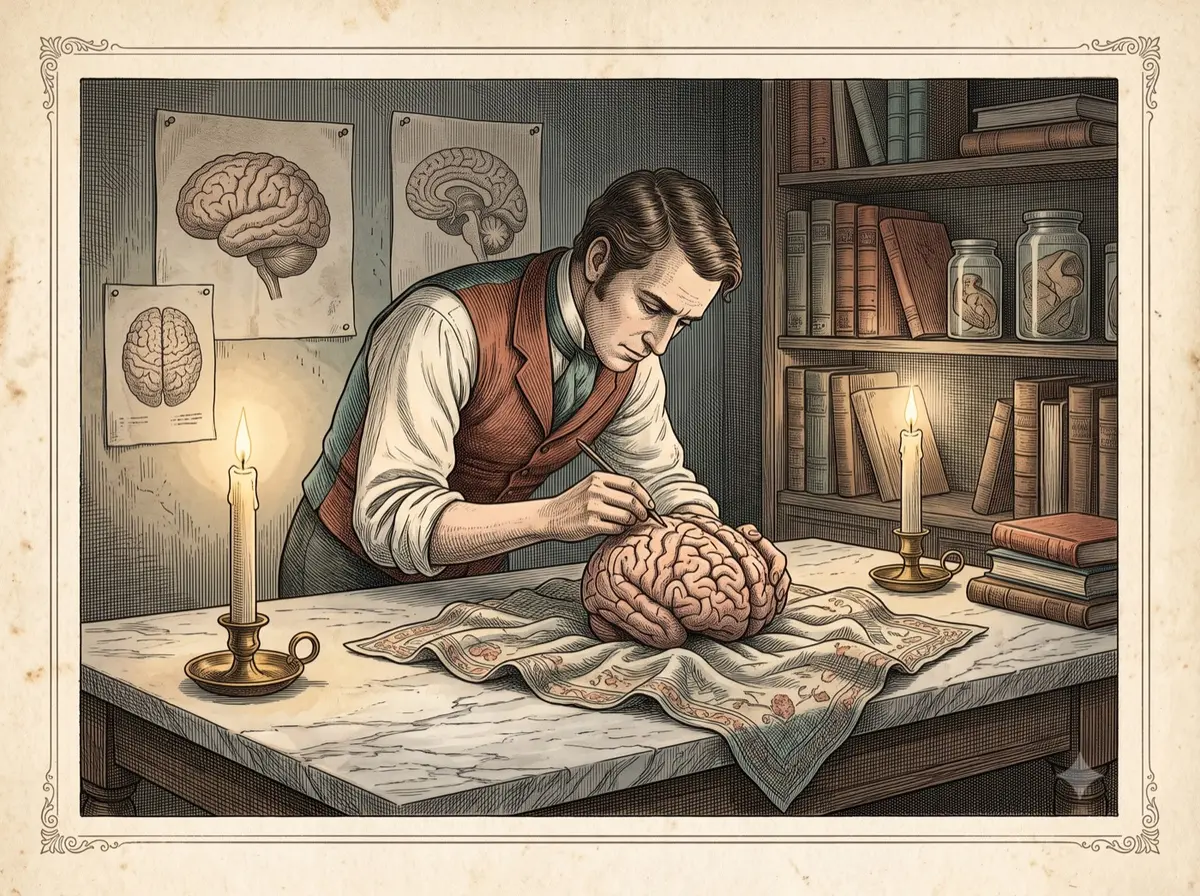
What happened: The Myth That You Only Use 10% of Your Brain
The 10% claim has been floating through popular culture for over a century, and it’s been pinned — falsely — on famous names, most often Albert Einstein, who never said it. Tracing its origin is like following smoke, but historians point to a few likely sources.
In the 1890s, Harvard psychologist William James argued that people meet only a fraction of their full mental potential — a reasonable, motivational idea about effort and capability, not about literally unused brain tissue. That sensible notion got mangled over the decades. By 1936, the writer Lowell Thomas, in a foreword to Dale Carnegie’s mega-bestseller How to Win Friends and Influence People, sharpened James’s vague claim into a falsely precise statistic: “Professor William James of Harvard used to say that the average man develops only ten percent of his latent mental ability.” The self-help movement of the 1920s and science fiction writers ran with it, and the “10%” figure calcified into folklore.
Why it was strange: The Myth That You Only Use 10% of Your Brain
The myth is strange precisely because it’s so sticky — it survives despite being one of the easiest claims in all of science to disprove. It persists partly because it’s flattering (imagine the hidden genius inside you!) and partly because it’s been endlessly recycled by movies like Lucy and Limitless, advertising, and motivational speakers. A comforting story, repeated often enough, can outrun a century of evidence.
Another claim that stuck harder than the correction: The Recipe for Making Mice Out of a Sweaty Shirt and a Jar of Wheat.
What scientists learned: The Myth That You Only Use 10% of Your Brain
Modern neuroscience is blunt about it. As neurologist Barry Gordon put it, “We use virtually every part of the brain, and most of the brain is active almost all the time.” Neuroscientist Barry Beyerstein laid out several independent lines of evidence against the myth:
- Brain scans (PET and fMRI) show activity across the entire brain over the course of a day — even during sleep, no region goes truly silent.
- Brain damage: there’s almost no area you can damage without losing some ability. If 90% were idle, most strokes and injuries would be harmless. They aren’t.
- Energy cost: the brain is about 2% of your body weight but consumes up to 20% of its energy. Evolution would never have built and fueled a costly organ that was 90% dead weight.
- Mapping and microscopy: decades of research mapping brain functions have found no function-less regions, and recordings of individual cells show they’re in use.
In fact, using all of your brain at maximum capacity at once isn’t a superpower — it’s roughly a description of an epileptic seizure.
Another story that outran the evidence: The Starlings America Blamed on Shakespeare — and the One Sentence That Invented the Story.
How it reaches us today: The Myth That You Only Use 10% of Your Brain
The myth is a perfect teaching tool for media literacy and how misinformation spreads: a real, modest idea (we can grow and learn more) gets distorted into a false, dramatic one (90% of you is dormant). It also fuels a steady stream of products promising to “unlock your brain’s potential.” Recognizing the 10% myth for what it is makes you a sharper consumer of every other too-good-to-be-true brain claim.
A close cousin: The Frozen Chicken Cannon That Supposedly Wrecked a British Train.
Fun fact: The Myth That You Only Use 10% of Your Brain
In 2010, the TV show MythBusters tackled the myth by scanning someone’s brain during a demanding mental task and measuring activity across as much as 35% of the brain at a single moment — far more than 10%, and that’s before accounting for everything that lights up across a full day.
Sources: The Myth That You Only Use 10% of Your Brain
- “Ten percent of the brain myth,” Wikipedia — https://en.wikipedia.org/wiki/Ten_percent_of_the_brain_myth
- “Do People Only Use 10 Percent of Their Brains?” Scientific American, Feb. 7, 2008 — https://www.scientificamerican.com/article/people-only-use-10-percent-of-brain/
- Barry L. Beyerstein, “Whence Cometh the Myth that We Only Use 10% of our Brains?” in Mind Myths (Wiley, 1999)
Related stories: The Myth That You Only Use 10% of Your Brain
- The Man Who Took an Iron Rod Through His Brain and Lived — An iron rod through the skull, and the man who lived to change neuroscience
- The Lemmings That Never Jumped Off the Cliff — Disney pushed the lemmings off the cliff, not the lemmings
- The Million-Dollar Space Pen Myth — and the $128.89 Pencils NASA Actually Bought — NASA never spent millions on a zero-gravity pen