Weird Medical History · Medicine
The Doctor Who Toured America in a 'Lobotomobile'
On January 17, 1946, in a doctor's office in Washington, D.C., Walter Freeman — the psychiatrist who would later make his rounds in the lobotomobile — knocked a patient unconscious with electroshock, lifted her eyelid, and pressed the tip of an ice pick from his own kitchen drawer against the thin bone at the top of her eye socket. A few taps with a small hammer drove it through the bone and into her brain. He wiggled it side to side, withdrew it, and sent her home in a taxi less than an hour later. There was no operating room, no anesthesia beyond the electric shock, and — that first time — no surgical instrument at all. Just a household ice pick.
By the Curiosities Desk · · 7 min read · Filed under Medicine · Today’s round
What happened: The Lobotomobile
Walter Freeman was a neurologist, not a trained surgeon, working at George Washington University in the 1930s and 40s. He had spent years performing prefrontal lobotomies alongside neurosurgeon James Watts, drilling holes in patients’ skulls and severing connections in the frontal lobes to calm symptoms of severe mental illness. The technique itself traced back to Portuguese neurologist António Egas Moniz, who introduced it in the mid-1930s and received the 1949 Nobel Prize in Physiology or Medicine for the work — a decision that remains one of the most disputed in the prize’s history, and one the Nobel committee has never revoked.
Freeman and Watts performed one of the earliest American prefrontal lobotomies in November 1941 on 23-year-old Rosemary Kennedy, sister of the future president, whose family hoped to calm her mood swings. As Watts cut, Freeman had her recite the Lord’s Prayer and count backward, gauging how far to go by how her speech deteriorated. The result was catastrophic: Rosemary lost most of her ability to speak clearly and to walk. She spent the rest of her life, more than fifty years, in an institution in Wisconsin.
Freeman wanted a version of the operation that didn’t need a neurosurgeon, an operating room, or even much time. In 1946 he adapted a technique pioneered in Italy for a faster approach: going in through the eye socket instead of the skull. He called it the transorbital lobotomy, and it could be done in under ten minutes. After that first ice-pick procedure, Freeman had a manufacturer produce a sturdier version of the tool, called an orbitoclast — but it still looked, and worked, almost exactly like an ice pick.
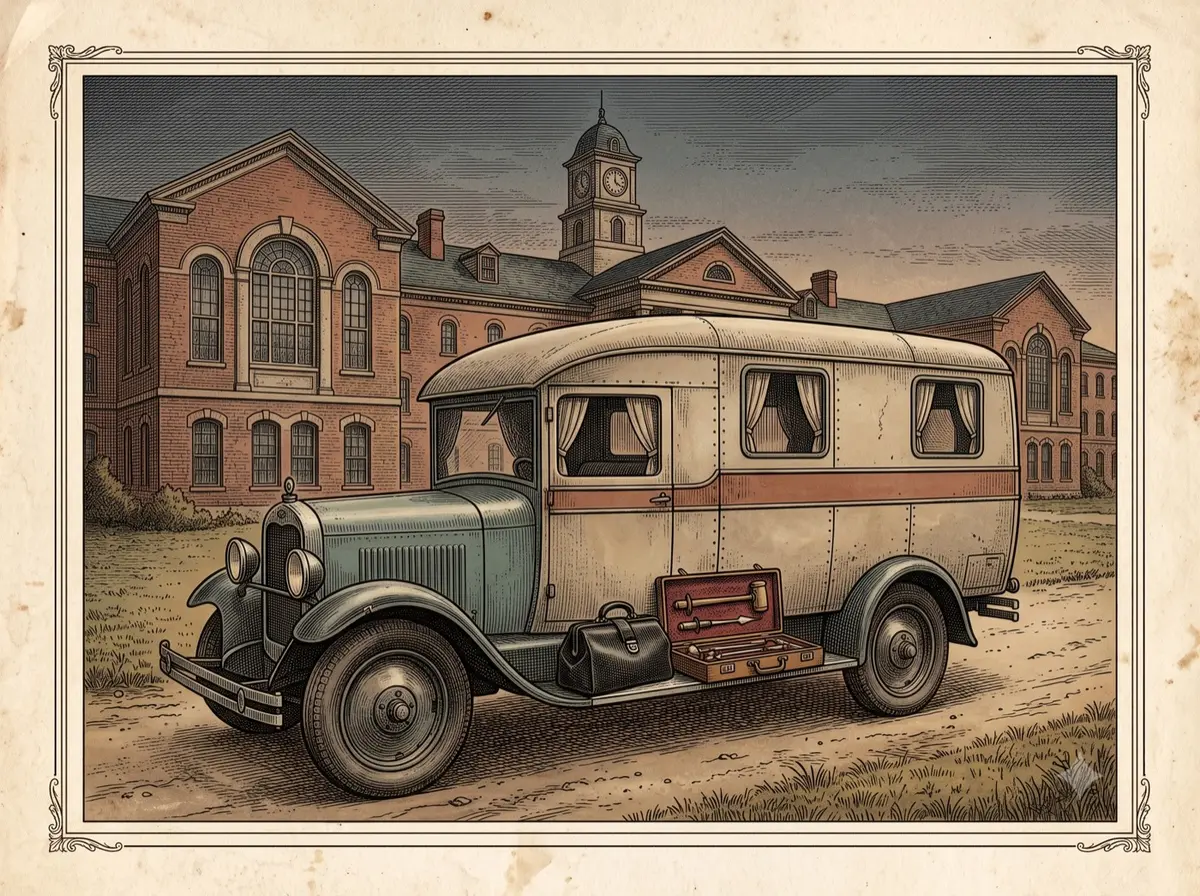
Watts, appalled that his partner now wanted to perform brain surgery outside a sterile operating room, broke off their partnership in 1950. Freeman kept going alone. He drove around the country in a converted camper van — later nicknamed the “lobotomobile” by writers, though Freeman himself called these “headhunting trips” — visiting state mental hospitals to demonstrate the procedure to other doctors and treat patients directly. He sometimes performed more than twenty lobotomies in a single day. In July 1952, during a two-week stretch at West Virginia state hospitals that newspapers dubbed “Operation Ice Pick,” he performed 228 transorbital lobotomies himself. Over his career, Freeman personally performed transorbital lobotomies on somewhere between roughly 2,500 and 3,500 patients, depending on the source and which years are counted, in at least 23 states.
Why it was strange: The Lobotomobile
Brain surgery, by 1946, was already a serious, hospital-based specialty requiring sterile conditions and a trained neurosurgeon. Freeman’s innovation was to strip nearly all of that away. He treated a procedure that permanently altered personality and cognition as something closer to a dental extraction: no scalpel, no incision, no operating room, performed sometimes in a psychiatrist’s office or a hospital hallway, and in the case of patients too “difficult” to reason with, without much in the way of informed consent as we would understand it today. A technique invented to be quick and portable ended up being applied to patients — including children, rebellious teenagers, and people with everyday depression or anxiety — well beyond the severe, otherwise-untreatable cases it was originally intended for.
It shares a shelf with When Doctors Recommended Cigarettes, in Cures That Were Worse Than the Disease.
What scientists learned: The Lobotomobile
Lobotomy was built on a plausible-sounding idea: that severing connections between the frontal lobes and the rest of the brain could dampen runaway emotional or psychotic symptoms. In some patients, agitation did decrease. But the operation could not selectively remove symptoms; it blunted the whole personality along with them, often leaving people passive, disoriented, or, as with Rosemary Kennedy, unable to function independently at all. Follow-up studies were often thin, run by the same doctors performing the surgery, with little long-term tracking of outcomes — a pattern later cited as a central flaw in both Moniz’s and Freeman’s work. The episode became a case study in what happens when a dramatic-looking intervention outruns the evidence for it, and when the person most invested in a treatment’s success is also the one measuring whether it worked.
Also in Cures That Were Worse Than the Disease: The Watch Painters Who Glowed in the Dark.
How it reaches us today: The Lobotomobile
Lobotomy’s decline came fast once an alternative appeared. Chlorpromazine, marketed as Thorazine starting in 1954, calmed psychiatric symptoms with a pill instead of a permanent brain injury — doctors at the time even called it a “chemical lobotomy.” Between that and mounting public and professional unease, the number of lobotomies performed in the U.S. collapsed within a few years. Freeman kept operating until 1967, when a patient died of a brain hemorrhage during her third lobotomy at his hands; he was barred from surgery after that and died in 1972.
The history of lobotomy now sits at the center of modern medical ethics training: it’s a standard example in discussions of informed consent, the need for independent oversight of new medical procedures (the kind of review now handled by institutional review boards), and skepticism toward treatments promoted mainly by their own inventors. Psychosurgery hasn’t vanished entirely — a small number of highly targeted procedures, like cingulotomy for severe, treatment-resistant OCD, are still used today — but they’re now approached with a level of caution, patient consent, and evidence review that Freeman’s era never had.
Another from Cures That Were Worse Than the Disease: The Everlasting Pill That Families Fished Out of the Chamber Pot and Passed Down.
Fun fact: The Lobotomobile
One of Freeman’s patients, 12-year-old Howard Dully, was lobotomized in 1960 largely because his stepmother found him difficult to manage. He survived, and decades later tracked down Freeman’s original case files and told his story on NPR’s StoryCorps and in a memoir titled, plainly, “My Lobotomy.”
This article discusses historical psychiatric treatment and a patient death. If you or someone you know is struggling with mental health, a doctor or local mental health service can help you find support.
Sources: The Lobotomobile
Related stories: The Lobotomobile
- The Man Who Took an Iron Rod Through His Brain and Lived — An iron rod through the skull, and the man who lived to change neuroscience
- The Myth That You Only Use 10% of Your Brain — You use all of your brain; the myth just will not die
- Eben Byers and the Radium Water That Dissolved His Jaw — Eben Byers and the radium water that took his jaw
- Part of Cures That Were Worse Than the Disease